
Your driveway looked fine when you moved in. Then Melbourne did what Melbourne does. Damp mornings, shaded corners, parked cars dripping oil, wind pushing grit across the slab, and a green tinge creeping over the path you stopped noticing until inspection time.
That’s usually when pressure cleaning concrete jumps from “one day” to “needs doing now”. For homeowners, it’s about presentation and safety. For tenants, it can be the difference between a routine handover and an argument over outdoor cleaning. The trick is knowing how to clean concrete hard enough to remove grime, but not so hard that you leave wand lines, etching, or flaking behind.
From Grimy to Gleaming Why Pressure Clean Your Concrete
A typical Melbourne concrete path tells on itself. The sunny side goes dusty and stained. The shaded side grows dark, slick and patchy. Patios pick up mildew. Garage aprons collect tyre marks and oil. By the time you’re preparing for a rental inspection, the whole area can look older than it is.
That’s why pressure cleaning works so well. Done properly, it strips away the layer that makes concrete look tired and neglected. It also removes slippery build-up that makes outdoor areas unpleasant to walk on after rain.
Why it matters in Melbourne
Melbourne’s humidity and damp weather create ideal conditions for mould on outdoor hard surfaces. That’s not just cosmetic. It can make concrete slippery underfoot, especially on older paths and patios that don’t get much sun.
For tenants, there’s another practical issue. Bond claims related to inadequate cleaning of concrete patios and driveways made up 15% of all rental disputes in 2025, according to this Melbourne-focused cleaning guidance citing Residential Tenancies Victoria data.
Concrete is forgiving up to a point. Dirt comes off. Pressure damage doesn’t.
A clean slab photographs better, presents better at inspection, and makes the whole property feel maintained. That matters whether you’re handing keys back or trying to improve street appeal before sale.
The part most DIY guides skip
A lot of generic advice treats all concrete the same. It isn’t. Older porous concrete in Melbourne rentals behaves differently from a newer sealed driveway in an outer suburb. Damp climate, mould, local runoff rules, and bond-return expectations all change the job.
If you want more Melbourne-specific cleaning advice beyond hard surfaces, the End Of Lease Cleaning Melbourne blog is a useful local reference point.
Choosing Your Concrete Cleaning Arsenal
Pressure cleaning concrete starts with the machine, but the machine isn’t the whole story. Pressure, water flow, nozzle choice and safety gear all work together. Get one wrong and the job gets slower, rougher, or both.
Pick the right PSI and GPM
For residential concrete in Australia, the practical working range is 2,500 to 3,000 PSI. That’s the range that removes embedded dirt, mildew and common driveway staining without pushing into damage territory on most standard surfaces.
A stronger machine isn’t automatically better. Once you push too far, concrete can start to etch or lose its top layer. That damage doesn’t wash away.
A useful benchmark from Melbourne work is this: a 4 GPM machine at that pressure can clean about 1,500 square feet per hour according to AquaJets’ guide on PSI for concrete cleaning. That matters if you’re trying to finish a vacate clean in a tight window.
Here’s the practical read on machine choice:
- For standard driveways and paths: Use a machine in the 2,500 to 3,000 PSI range.
- For sealed or decorative concrete: Dial down and work more cautiously.
- For large open areas: Water flow matters as much as pressure. A machine with better GPM will clean faster and more evenly.
Nozzles matter more than most people think
The nozzle controls how aggressive the spray feels on the slab.
- 25° green nozzle: Best all-round choice for concrete cleaning. It gives enough force to cut grime without acting like a chisel.
- 40° white nozzle: Better for rinsing and flushing residue away.
- 0° red nozzle: Avoid it on residential concrete unless you know exactly why you’re using it. It concentrates force into a tiny point and is the fastest way to scar a surface.
Practical rule: If the spray pattern looks like it could write your name in the concrete, it’s too aggressive for general cleaning.
A surface cleaner is even better on big flat areas. It keeps the spray contained and reduces visible passes.
Safety gear isn’t optional
Pressure washers throw grit back at you. Concrete chips, dirty water and chemical overspray all become projectiles.
Use:
- Eye protection: Safety glasses or sealed goggles.
- Gloves: Better grip on a wet wand and protection from cleaners.
- Boots: Closed-toe, non-slip footwear.
- Hearing protection: Especially with petrol units.
- Long pants: Concrete spray-back is abrasive.
If you’re working around drains, garden beds or walls, keep hose routing tidy. Most mistakes happen when people rush, twist awkwardly, or drag a live hose through the area they just cleaned.
Surface Prep and Advanced Stain Removal
Most bad pressure cleaning jobs go wrong before the trigger gets pulled. The slab is cluttered, the stains haven’t been treated, the plants are exposed, and the operator tries to solve everything with more pressure.
Start with prep. It gives you a cleaner result and lowers the temptation to overwork the surface.
Prep the area properly
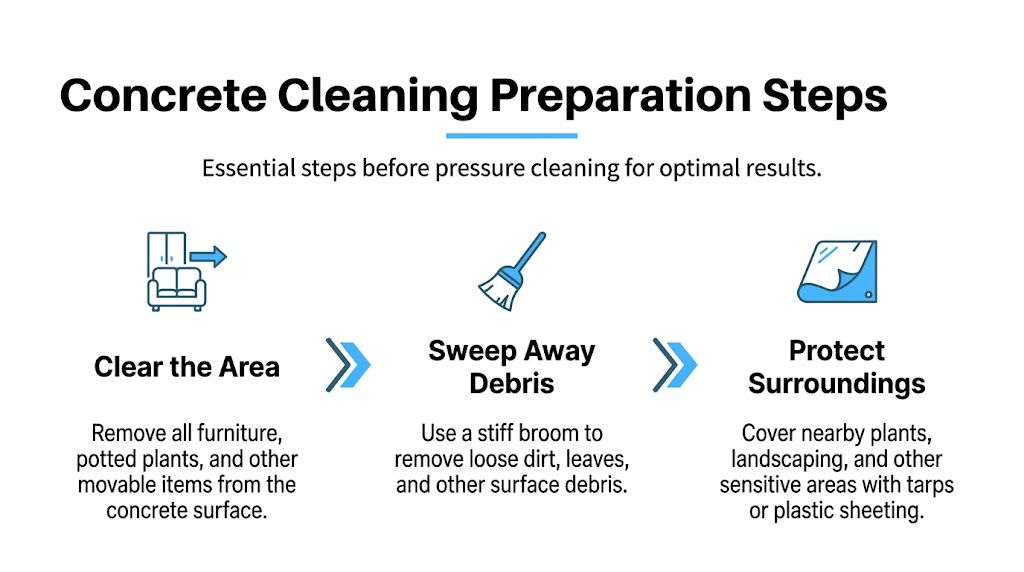
Before washing, do three things well:
Clear the slab
Move pots, chairs, bins, mats and anything else sitting on the concrete.Sweep thoroughly
Remove loose grit, leaves and soil. If you don’t, the wand just turns it into muddy slurry.Protect what’s nearby
Cover sensitive plants, keep water away from power points, and check where runoff will go.
Many people skip the test patch. Don’t. Concrete varies a lot in age and finish. Test your settings in a hidden corner first.
A good visual walkthrough helps if you’re setting up for the first time:
Technique that avoids lines and scars
The common DIY mistake is standing too close and moving too slowly. That leaves visible arcs and pale stripes.
Pressure washing forums report that 15% of residential jobs in Melbourne need repairs due to etching from holding nozzles too close, and 40% of amateur attempts leave visible striping or wand marks, as noted in this concrete pressure washing guide.
Use a steady sweep. Overlap your passes. Keep the nozzle moving. Work top to bottom so dirty water doesn’t run back over the clean section.
Concrete Stain Treatment Guide
Some marks won’t come off with water alone. Pre-treatment is what separates a decent result from a proper one.
| Stain Type | Recommended Treatment | Application & Dwell Time |
|---|---|---|
| Oil and grease | Concrete degreaser or eco-friendly softwash chemical | Apply directly to the stain, scrub in with a stiff broom if needed, and allow it to dwell according to the product label before washing. |
| Rust | Concrete-safe rust remover | Spot apply carefully, test first in a hidden area, and follow the label dwell time closely to avoid discolouration. |
| Mould and mildew | Mould treatment or eco-detergent suitable for exterior concrete | Wet the area lightly if required by the product, apply evenly, allow dwell time, then rinse thoroughly after pressure cleaning. |
| Paint spills | Paint remover suited to the paint type, followed by mechanical agitation | Scrape loose material first, apply treatment to the affected area only, allow dwell time per label, then rinse and reassess before repeating. |
| General embedded grime | Concrete cleaner | Spray or brush on, keep it from drying out, then pressure clean in overlapping passes. |
What works and what doesn’t
A few hard-won rules from concrete work in Melbourne:
- Don’t chase stains with raw pressure alone: Oil usually needs chemistry first.
- Don’t let cleaners dry on the slab: They stop working well and can leave residue.
- Do use a stiff broom for agitation: Especially on garage floors and parking spots.
- Don’t assume old concrete will behave like new concrete: Softer, porous surfaces need a gentler touch.
If a stain lightens but doesn’t disappear, stop and reassess. Another chemical pass is usually smarter than blasting the same spot until it scars.
Future-Proofing Your Concrete with Sealers and Repairs
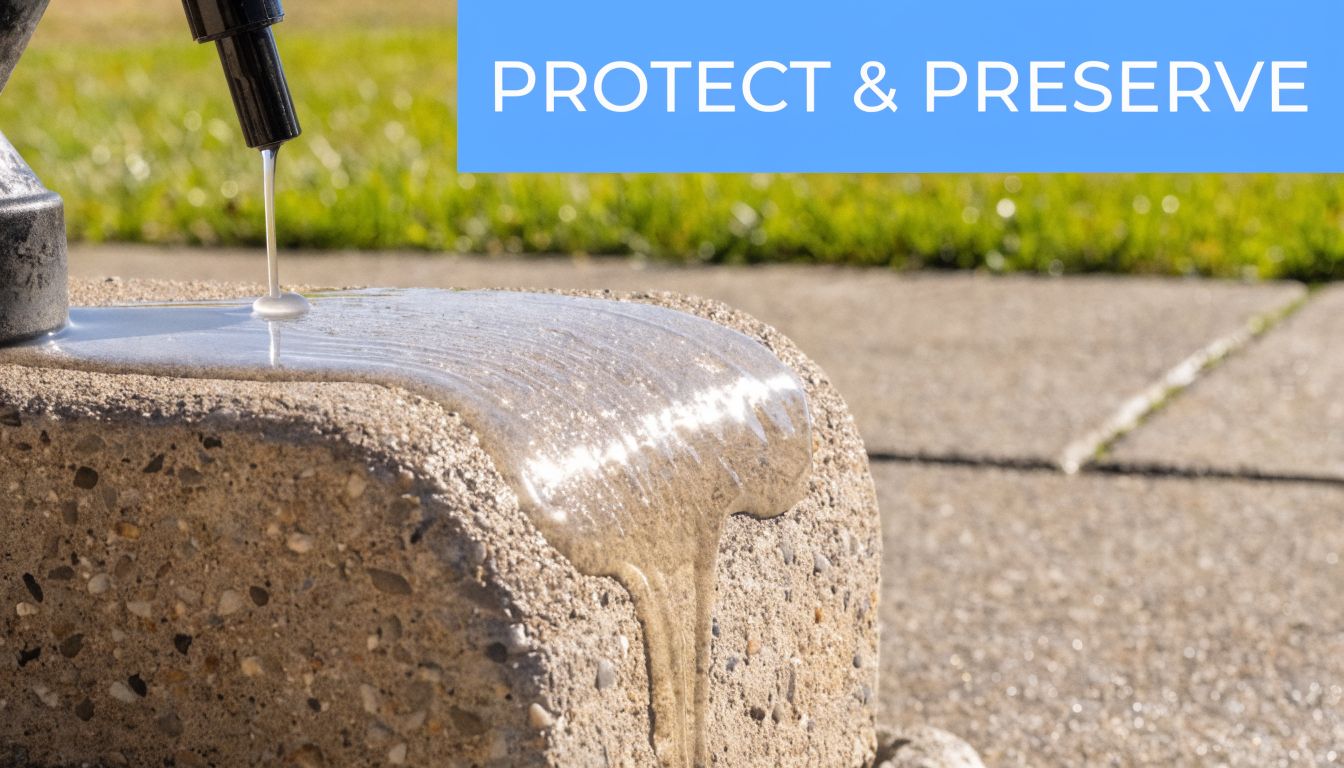
Cleaning gets the slab looking right. Sealing helps keep it that way. In Victoria’s damp conditions, that isn’t a luxury. It’s the part that reduces how quickly the concrete falls back into the same cycle of mould, staining and repeated hard washing.
Why sealing is worth doing
Freshly cleaned concrete is open and absorbent. That means it looks good, but it’s also ready to take on new contamination if you leave it bare.
Recent Australian trials found that post-cleaning sealing with a permeable sealer can cut moss and mould regrowth by up to 60% in humid suburbs, and eco-friendly softwash chemicals can be 95% effective on oil stains without harsh residues, as reported in this Australian cleaning video reference.
That’s the practical argument for sealing. It protects the result you just paid for in time and effort.
On outdoor concrete, the cheapest clean is the one you don’t have to repeat too soon.
Choosing the right sealer
There are two broad approaches.
Penetrating sealers
These soak into the concrete and protect below the surface. They’re a good choice when you want a natural look and less chance of a slippery film on paths or patios.
Film-forming sealers
These sit on top and can deepen colour or add sheen. They can work well in the right setting, but they need more caution on traffic areas where slip resistance matters.
For most residential outdoor slabs, a permeable sealer is the safer practical option. It protects without trapping moisture as aggressively, which matters in Melbourne’s wet periods.
Application and minor repairs
Let the slab dry fully before sealing. If moisture is still sitting in the pores, the finish can fail or turn patchy.
Basic process:
- Inspect the slab: Cleaning often reveals small cracks or chips you couldn’t see before.
- Patch minor defects first: Use a suitable concrete repair product for small localised damage.
- Wait for full dryness: Don’t rush this step.
- Apply evenly: Use the method specified for the sealer, usually a sprayer or roller.
- Keep traffic off it until cured: Especially cars, bins and heavy furniture.
If you’re doing this as part of a vacate, practical guidance in the complete Melbourne end of lease cleaning guide helps put exterior work into the wider bond-return checklist.
Regulations and Knowing When to Hire a Professional
Pressure cleaning concrete doesn’t happen in a vacuum. The water has to go somewhere, and on a dirty driveway that water carries grime, detergent, oil and whatever’s been sitting in the slab. In Melbourne, that matters because runoff into stormwater drains can create problems you don’t want.
Victorian EPA expectations mean you should manage runoff carefully, especially if you’re using cleaners. That usually means blocking or diverting flow where practical, using products suited to exterior use, and not washing contaminants straight into the street.
DIY makes sense when the job is controlled
A homeowner can usually handle:
- Small to medium flat areas: Standard paths, patios, short driveways.
- Light to moderate staining: Dirt, mildew, general traffic film.
- Plenty of time: You’re not under pressure from an inspection date.
- The right equipment: Proper PSI, proper nozzle, proper prep.
If you’re in that category, a careful DIY clean can work well.
Call a professional when the risk is higher
Some jobs look simple until they start going wrong.
Bring in a pro when:
- The area is large: Big driveways and long common paths take time and consistent technique.
- The concrete is old or fragile: Porous or damaged slabs mark easily.
- Stains are severe: Deep oil, heavy mould, rust and neglected garage floors often need more than a hire machine.
- You’re at end of lease: If the handover date is close, mistakes get expensive.
- Runoff control is awkward: Sloped driveways and drain-heavy sites need better planning.
The cost is often more reasonable than people expect. Professional pressure cleaning in Melbourne typically costs $0.20 to $0.40 per square foot, and a standard 500 square foot driveway usually falls around $100 to $200, according to this Melbourne pricing guide for pressure washing concrete.
That can be a sensible trade-off if the alternative is a failed inspection, damaged concrete, or losing time trying to fix a striped driveway yourself. If you need help booking a service, the simplest next step is to contact End Of Lease Cleaning Melbourne.
Frequently Asked Questions About Concrete Cleaning
Can you pressure clean stamped or coloured concrete?
Yes, but it needs a gentler approach. Decorative finishes can mark more easily than plain broom-finished concrete. Use lower pressure, test first, and avoid aggressive nozzles.
Why does concrete sometimes look fuzzy or rough after washing?
That usually means the surface has been overworked. Excessive pressure can strip off the weak top layer and leave the slab looking raised, pale or furry. Once that happens, cleaning won’t reverse it.
Is an electric or petrol pressure washer better for home use?
For small domestic jobs, an electric machine is easier to manage, quieter and often enough if the concrete isn’t heavily stained. Petrol machines make more sense when you need stronger output, longer run time, or you’re cleaning a larger driveway and don’t want the job dragging on.
Do I need detergent every time?
No. Light dirt often comes off with water and good technique. Oil, mildew and dark traffic staining usually respond much better if you pre-treat first.
How do I avoid striping?
Keep the nozzle moving, maintain a consistent distance from the slab, and overlap each pass. A surface cleaner helps a lot on open areas because it keeps the spray pattern controlled.
How long should I wait before using the driveway after cleaning?
After cleaning alone, wait until the surface is dry and safe underfoot. After sealing, follow the product directions and don’t rush vehicles back onto it. Sealer failure often comes from traffic returning too early.
Is soft washing ever better than pressure cleaning concrete?
Sometimes, yes. On older, fragile or mould-heavy surfaces, a lower-pressure chemical approach can be the smarter option. It reduces the risk of visible damage while still treating organic growth properly.
If you're moving out, preparing for inspection, or just don't want to risk etching a driveway at the worst possible time, End Of Lease Cleaning Melbourne can handle the job with the right equipment, eco-friendly products, and the level of detail bond cleans demand across Melbourne and greater Victoria.
