
Some days, keeping a home clean isn’t just another chore. It’s the difference between moving safely through the hallway and tripping over clutter. It’s the difference between using a clean bathroom comfortably and putting it off because the space has become too hard to manage.
That’s where ndis cleaning services melbourne can make a real difference. For many participants, carers, and families, cleaning support isn’t about convenience. It’s about staying well, protecting energy, and keeping home life manageable.
If you’re looking into this for the first time, the process can feel confusing fast. People hear terms like Core Supports, registered providers, service agreements, and plan-managed invoices, then get stuck before they’ve even booked a cleaner. This guide is written to make that simpler.
Specialised cleaning support is also becoming a bigger part of the disability support sector. The Australian cleaning services market is projected to grow at a 5.10% CAGR between 2026 and 2035, with forecasts reaching AUD 31.20 billion by 2035, and that growth is being driven in part by the expansion of the NDIS, according to Expert Market Research’s Australia cleaning services market report.
Your Guide to NDIS Cleaning in Melbourne
A common situation looks like this. A participant is managing fatigue, pain, mobility issues, or sensory overload. The kitchen benches start piling up. Vacuuming gets postponed. The bathroom becomes harder to clean safely. What used to be a regular routine turns into a cycle of stress, guilt, and risk.
In Melbourne, that’s often the point where people start asking whether the NDIS can help with household cleaning. The short answer is yes, in the right circumstances. But it only helps if the support is set up properly and the provider is a good fit.
Why this support matters in everyday life
Cleaning support can help a person stay independent in their own home for longer. It can reduce the pressure on family members. It can also make it easier to keep a home functional between other supports, appointments, and daily demands.
Home cleaning under the NDIS isn’t just about appearance. It’s tied to practical living. Clean floors, hygienic bathrooms, accessible walkways, and manageable household tasks all affect how safely someone can live day to day.
Practical rule: If the lack of cleaning support is making daily living harder because of your disability, it’s worth looking closely at whether this support belongs in your plan.
What people usually get confused about
Most first-time questions fall into a few areas:
- Funding confusion: People aren’t sure where cleaning sits in the plan.
- Provider confusion: They don’t know whether they can choose any cleaner or need a registered provider.
- Task confusion: They assume every kind of cleaning is covered, then get surprised when some jobs are excluded.
- Booking confusion: They don’t know what to ask for in a quote or a service agreement.
That confusion is normal. The NDIS uses specific language, and provider websites often skip the practical details. What you need is a plain-English approach that helps you check your funding, understand what can be claimed, and choose a cleaner who won’t create invoice or compliance problems later.
What Exactly Are NDIS Cleaning Services
NDIS cleaning services are home cleaning supports funded to help a participant manage daily living when disability makes those tasks difficult. The official place for this support is usually under Core Supports, within Assistance with Daily Life.
Here's the difference: A standard cleaner helps tidy a house. An NDIS cleaner supports the home environment so the participant can function more safely and consistently within it. That difference matters.

The purpose is independence, not luxury
The NDIS doesn’t fund cleaning because everyone likes a spotless home. It funds support where cleaning is connected to disability-related needs and helps the person live more independently.
That means the service is usually framed around practical tasks such as keeping floors clear, bathrooms hygienic, and kitchen areas usable. It’s about making daily life more manageable, not paying for one-off premium cleaning jobs.
A good way to think about it is this:
- Standard house cleaning: focused on general convenience
- NDIS cleaning support: focused on disability-related daily living needs
- NDIS-aligned service delivery: focused on reliability, safety, documentation, and agreed tasks
Where it sits in your plan
The wording that matters most is usually Core Supports and Assistance with Daily Life. If you’re a participant or a carer reading a plan for the first time, those are the terms to look for before you start contacting providers.
According to Absolute Domestics’ guide to NDIS house cleaning rates, NDIS cleaning is funded under Assistance with Daily Life in the Core Supports budget.
What this looks like in practice
A participant might use this support for regular household help because bending, lifting, standing for long periods, or managing cleaning products isn’t realistic or safe. Another person might need a cleaner who can work carefully around mobility aids, sensory preferences, or fatigue limits.
Good NDIS cleaning isn’t just “someone who cleans”. It’s someone who follows an agreed scope, respects the participant’s needs, and understands that the service supports daily living.
If you’re searching for ndis cleaning services melbourne, keep that definition in mind. It helps you separate providers who only offer domestic cleaning from providers who understand how NDIS-funded household support operates.
Funding Pathways for NDIS Cleaning
You ring a cleaner, explain that you have NDIS funding, and the first reply is, “No problem, just pay upfront and claim it back later.” That is the moment to pause.
Funding problems usually start with simple mix-ups. A provider may offer regular domestic cleaning but not understand NDIS claiming. A participant may know they need help at home but feel unsure about which budget pays for it, who can send the invoice, or whether their plan lets them choose any cleaner in Melbourne.
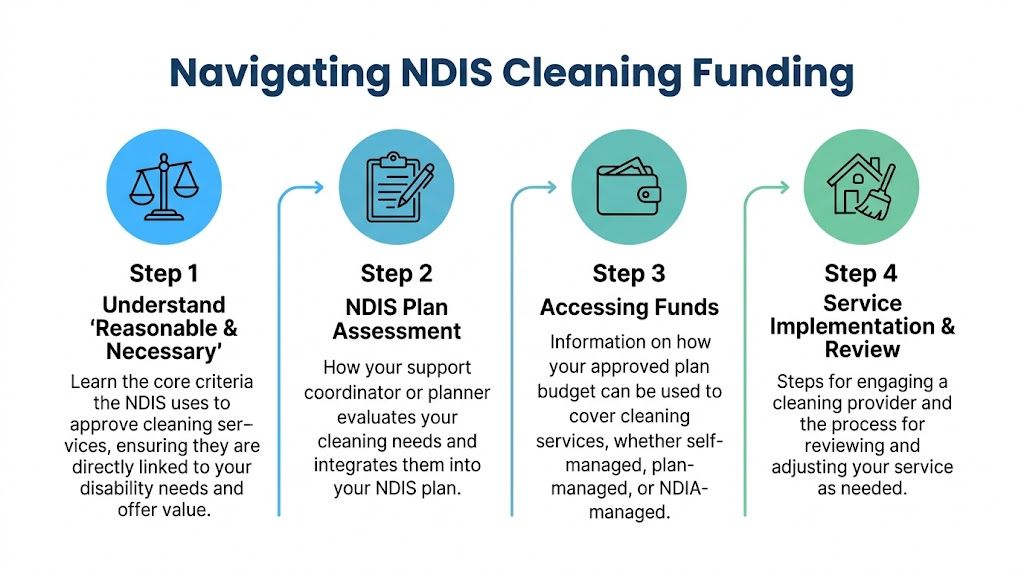
The starting point is simple. Cleaning needs to connect to your disability-related support needs and fit the NDIS idea of reasonable and necessary. In plain language, the service should help with a real barrier caused by your disability, such as difficulty standing, bending, lifting, managing fatigue, or using cleaning products safely. It is less about having a spotless home and more about keeping your home safe and usable.
What the budget and price limit mean
For many participants, cleaning is paid from Core Supports, usually under Assistance with Daily Life. Earlier in this guide, we noted that NDIS cleaning is commonly funded in that part of the plan.
There is also a price limit for House Cleaning and Other Household Activities. That cap matters because it helps you check whether a quote looks normal or whether a provider is adding charges that need a closer look. Payment is usually made after the service is delivered through the correct claiming pathway for your plan type.
That gives you a useful first screening question: How do you invoice NDIS cleaning, and who do you send the invoice to? A provider who works with NDIS participants regularly should answer that clearly. If the answer is vague, rushed, or inconsistent, keep asking questions.
How management type changes your options
Your plan management type works like the payment rules for the service. The cleaning itself may look the same, but the booking and invoicing process can change a lot.
Self-managed
If you are self-managed, you usually have the widest choice of providers. You can often book a cleaner who suits your needs, even if they are not a registered NDIS provider, as long as the support fits your plan and your records are accurate.
That flexibility is helpful, but it also means more checking is in your hands. Ask for clear invoices, keep service agreements, and make sure the tasks match what can be claimed.
Plan-managed
If you are plan-managed, you still have broad choice, but your plan manager usually pays the provider for you. This can take a lot of pressure off, especially if paperwork is tiring or confusing.
It also gives you an extra checkpoint. If you are unsure whether a cleaner’s invoice format or item description is suitable, your plan manager can often spot problems before they turn into rejected claims.
NDIA-managed
If your plan is NDIA-managed, your options are narrower because you usually need to use a registered NDIS provider.
That does not automatically mean the service will be better. It just means the provider has met registration requirements. You still need to ask practical questions about reliability, communication, cancellation terms, and whether they understand disability-related household support rather than standard domestic cleaning only.
A practical checklist before you book
Use this like a pre-booking filter.
- Read your plan wording carefully. Look for Core Supports and Assistance with Daily Life.
- Write down the reason cleaning is needed. Keep it linked to your disability and day-to-day function.
- Check your management type. This tells you who you can book and how payment is handled.
- Ask the provider who they invoice. The answer should match your self-managed, plan-managed, or NDIA-managed setup.
- Request a simple service agreement. It should list tasks, hours, rates, cancellations, and invoice details.
- Check for red flags. Be cautious if a provider pushes prepayment, avoids written agreements, or cannot explain NDIS item descriptions.
- Separate routine cleaning from one-off specialist jobs. For example, if you are also looking into end of lease cleaning in Melbourne, treat that as a different type of service and check funding rules carefully before assuming it can be claimed.
One more tip. If a provider becomes impatient when you ask how NDIS billing works, that tells you something useful. A good NDIS cleaner should be able to explain their process in plain English, because clear invoicing and clear task boundaries are part of good support.
What NDIS Cleaning Includes and Excludes
Expectations need to be clear. Many invoice problems start because a participant thinks “cleaning” means every cleaning job in the home, while the provider or plan manager is working from a narrower definition.
The safer approach is to separate ongoing household tasks from specialist or one-off jobs.
Tasks that are generally included
According to Avers plan management guidance on NDIS cleaning rates and invoicing, NDIS funding covers labour for essential household tasks such as cleaning floors and bathrooms. That usually includes routine domestic work that supports day-to-day living.
Common examples include:
- Floors: vacuuming and mopping general living areas
- Bathrooms: cleaning toilets, showers, baths, and surrounding surfaces
- Kitchen surfaces: wiping benches, sinks, taps, and similar everyday areas
- Dusting: removing dust from accessible household surfaces
- General household upkeep: routine cleaning that keeps the home safe and usable
Tasks that are generally excluded
The same guidance makes an important distinction. Specialist services like bond cleaning and professional carpet cleaning are excluded because they aren’t treated as ongoing disability-attributable household costs under NDIS rules.
That means these jobs are usually outside standard NDIS cleaning claims:
- Bond or vacate cleaning: cleaning tied to moving out of a property
- Professional carpet cleaning: specialist steam or deep carpet services
- Pest control: separate specialist treatment
- Other one-off specialist jobs: work that goes beyond routine household maintenance
If you’re moving house and need a separate vacate clean, this Melbourne end of lease cleaning guide explains that process, which is different from regular NDIS-funded household cleaning.
Sample NDIS Cleaning Visit Checklist
| Area | Tasks Included | Tasks Generally Excluded |
|---|---|---|
| Living areas | Vacuuming floors, mopping, dusting accessible surfaces | Heavy decluttering, removal of hoarded items |
| Kitchen | Wiping benches, cleaning sink, cleaning taps, routine surface cleaning | Full bond clean standard detailing, specialist appliance restoration |
| Bathroom | Cleaning toilet, shower, bath, basin, routine sanitising | Major mould remediation or specialist restoration work |
| Bedroom | Vacuuming, dusting, general tidy support within agreed scope | Packing for relocation or move-out preparation |
| Floors and coverings | Routine floor cleaning | Professional carpet cleaning or steam cleaning |
The best service agreements name rooms and tasks line by line. That avoids the vague phrase “general cleaning”, which causes more disputes than people expect.
Where shared homes can get tricky
In shared arrangements, the question is often whether the task relates to the participant’s own needs or to the household more broadly. If a common area is shared with others who can contribute, funding questions can become more complex.
That’s why it helps to describe the support in functional terms. For example, say the participant needs help maintaining safe access through their usual living spaces, rather than asking for “the whole house to be cleaned”.
How to Book Your NDIS Cleaner in Melbourne
Once you know the support is likely to fit your plan, booking gets much easier. The key is to move in a straight line. Check the budget, shortlist providers, ask specific questions, then put everything in writing.
Step one is your plan, not Google
Before comparing cleaners, check whether your plan has relevant Core Supports funding available. If you have a support coordinator or plan manager, ask them to confirm the budget area and whether there are any limits on provider choice.
This step saves time. It stops you from having long conversations with providers before you even know what type of booking your plan allows.
Contact providers with a proper brief
When you reach out to a cleaner, don’t just ask, “Do you do NDIS cleaning?” Ask for a clear response to your actual needs.
A useful first message includes:
- Your location: suburb or general Melbourne area
- Your plan type: self-managed, plan-managed, or NDIA-managed
- The tasks you need: for example bathroom cleaning, kitchen surfaces, vacuuming, mopping
- Your preferred frequency: weekly, fortnightly, or another routine
- Any access needs: mobility, sensory, communication, or timing preferences
If you want to contact a Melbourne provider directly, you can use the End Of Lease Cleaning Melbourne contact page to ask about availability and service details.
Don’t skip the service agreement
A written service agreement protects everyone. It should set out:
- What tasks are included
- How often the cleaner attends
- How long visits are expected to run
- Who receives the invoice
- What happens if the schedule changes
- Any participant preferences or access instructions
Without that document, small misunderstandings turn into recurring problems. One person expects fridge detailing. The provider only priced routine surface cleaning. The invoice arrives, and nobody is happy.
What to watch for before saying yes
Ask for the quote in writing and compare it against the exact tasks. If the quote is broad but the task list is vague, get it clarified before the first visit.
Also pay attention to how the provider communicates. Slow replies, unclear answers, or shifting explanations early on usually don’t improve later. Booking should feel organised and easy to follow.
Choosing a High-Quality NDIS Cleaning Provider
You call two Melbourne cleaners. Both say they “do NDIS”. One sends a clear list of tasks, explains invoicing properly, and answers your questions without rushing. The other gives a vague hourly rate and says they can sort out the details later. On the surface, both sound available. In practice, only one is likely to make your support run smoothly.
That is why choosing a provider needs a quick screening process. A good cleaner is not just someone who cleans well. They also need to understand disability support, respect your preferences, and handle NDIS admin correctly.
Provider must-haves
Start with the basics first. This works like checking a tradesperson’s licence before you book the job.
Use this screening list:
- Registration status: If you are NDIA-managed, check that the provider is registered. If you are self-managed or plan-managed, still ask the question so you know where they stand.
- Insurance: Ask what public liability cover they hold and whether their workers are covered while attending your home.
- Worker screening: Ask what checks staff complete before working with participants.
- NDIS admin knowledge: They should be able to explain how they handle quotes, service agreements, invoices, and record keeping.
- Fit for your needs: They should ask sensible questions about access, communication, timing, and any household sensitivities.
A provider who cannot answer those points clearly is asking you to take a risk.
What quality looks like in day-to-day service
Marketing claims are easy to write. Daily habits tell you much more.
A strong provider usually does a few practical things well. They confirm bookings clearly. They explain what happens if a cleaner is away. They tell you whether they bring equipment and products. They also check whether anything in your home affects the service, such as fragrance sensitivities, pets, mobility equipment, or preferred times of day.
Another good sign is precision. If a provider says “general cleaning” but cannot break that down into actual tasks, you may end up paying for a service that does not match what you need. Clear scope protects both sides.
If you want to compare how a business presents its team standards, service approach, and operating background, review a provider’s NDIS cleaning company background and team information before you book.
Red flags that often cause problems later
Some issues look small at the start and become ongoing headaches.
Watch for these warning signs:
- They stay vague on inclusions: If they will not spell out what happens during each visit, disagreements are more likely.
- They dodge funding questions: A provider does not need to be your plan manager, but they should understand the difference between routine cleaning and tasks that may fall outside usual NDIS support.
- They promise every job without limits: That can be a sign they do not understand what is usually claimable.
- They change explanations from one call to the next: Inconsistent answers early often lead to invoicing or scheduling problems later.
- They rush you to book before screening your needs: Good providers usually ask questions before confirming the job.
A simple rule helps here. If you feel confused after the first call, the service may stay confusing after the first invoice.
Questions to ask before you choose
You do not need to interview providers like a lawyer. You just need enough detail to see whether they are organised and honest.
Ask questions like these:
- Have you worked with participants who have similar access or communication needs to mine?
- What cleaning tasks do you usually include in routine household support?
- Which tasks do you usually exclude or ask to quote separately?
- Do your cleaners bring their own equipment and products?
- How do you handle invoices for my plan type?
- Who do I contact if the cleaner is late, unavailable, or not a good fit?
- How do you record my preferences so I do not have to repeat them each visit?
These questions do two jobs at once. They help you compare providers, and they show you how the provider communicates under normal pressure.
A practical way to compare two or three providers
If several providers seem suitable, use a simple checklist and score each one against the same points:
- clear written scope
- understands your plan type
- respectful communication
- screening and insurance explained properly
- realistic answers about what is and is not included
- reliable process for schedule changes
- good fit for your household needs
That approach is often better than choosing the lowest hourly rate. A cheaper service that misses invoices, changes staff without notice, or ignores your preferences can cost more in time, stress, and repeated follow-up.
NDIS Cleaning FAQs and Your Next Step
Can I use NDIS cleaning if I live with other people
Sometimes yes, but the support still needs to relate to your own disability-related needs. In shared homes, the tricky part is showing why the cleaning support is required for you, rather than benefiting the whole household in a general way. Clear wording in the service agreement helps.
Why would a cleaning request be denied
The most common reason is that the task doesn’t appear clearly linked to disability-related daily living needs. Requests can also run into trouble when the work looks like a one-off specialist service rather than routine household support, or when the scope is too vague.
Do I need a registered provider
That depends on how your plan is managed. NDIA-managed participants usually need a registered provider. Self-managed and plan-managed participants may have more choice, but they still need a provider who can work properly within NDIS requirements.
What should I do before the first visit
Prepare a short written list of tasks, note any access or sensory preferences, and make sure the provider has the correct invoicing details. If something matters to you, such as fragrance-free products, preferred cleaning times, or avoiding certain rooms, put it in writing.
What matters most
The best outcomes usually come from three things working together. A plan with the right funding. A provider who understands NDIS expectations. A service agreement that says exactly what will happen at each visit.
If you’re comparing ndis cleaning services melbourne, don’t just ask who’s available. Ask who’s organised, compliant, and clear enough to make the service sustainable.
If you’d like help from a local team that understands regular house cleaning as well as NDIS-supported work, End Of Lease Cleaning Melbourne offers vetted cleaners, clear communication, flexible booking options, and professional equipment supplied by the company. With more than 20 years of experience serving Melbourne and greater Victoria, they can help participants, carers, and support coordinators arrange practical home cleaning with straightforward quotes and responsive support.
