
The call usually comes at the worst time. Keys are due back in a day or two. The agent has booked the final inspection. You've still got boxes in the hallway, grease in the oven, dust on the skirting boards, and no spare weekend left to sort it out.
Or it's a different kind of pressure. You're working long hours, the house keeps slipping behind, and basic upkeep has turned into a running source of stress. For some households, it's also about support and dignity. A clean home isn't just nice to have when mobility, health, or routine changes make everyday tasks harder.
That's where professional house cleaning melbourne stops being a luxury and starts being a practical decision. The right service can protect your bond, save time, reduce friction with agents or landlords, and make day-to-day living easier. The wrong one can leave you with missed details, arguments over scope, and a bigger bill than expected.
Your Guide to Professional House Cleaning in Melbourne
In Melbourne, cleaning jobs usually fall into one of three buckets. The problem is that many people book the wrong one. A tenant books a standard clean when they need an end of lease clean. A homeowner asks for a deep clean but expects the results of a reset after months of buildup. That mismatch is where disappointment starts.
A practical example. If you're handing a rental back, the cleaner isn't just making the place look tidy. They're working to inspection standard. That means oven glass, window tracks, bathroom grout, skirting boards, light fittings, and the small details agents notice first. If you're a busy household wanting the place under control each fortnight, that's a different brief entirely.
The Melbourne market is crowded, and pricing can look inconsistent until you understand what's included and what isn't. Some operators quote low and rely on hourly overrun. Others price properly but explain the scope poorly. For NDIS households, the challenge can be even harder because many providers talk about cleaning in general terms but don't clearly address accessibility, communication preferences, or invoicing requirements.
This guide cuts through that. It looks at what each service includes, how pricing works, how to vet a provider, how to prepare for the clean, and what matters if you need NDIS-funded support.
Practical rule: Book for the outcome you need, not the label that sounds cheapest.
Decoding Cleaning Services Standard vs Deep vs End of Lease
Most confusion starts with service names. “House clean” can mean very different things depending on who's quoting. If you want a useful quote, you need to know what category your job belongs to.
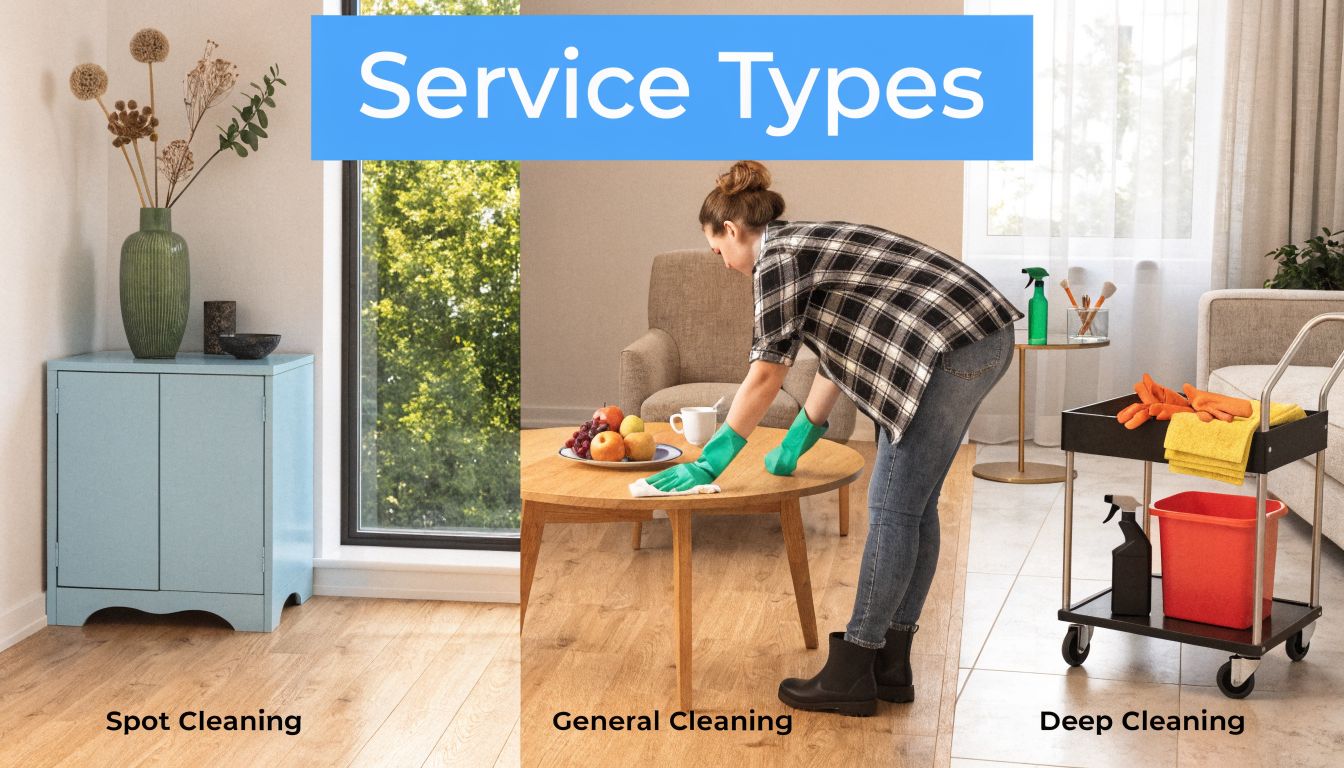
Standard cleaning
A standard clean is maintenance cleaning. It suits households that want the place kept under control on a weekly, fortnightly, or monthly basis. The cleaner is usually focused on visible hygiene and regular upkeep, not restoration.
Typical tasks include:
- Surface wiping: Benches, tables, cabinet fronts, and other accessible surfaces.
- Bathroom reset: Toilets, basins, showers, mirrors, and quick attention to splash marks.
- Kitchen upkeep: Sink, stovetop exterior, benchtops, and visible crumbs or grease.
- Floors: Vacuuming and mopping of accessible areas.
- General tidy presentation: Dusting of reachable surfaces and a room-by-room refresh.
This is the right choice if the home is already in reasonable condition and you want consistency rather than intensive detail work.
Deep cleaning
A deep clean is for buildup. Think neglected corners, higher-detail bathroom work, more time on grease, soap scum, dust edges, and areas that aren't usually touched during regular maintenance.
A deep clean often makes sense when:
- You haven't had professional cleaning for a while.
- You're preparing for guests or a sale campaign.
- You want to reset the home before moving onto regular visits.
The practical difference is time and intensity. Deep cleaning usually includes more detailed work on skirting boards, tougher bathroom residue, inside-facing surfaces, and more labour on kitchens. It's not automatically the same as an end of lease clean, though. That matters.
End of lease cleaning
An end of lease clean is the most specialised of the three. This isn't just about cleanliness in the everyday sense. It's about meeting the standard expected at final inspection, which is why experienced cleaners follow a room-by-room method aligned to what agents and property managers check.
A proper bond clean pays close attention to:
- Oven condition
- Bathroom grout and screens
- Window tracks and glass
- Skirting boards and architraves
- Dust on fittings and ledges
- Marks on walls where included in scope
- Final presentation
As covered in a detailed Melbourne end of lease cleaning guide, this service is best treated as a compliance-focused clean, not a general tidy-up.
| Service type | Best for | Main outcome |
|---|---|---|
| Standard | Busy households needing upkeep | Clean, manageable home |
| Deep | Homes with buildup or neglected detail areas | Reset and refresh |
| End of lease | Tenants, landlords, property handovers | Inspection-ready finish |
A standard clean makes a home pleasant to live in. An end of lease clean makes a home easier to hand back without dispute.
Understanding Professional Cleaning Costs in Melbourne
Pricing gets confusing because two quotes can sound similar while covering completely different work. One cleaner may be pricing a basic maintenance visit. Another may be factoring in oven degreasing, bathroom scale removal, and detailed handover work. If you compare them as if they're the same service, you'll get the wrong answer.
According to Maid2Match's Australian cleaning cost guide, the average hourly rate for professional house cleaning in Melbourne is around $60, with Melbourne specifically listed at $60.96 per hour. The same source notes that deep cleaning a standard 100 to 200sqm home can range from $230 to $600, and add-ons such as fridge cleaning at $50 or window washing at $80 can lift the total.

What the common price structures mean
Hourly pricing works best when the home is in fair condition and the scope is flexible. It can suit regular cleaning, especially if you want the team to focus on priority areas first and work within a set time.
Flat-fee pricing is often better for defined jobs. End of lease cleaning is the obvious example because the outcome matters more than the clock. If the oven takes longer than expected or the bathroom needs extra passes, the cleaner still has to get the property to standard.
That predictability is why many tenants prefer flat-fee packages for handovers. You know the scope, the provider knows the expected finish, and there's less room for argument when the property has multiple bathrooms, older fittings, or hidden grime.
What usually pushes a quote up
Some cost increases are reasonable. Some aren't. The trick is knowing the difference.
- Property size: More rooms, more bathrooms, more glass, more floor area.
- Condition: A neglected home takes longer than a maintained one.
- Kitchen workload: Ovens, rangehoods, splashbacks, and cupboard fronts can add labour quickly.
- Bathrooms: Soap scum, grout staining, calcium marks, and mould take time.
- Add-ons: Internal windows, fridge cleaning, upholstery, and specialist jobs like sofa steam cleaning in Melbourne are often separate items.
- Access issues: No lift, limited parking, or delayed entry can affect timing and staffing.
A quick way to pressure-test a quote is to ask what's excluded. If the answer is vague, the quote probably is too.
What typical Melbourne jobs often look like
Some broad benchmarks help. The verified market data states that:
- Regular house cleans often sit around $120 to $190 per visit.
- Deep cleans commonly range from $200 to $450+.
- End of lease cleaning can range from $450 to $900 depending on property size and condition.
- A standard 3-bedroom end-of-lease clean might cost $180 to $270 for 3 hours under hourly pricing assumptions.
- Regular weekly visits for a busy professional household can run $500 to $700 monthly under recurring packages.
Those figures come from the verified market summary and show why cheap quotes need scrutiny. If someone prices well below market, ask what's missing. Insurance? Equipment? Oven cleaning? A return visit policy? Those omissions are where a “cheap” clean gets expensive.
A short explainer can help if you're comparing options:
Cheap isn't always good value
A low quote can still be legitimate if the property is tiny, very clean, and the scope is narrow. But if a provider is offering a full vacate clean at a bargain rate without asking about bathrooms, oven condition, access, or windows, they're either guessing or underquoting.
If the cleaner doesn't ask questions before quoting, they're not pricing the real job.
Good value means the quote matches the property, the service type, and the expected result.
How to Find and Vet a Reliable Cleaning Company
The Melbourne cleaning market is busy, and that's good and bad for customers. There's plenty of choice, but choice only helps if you can separate capable operators from people who are just easy to book. According to IBISWorld's Residential Cleaning Services industry profile, Australia's residential cleaning industry reached 17,676 businesses by 2025, which helps explain why quality varies so much.
Start with how they quote
A reliable company asks questions. They'll want to know property size, service type, number of bathrooms, current condition, whether the oven needs attention, whether windows are included, and whether access is straightforward. If it's an end of lease job, they should ask about the agent's expectations and any problem areas from prior inspections.
Be cautious when a provider gives a fast price with almost no detail. A rushed quote often leads to one of two outcomes. The cleaner arrives and says the property is worse than expected, or they rush the job to stay profitable.
What to check on the website and before booking
Use a simple due diligence pass. You don't need to overcomplicate it.
- Business identity: Look for a real business presence, not just a mobile number and a form.
- Insurance and vetting: Ask directly whether the team is insured and whether staff are vetted.
- Equipment and products: Confirm they bring their own gear and products unless you've agreed otherwise.
- Scope clarity: Get a written outline of what's included and excluded.
- Receipt and invoicing: This matters for property records, tax, and NDIS claims.
- Return policy: For vacate cleans, ask what happens if the agent requests touch-ups within a reasonable timeframe.
Questions worth asking on the call
Not every customer asks good questions, which is one reason bad providers keep getting booked. These are the ones that matter most:
- Are you quoting hourly or fixed price?
- Is oven cleaning included?
- Are internal windows and tracks included?
- Do you supply all chemicals and equipment?
- Are your cleaners insured?
- What happens if the property manager flags something after inspection?
- Can you handle mould-prone areas if they need cleaning attention, or should I organise specialist help such as mould remediation in Melbourne separately?
That last question is important because not all cleaning issues are routine cleaning issues. Surface cleaning and remediation aren't the same job.
Red flags that usually signal trouble
A provider doesn't need to be large to be good. Plenty of small operators do careful work. But the warning signs tend to repeat.
| Red flag | Why it matters |
|---|---|
| Very low quote with no questions | The scope probably isn't understood |
| No written inclusions | Easy path to disputes |
| Cash-only language and no invoice clarity | Harder to prove what was done |
| Avoids insurance questions | Risk sits with you |
| Vague bond-back claims | Guarantees mean little without process |
Watch for this: If the cleaner talks more about being cheap than being thorough, they're selling price, not outcome.
Reviews matter, but read them properly
Don't just look at the star rating. Read the wording. Useful reviews mention punctuality, communication, follow-up, and whether the cleaner handled specific tasks properly. For end of lease work, look for comments about inspections, not just “looked lovely”.
The most dependable providers tend to be boring in a good way. They confirm the booking, arrive on time, know their checklist, and don't make the customer chase them.
Your Essential Pre-Clean and Post-Clean Checklists
A good cleaning job starts before the cleaner arrives and finishes after the last mop pass. If you skip the prep, the team loses time on obstacles that have nothing to do with cleaning. If you skip the final check, you can miss details while there's still time to fix them.
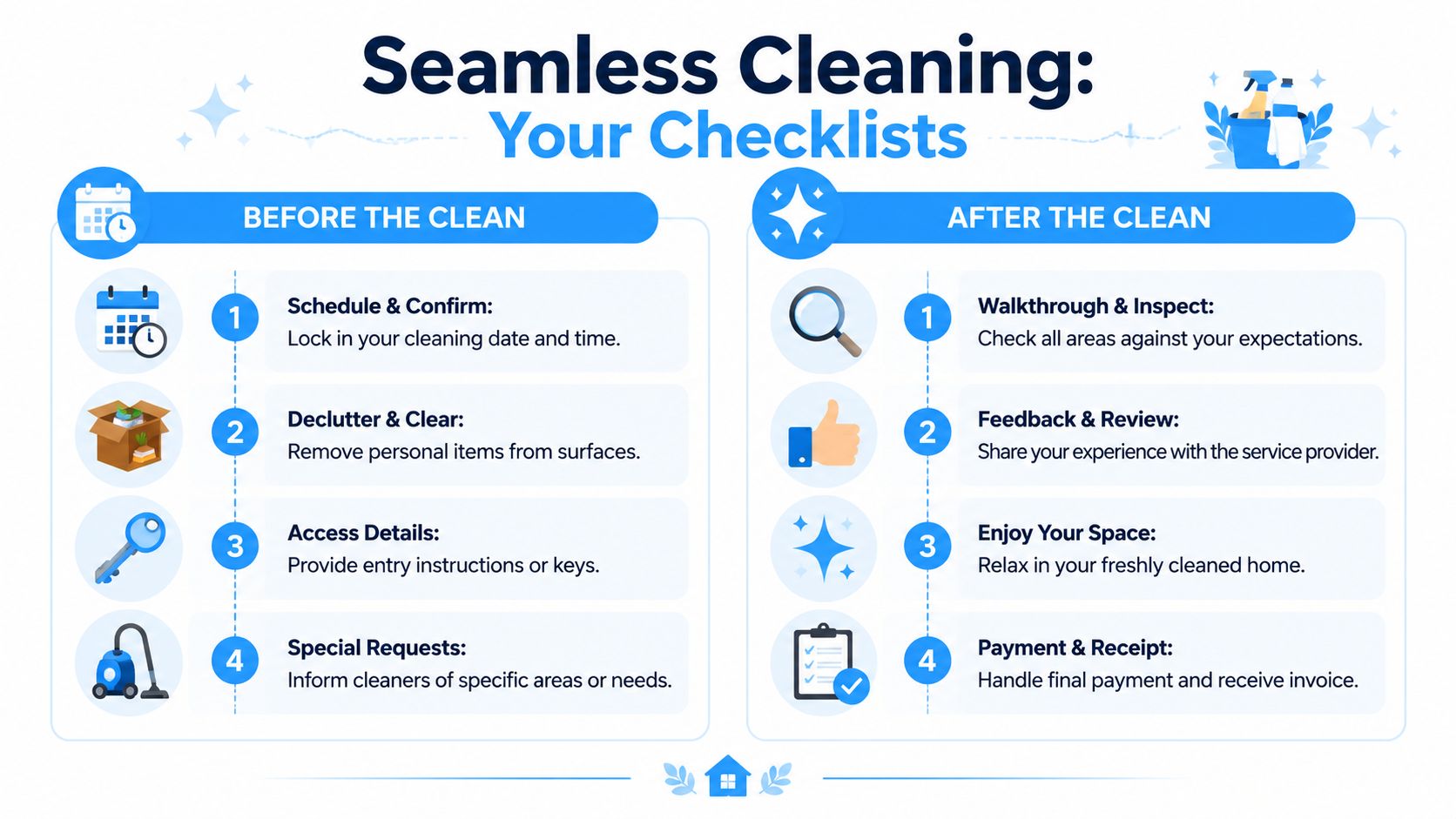
Before the clean
For regular house cleaning, preparation is mostly about access and priorities. For end of lease work, it's more serious. The cleaner needs a property that's ready to be cleaned properly, not one still being packed around.
Use this checklist before the team arrives:
- Declutter surfaces: Remove personal items from benches, floors, shelves, shower ledges, and window sills.
- Empty the property if it's a vacate clean: Cleaners can't properly detail around leftover furniture, bags, or loose household items.
- Defrost the fridge if it's included: If a fridge clean is booked, switch it off early enough for safe cleaning.
- Arrange access clearly: Keys, lockbox details, concierge instructions, parking, alarm codes, and lift access should be sorted in advance.
- Secure pets: Even calm pets can slow the job or become stressed by equipment and strangers.
- Flag problem areas: Point out limescale, grease, mould-prone bathrooms, stains, or spots that worried you at the last inspection.
- Check utilities: Power and running water need to be available for the full appointment.
If you're moving out, finish the removals before the cleaners start. The common mistake is having a “mostly empty” property. That usually means the job gets split between cleaning and waiting for someone to move the last items.
The method that improves bond outcomes
A proper bond clean isn't random. Verified guidance from Clean Freaks' Melbourne cleaning charges guide describes a specific method using pH-neutral disinfectants in bathrooms, alkaline solutions for oven degreasing, and HEPA vacuums. The same verified data notes that overlooking common failure points such as oven carbon buildup is a major reason self-cleans fail, while professional services following REIV standards achieve up to a 98% bond recovery rate.
That's why the order of work matters. Bathrooms and kitchens need chemistry that matches the soil load. Dust needs to be removed before final floors. Ovens need dwell time. Window tracks and edges need hand detail, not just a quick pass.
On a final inspection, the places people miss are rarely the centre of the room. They're the edges, tracks, fittings, and inside surfaces.
After the clean
Do a walkthrough before you mentally switch off. This is the moment to check with fresh eyes, ideally in daylight if possible.
Use a post-clean inspection checklist like this:
- Start at the entry and move room by room. Don't bounce around or you'll miss things.
- Check high-visibility items first. Benchtops, sinks, shower glass, mirrors, floors, and toilet presentation.
- Move to common failure points. Oven interior, stovetop edges, rangehood exterior, skirting boards, window tracks, switches, and light fittings.
- Open and close things. Cupboards, drawers, shower screens, and sliding windows reveal residue faster than a surface glance does.
- Photograph key areas. Take clear photos of bathrooms, kitchen, oven, floors, and any area that previously caused concern.
- Keep the invoice and any written scope. If there's an inspection dispute, records matter.
A simple handover standard for tenants
This is the practical standard many renters should use. Ask yourself whether each room looks consistently cleaned, not selectively cleaned. A sparkling sink with dusty skirting boards still reads as incomplete.
| Area | What to verify |
|---|---|
| Kitchen | Oven, stovetop, sink, splashback, cupboard fronts |
| Bathroom | Shower screen, grout lines, toilet base, mirror, exhaust area |
| Bedrooms and living areas | Floors, skirting boards, wardrobes, ledges |
| Windows and doors | Glass, tracks, frames, handles |
| Final presentation | Rubbish removed, no leftover supplies, tidy finish |
If something looks borderline, raise it straight away. It's much easier to fix while the cleaner is still available than after the agent's report lands.
Navigating NDIS Cleaning Services in Melbourne
This is where many guides fall short. They talk about cleaning as if every customer books the same way and needs the same thing. That isn't true for NDIS participants, carers, and support coordinators.
According to the verified gap analysis based on ASRC Cleaning's standard cleaning page, few cleaners explicitly cater to NDIS participants, and there's a real gap in providers who understand NDIS quality standards, trauma-informed approaches, and specific invoicing requirements. In practice, that means many households spend extra time calling around just to find a provider who understands the basics of compliant service delivery.

What disability-inclusive cleaning looks like in real life
A suitable NDIS cleaner does more than turn up with products and a mop. They work in a way that supports the person in the home.
That can include:
- Predictable scheduling: Consistent days and time windows reduce stress.
- Clear communication: Simple confirmations, respectful language, and contact preferences that are followed.
- Sensory considerations: Fragrance-free or lower-scent products where requested.
- Routine awareness: Understanding that some clients need a set order of tasks or minimal disruption.
- Respect for support environments: Working appropriately around carers, support workers, mobility aids, and home modifications.
These details matter because cleaning is an in-home service. The quality of the interaction is part of the quality of the service.
Questions NDIS participants and carers should ask
When calling providers, ask direct questions that reveal whether they really understand the work.
- Do you currently support NDIS clients?
- Can you issue invoices with the details needed for claiming or plan management?
- Can the same cleaner or a consistent small team attend where possible?
- Can you accommodate fragrance-free or specific product requests?
- How do you communicate with support coordinators or family if needed?
- Are your staff vetted and comfortable working in disability-inclusive settings?
A provider doesn't need to use perfect language. They do need to answer clearly and show they understand that the service is support, not just labour.
Funding and scope need to be discussed early
Cleaning support can sit differently depending on plan arrangements and the participant's circumstances, so it's important to confirm funding and documentation requirements before the first booking. The practical mistake is assuming a mainstream cleaner can “just invoice it later”. If they don't understand what information must appear on the invoice or how the service should be described, the admin becomes harder than the clean itself.
Good NDIS cleaning support feels organised, respectful, and predictable. If the booking process already feels confusing, that won't improve once the service starts.
The best fit is often the provider who listens properly
Price still matters, but for NDIS households it isn't the only filter. Reliability, consistency, communication style, and willingness to adapt matter just as much. A provider who asks thoughtful questions about access needs, routines, and preferences is usually a safer choice than one who rushes to quote.
If you need a team that handles vacate cleans, regular home cleaning, deep cleaning, or NDIS-supported services across Melbourne, End Of Lease Cleaning Melbourne offers experienced, vetted cleaners, clear communication, and practical support built around real household needs. Whether you're trying to protect your bond, reset a busy home, or arrange respectful in-home cleaning assistance, they're a solid local option to contact.
