
Moving day usually looks the same. There are half-packed boxes in the hallway, the fridge is nearly empty, the removalist is booked, and then you look around properly and realise the place still needs to be returned in inspection-ready condition.
That’s the point where a lot of tenants panic. They’ve cleaned before, they keep a decent home, and they assume a long day with sprays, cloths and a vacuum will do it. Sometimes it does. Often it doesn’t, because an end of lease cleaning service isn’t about making a place look tidy. It’s about meeting the standard your agent or landlord will inspect against.
In Melbourne, that difference matters. A final clean gets judged against the condition report, the lease, and in disputed cases, the sort of detail that can end up being argued at VCAT. Oven glass, exhaust filters, shower grout, window tracks, greasy cupboard tops, soap residue behind taps. Those are the spots that trip people up.
If you’re stressed, that’s normal. The good news is that this job becomes much easier when you know what gets checked, what’s worth outsourcing, and where tenants lose money by taking shortcuts.
Your Guide to a Stress-Free Move in Melbourne
Most tenants don’t call for help because they love cleaning. They call when the clock starts closing in.
You’ve got keys to return, utilities to disconnect, a new place to set up, and a property manager who will inspect the old one with fresh eyes. The home you’ve lived in for months or years suddenly gets judged like a display suite. Marks you stopped noticing now stand out. The oven you meant to tackle “one weekend” becomes a problem. The shower screen that looked acceptable last week now has water staining you can’t unsee.

After two decades in this trade, I can tell you the stress usually comes from uncertainty more than the cleaning itself. Tenants ask the same practical questions. What needs to be done? What will an agent care about? What’s normal wear and tear, and what gets treated as poor cleaning? What if you’ve already booked a cleaner but still don’t know whether the result will hold up at inspection?
Practical rule: If you can’t point to how a room compares with the original condition report, you’re guessing.
Melbourne’s rental market doesn’t reward guessing. A rushed wipe-over might be enough for your own standards, but end-of-lease work is judged by someone checking details room by room. That’s why a calm plan matters more than brute effort.
A proper roadmap helps you do three things:
- Prioritise the right tasks so you don’t waste hours on areas that won’t affect the inspection.
- Spot risk areas early such as ovens, tracks, grout, blinds, and built-in cupboards.
- Choose the right level of service if the job is bigger than you can realistically handle before handover.
If your goal is a clean exit and a full bond return, the smartest move is to treat cleaning as part of the move, not something tacked on at the end when you’re already exhausted.
What an End of Lease Clean Actually Involves
A standard weekly clean keeps a home pleasant to live in. An end of lease clean gets a property ready for formal inspection.
That’s the difference.
Consider a car wash versus a major service. A car wash handles what you can see at a glance. A major service deals with what gets checked closely. End of lease cleaning works the same way. It isn’t just benches, sinks and a quick vacuum. It’s the detailed work that agents notice because they inspect slowly and compare condition, not effort.

What makes it different from a regular clean
A proper vacate clean usually includes work people skip during everyday life. That means removing built-up grease, scale, dust and residue from places that aren’t part of a normal tidy-up.
Typical examples include:
- Kitchen detailing with oven interior degreasing, rack cleaning, splashback wiping, rangehood filter cleaning, and cupboard interiors.
- Bathroom finishing work such as soap scum removal, tapware polishing, grout attention, mirror cleaning and detail work around the toilet base.
- Edges and fittings like skirting boards, light switches, door frames, wardrobe shelves, power points and window sills.
- Tracks and frames because window tracks and sliding door runners collect compacted dirt that stands out immediately during inspections.
What it is not is a rubbish removal service, a repair service, or a miracle fix for damage. If blinds are broken, walls are badly marked, silicone is mould-stained beyond cleaning, or carpet is physically damaged, cleaning alone won’t solve that.
The clean has to match the standard of inspection, not the standard of daily living.
The places agents notice first
In Melbourne rentals, the usual pain points are surprisingly consistent. Agents and landlords often focus on spots that show buildup or neglect because they’re easy to check quickly.
Those include:
- Oven glass, trays and racks
- Rangehood filters
- Shower screens and grout lines
- Window tracks
- Skirting boards
- Inside cupboards and wardrobes
- Marks on doors, handles and switches
If you want a visual sense of what a detailed vacate clean looks like, this walkthrough gives a useful overview:
Why the condition report matters
In practice, an end of lease clean should line up with the property’s original recorded condition, allowing for fair wear and tear. That’s why experienced cleaners always think beyond “clean enough” and look at whether the result will stand up to a final inspection and, if needed, to the scrutiny that can come with a bond dispute.
That’s also why oven degreasing, window track cleaning and finishing details aren’t optional extras in a true end of lease cleaning service. They’re often the difference between a smooth handover and a call from the agent asking for a return visit.
The Ultimate End of Lease Cleaning Checklist
A checklist is your best defence against missed items and last-minute deductions. It keeps the clean objective. If you’re doing some of the work yourself, it stops you from forgetting awkward areas. If you’re hiring professionals, it helps you confirm exactly what’s included.
For a more detailed room-by-room reference, use this end of lease cleaning checklist for Melbourne tenants.
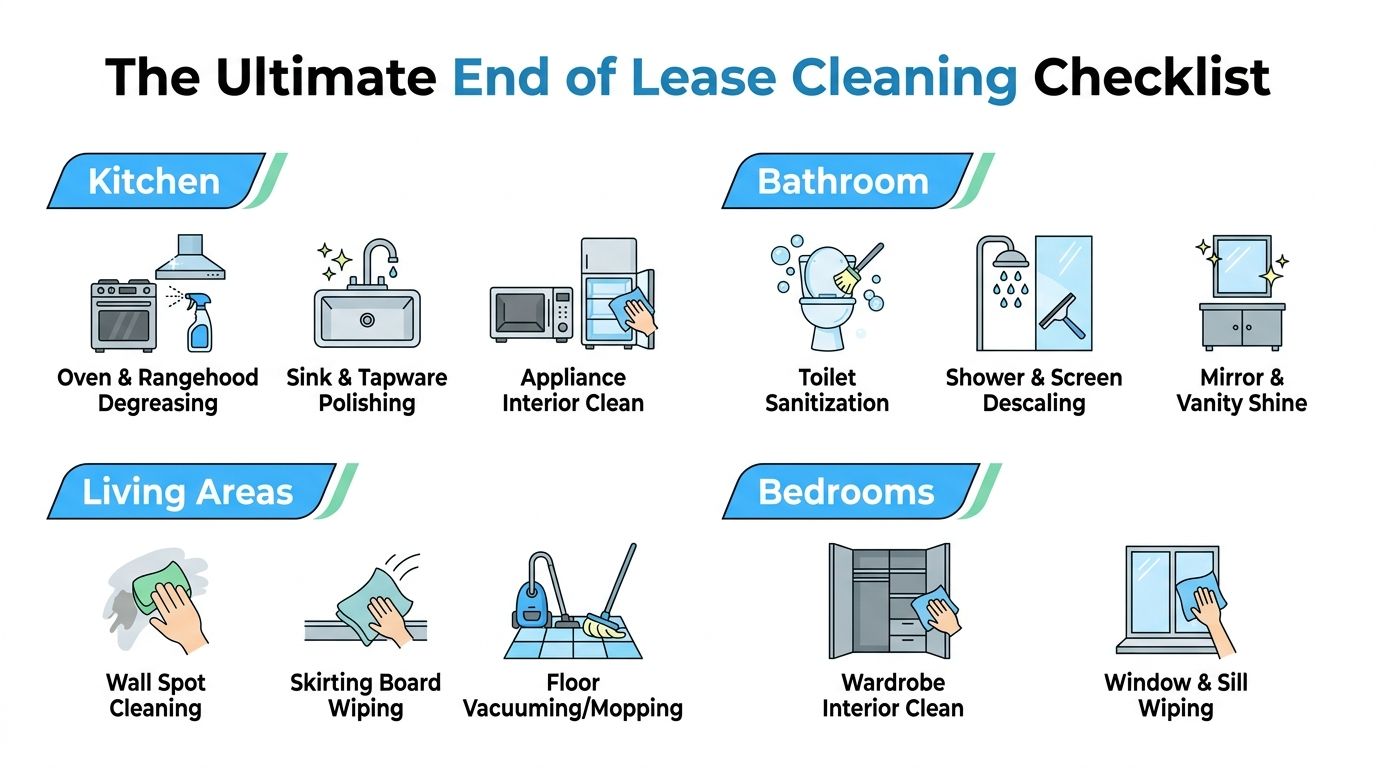
Kitchen
The kitchen usually decides how the rest of the inspection feels. If the oven, rangehood and cupboards are clean, agents tend to relax. If they’re greasy, they start looking harder everywhere else.
- Oven interior Clean the floor, sides, fan area, racks and inner glass. Don’t leave carbon buildup on the door edge.
- Stovetop and burners Remove grease from trivets, knobs and hard edges around burners.
- Rangehood Wipe the canopy and degrease the filters properly.
- Cupboards and drawers Empty them fully, then wipe inside, outside, handles and top edges.
- Benchtops and splashback Remove food residue, grease flicks and water marks.
- Sink and tapware Descale around the base, polish the taps and clear the drain area.
Bathroom and laundry
Bathrooms fail inspections over residue, not clutter. Soap scum, hair, dust and old splash marks are what get noticed.
- Shower Descale glass, scrub tiles, clear soap buildup and clean around the drain cover.
- Toilet Clean the bowl, seat hinges, cistern, base and the floor around it.
- Vanity and mirror Remove toothpaste marks, water spotting and product residue.
- Exhaust fans Dust and wipe covers where accessible.
- Laundry sink Clean the basin, cabinet, splashback and taps.
- Tiled floors Mop properly after detail work so you don’t leave grit in corners.
If a bathroom still has soap residue on chrome or streaks on glass, it won’t read as professionally cleaned.
Bedrooms and living areas
These rooms look simple, but they contain a lot of edge work.
- Floors Vacuum carpets thoroughly and mop hard floors once the room is empty.
- Skirting boards Wipe dust from the full length, not just visible sections.
- Wardrobes Clean shelves, rails, corners, doors and tracks.
- Walls and doors Spot-clean removable marks carefully.
- Switches and handles Wipe fingerprints and grime from touch points.
- Windows Clean glass internally where included, plus sills and accessible frames.
Entryways, balconies and final details
These areas shape the first and last impression.
- Sliding door tracks Lift out compacted dirt with a brush and vacuum before wiping.
- Front door area Clean the door, frame, threshold and any visible cobwebs.
- Balcony or courtyard Sweep thoroughly and remove loose debris.
- Bins and storage areas Empty and wipe where required by the lease.
- Garage area Leave it swept and free of obvious dust buildup or rubbish.
The commonly missed items
The places most often forgotten are rarely large. They’re small, awkward and easy to put off.
Here’s the short list I’d check before handing keys back:
| Area | What gets missed | Why it matters |
|---|---|---|
| Oven | Door edges, racks, trays | Grease is obvious under inspection lighting |
| Windows | Tracks and corners | Dirt compacts and stands out immediately |
| Bathroom | Exhaust covers, shower screen edges | These signal whether the clean was detailed |
| Bedrooms | Wardrobe shelves and runners | Empty storage gets inspected closely |
| Whole home | Skirting boards, switches, handles | High-touch surfaces show grime fast |
If you work from a checklist and inspect each room while it’s empty, you’ll catch far more than you would by cleaning as you pack.
How Professional Cleaning Secures Your Bond
You hand back the keys, feel relieved, then the agent emails photos of oven grease, dusty window tracks and soap scum on the shower screen. A few days later, part of your bond is being withheld. I see that pattern every week in Melbourne.
Bond cleaning is tied to money first, and sometimes to a VCAT dispute after that. The argument is rarely about whether you tried hard. It comes down to whether the property was returned reasonably clean, whether the exit condition matches the entry report, and whether anyone can prove it.
That is why a proper vacate clean is usually cheaper than a bond deduction.
Why “good enough” cleaning often falls short
A property can look tidy and still fail inspection. Agents and property managers check the spots tenants tend to rush at the end. Oven interiors, rangehood filters, shower screen edges, skirting boards, wardrobe runners, window tracks and fingerprints on switches are the usual trouble areas.
In Melbourne, that matters because bond disputes are handled against evidence, not effort. If a claim reaches VCAT, photos, the condition report, invoices and written scope matter far more than saying you spent all Sunday cleaning. A professional cleaner cannot guarantee an outcome, but a documented vacate clean puts you in a much better position if the standard is challenged.
There is also a timing issue. Many tenants clean while boxes are still in the way, then discover too late that hidden dust, marks behind furniture and missed corners show up once the place is empty. The best results come after removalists have finished and power and water are still connected.
Why paying for cleaning can save money
The financial trade-off is usually simple. You pay an upfront fee to reduce the chance of a larger bond deduction later.
That matters in Victoria because the bond itself is often substantial. RTBA bond figures and claim processes are set out by the Residential Tenancies Bond Authority, and in Melbourne’s rental market even a partial deduction can wipe out what looked like a saving from doing the job yourself.
Here is how the risk usually stacks up:
| Scenario | Upfront Cost | Risk at Final Inspection | Likely Financial Result |
|---|---|---|---|
| DIY clean | Lower cash cost, but your own time, products and equipment | Higher if detail areas are missed or the lease has extra requirements | Can end up costing more if the agent claims cleaning from the bond |
| Professional end of lease clean | Service fee paid upfront | Lower when the scope matches the condition report and lease | Often the safer option when a full bond refund matters |
| Professional clean plus carpet work | Higher than a standard clean | Lower where carpets are a stated lease requirement or visibly marked | Better protection against deductions tied to odour, stains or hygiene concerns |
If your lease calls for carpets to be professionally cleaned, check this guide to end lease carpet cleaning requirements and timing before you book. Carpet invoices are one of the first documents agents ask for.
What actually helps if there is a dispute
A proper vacate clean is part cleaning job, part risk management.
The tenants who protect their bond best usually do four things well:
- Clean after the property is empty, so nothing blocks access
- Match the job to the entry condition report, not to memory
- Get the scope in writing, especially for ovens, windows, walls, carpets and outdoor areas
- Keep evidence, including photos, receipts and any re-clean correspondence
The mistakes are predictable too:
- Booking a general domestic clean instead of a vacate clean
- Assuming the oven or windows are included without asking
- Leaving marks, rubbish or balcony debris for the final hour
- Ignoring lease terms about carpets, pest control or exterior areas
I tell tenants the same thing every time. The point is not convenience. The point is reducing the chance that a fixable cleaning issue turns into a bond claim you then have to argue about.
Specialised Cleaning for NDIS and Commercial Leases
A tenant can get through a standard apartment handover with a fairly predictable vacate clean. NDIS homes and commercial sites are different. The cleaning still needs to be inspection-ready, but there are extra obligations around access, safety, communication, timing and documentation.
That changes how the job should be planned from the start.
NDIS cleaning needs the right setup
In an NDIS property, the clean has to suit the person living there, not just the checklist. Fragrance sensitivity, preferred visit times, support worker access, clear communication, and careful product selection all matter. A cleaner who is fine in a standard rental may still be the wrong fit for a supported home if they cannot follow the support arrangement properly.
That is why provider suitability matters as much as the result on the day. If you need a practical overview, this guide to NDIS cleaning services in Melbourne explains what to confirm before booking.
In practice, the trade-off is usually speed versus care. A rushed team can finish quickly and still create problems if surfaces are left with strong residue, equipment is moved without approval, or the visit causes stress for the participant. A well-planned clean takes longer, but it is far less likely to create complaints, rework, or payment issues later.
Commercial lease exits are about handover risk
Commercial vacates are less about bond release and more about avoiding make-good claims, delayed access charges, and disputes over handover condition. The pressure can be higher because leases often spell out the return standard in more detail than a residential agreement. Office carpets, partition glass, kitchens, bathrooms, bins, grease build-up, hard floors and signage residue can all become chargeable issues if they are left behind.
Timing is usually tighter too.
A lot of these jobs happen after hours, around building rules, lift bookings and key return deadlines. If the cleaner is late, under-equipped, or unclear on scope, the tenant can wear extra costs very quickly. I have seen plenty of cases where the cleaning quote looked cheap, then the outgoing tenant paid more in extra attendance, rubbish removal, or missed items picked up by the landlord’s contractor.
Product choice matters in both settings
In supported homes and commercial spaces, product choice is part of risk control. Harsh chemicals, heavy fragrance and sticky residue can all cause trouble, whether that is a participant reaction, a complaint from carers, or a workplace that still smells like solvent at handover.
Good specialised cleaners use products that clean properly and suit the site. They also ask better questions upfront. Who will inspect the property? Are there building access restrictions? Is there medical equipment onsite? Does the lease require consumables removal, window work, or floor treatment?
Those details decide whether the clean solves the problem or leaves you arguing over the final invoice and the condition report.
Why Choose End Of Lease Cleaning Melbourne
You hand back the keys, assume the hard part is over, then the agent comes back with a short list that costs you part of the bond. In Melbourne, that happens more often than tenants expect, especially when the clean looks fine at a glance but does not hold up against the final inspection standard.
Choice matters because the market is crowded. According to Data Insights Market's end-of-tenancy cleaning services report, the global end-of-tenancy cleaning market was valued at approximately $5.2 billion USD in 2025, with growth linked to urbanisation, rental turnover and higher expectations around property condition. A busy market gives tenants plenty of options, but it also means plenty of providers are selling low prices without the systems, staff, or follow-through needed for a bond clean.
In Melbourne, the critical test is not whether a cleaner offers a long checklist. It is whether the job stands up when the property manager compares the condition at handover against the lease and exit report, and whether the money spent on cleaning reduces the risk of a deduction or a VCAT dispute.
Experience matters when the clean is tied to your bond
After 20 years in this trade, the pattern is familiar. Tenants usually do not lose bond money over the obvious stuff alone. They lose it over missed edges, greasy rangehood filters, soap residue in shower screens, crumbs in drawers, marks around switches, and dust that shows up once afternoon light hits the skirting.
That is why experience matters. An established Melbourne operator usually knows where agents look first, how long different property types really take, and which jobs need extra work approved before the team starts. That saves a lot of grief later. A cheap quote that ignores heavy oven buildup, mould, blinds, walls, or carpet requirements often turns into a bigger bill after the inspection.
What to look for before you book
A good end of lease cleaner should make the risk clear, not just the price. Look for:
- Clear written quotes that spell out inclusions, exclusions, and any extra-charge items
- Teams who bring their own equipment and products so there is no confusion on the day
- A re-clean policy for reasonable inspection issues
- Reliable booking and communication because access times, key handover, and settlement dates change
- A track record in Melbourne rentals rather than general house cleaning alone
Those basics are what protect your budget. If the quote is vague, the tenant usually wears the cost later.
Why this business stands out
End Of Lease Cleaning Melbourne is a family-owned company serving Melbourne and greater Victoria, with over 20 years of experience, flexible bookings seven days a week, eco-friendly products, vetted cleaners, transparent quotes, and consistent 5/5 Google reviews as described in the publisher information for this article.
Those points are not marketing fluff if you are trying to get your bond back. They affect whether someone answers the phone when your agent changes the inspection time, whether the team turns up properly equipped, and whether the clean matches what a vacate inspection requires.
The best choice is rarely the cheapest line item on moving day. It is the cleaner who helps you avoid paying twice. Once for the clean, and again through bond deductions.
Your Questions Answered & How to Book Your Clean
How long does an end of lease clean take
A one-bedroom unit in decent condition is very different from a four-bedroom family home with an oven that has not seen a proper scrub in two years. Time depends on size, condition, and any booked extras such as carpet steam cleaning, internal windows, balcony glass, or wall spot cleaning.
In practice, the issue is not the clock. It is whether the cleaner has allowed enough time to meet the standard your agent will inspect against. In Melbourne, that matters because bond disputes often come down to whether the property was left reasonably clean, not whether someone says they tried hard on the day.
Do I need to be there during the clean
No, as long as access is organised properly.
A lot of tenants hand over keys, alarm codes, parking details, and any lift booking instructions in advance, then return once the property is finished. That usually makes the job easier. Cleaners can work faster in an empty property without removals happening around them.
The basics still matter. Leave power and water connected, make sure the place is fully vacated, and confirm access instructions in writing so there is no argument later about missed areas or time lost at the door.
What if the landlord or agent isn’t happy
Ask about the re-clean policy before you book, not after the final inspection.
That one question can save you money. If an agent raises a reasonable cleaning issue, a clear return policy gives you a way to fix it quickly instead of arguing over part of your RTBA bond while moving into your next place. In Melbourne's rental market, that delay hurts. Many tenants need the old bond released to cover the new one.
As noted earlier, professionally cleaned properties are far less likely to trigger cleaning disputes than DIY jobs. The point is practical. You are not only paying for labour. You are reducing the chance of a deduction, a delayed bond claim, or a rushed second clean at your own cost.
What should I do before the cleaners arrive
Good preparation keeps the invoice accurate and the clean focused on the right work.
- Empty the property completely, including cupboards, drawers, shelves, and the fridge if that is included
- Check your lease and agent instructions for carpets, pest treatment, garages, courtyards, and rubbish removal
- Find the original condition report so you can compare the exit standard properly
- Flag problem areas early such as built-up oven grease, mould, soap scum, pet hair, or stained grout
- Take your own photos after the clean in case there is any later disagreement about condition
How do I book without getting caught by hidden extras
Start with a written quote. It should list what is included, what is excluded, and what can change the price once the team sees the property.
Then book the clean for after the removalists have finished and before the final inspection. If carpets, key return, or building access need to happen on the same day, say that upfront. That is how you avoid the common Melbourne moving-day mess where the cleaner arrives on time but cannot start because the truck is still in the driveway.
If you want a reliable End Of Lease Cleaning Melbourne team to handle the hard part, book a transparent quote online or by phone and get your move-out clean sorted properly the first time.
