
You've packed most of the flat, then you open the oven and realise that one appliance can still cause the argument at final inspection. The bathroom looks decent. Floors can be redone. Windows can be touched up. But a greasy oven door, blackened rack grooves, or burnt residue around the seals can make the whole kitchen look neglected.
That's why oven cleaning becomes such a common stress point at end of lease in Melbourne. Tenants aren't usually asking for a showroom finish. They want to know one practical thing: will this pass the condition check without triggering a bond dispute?
In real vacate cleans, that question matters more than marketing language. A landlord or property manager usually isn't judging the oven by whether it “looks better than before”. They're judging whether it has been returned to a reasonably clean condition that matches the condition report standard. That means details matter. Smears between door glass panels matter. Carbon on the base matters. Grease on racks and around the seal matters.
A lot of people try the oven's self-clean cycle at the last minute and then regret it. For Melbourne tenants, timing is critical. A standard oven self-clean cycle can take 3 to 5 hours and can still leave residue, which is why many move-out situations are better handled through targeted professional cleaning rather than long appliance downtime, as noted in KitchenAid's oven cleaning guidance.
Your End-of-Lease Checklist and the Dreaded Oven
The last week of a lease usually looks the same. You're chasing boxes, redirecting mail, arranging keys, checking the entry condition report, and trying to work out which parts of the clean matter. Then the oven enters the conversation.
It's often the appliance tenants leave too late because it's unpleasant, messy, and easy to underestimate. On inspection day, though, it stands out fast. A property manager opens the door, slides out the racks, checks the glass, glances at the rubber seal, and forms an opinion in seconds. If the rest of the kitchen is clean but the oven is still carrying old grease and baked-on food, that can become the sticking point.
Why the oven causes bond stress
The issue isn't just dirt. It's visible neglect in a high-scrutiny area. Ovens trap grime in places people don't usually clean properly:
- Door glass edges where brown residue sits between frames
- Rack grooves that hold grease and crumbs
- Seals and corners where burnt splatter hardens
- Racks and trays that look clean from a distance but still feel greasy
In Melbourne vacate jobs, generic checklists fall short. A broad moving list won't tell you what an actual inspection tends to focus on. If you need a wider prep list before the clean, this end of lease cleaning checklist is the right place to start.
Practical rule: If the oven is the one part of the kitchen you're hoping they won't inspect closely, assume they will.
Why last-minute self-cleaning often backfires
Tenants usually try one of three things. They wipe the visible surfaces only. They spray a retail cleaner and stop once the smell gets too strong. Or they use the self-clean setting and expect it to solve everything.
The problem is that self-cleaning doesn't remove every mark you'll be judged on. It also locks the oven up for hours, creates smoke and fumes, and still leaves you with manual cleanup after the cycle in many cases. When you're juggling removalists, key return, and a final inspection window, that's a poor trade.
Professional oven cleaning services work better in this context because they target the exact appliance that most often creates friction at handover. Not the whole house. Not a vague “deep clean”. The oven itself, cleaned to a level that stands up when someone opens the door and checks properly.
What Professional Oven Cleaning Actually Includes
A proper oven clean is not a quick spray and wipe. If a service is done well, it deals with the parts that fail inspections, especially the areas tenants usually miss on a rushed DIY job.
In Victoria, bond disputes often arise from vague cleaning standards. Professional services help by cleaning to the condition-report standard and paying attention to the oven parts most commonly checked, including door glass, seals, and rack grooves, as discussed in this piece on oven cleaning and end-of-lease expectations.
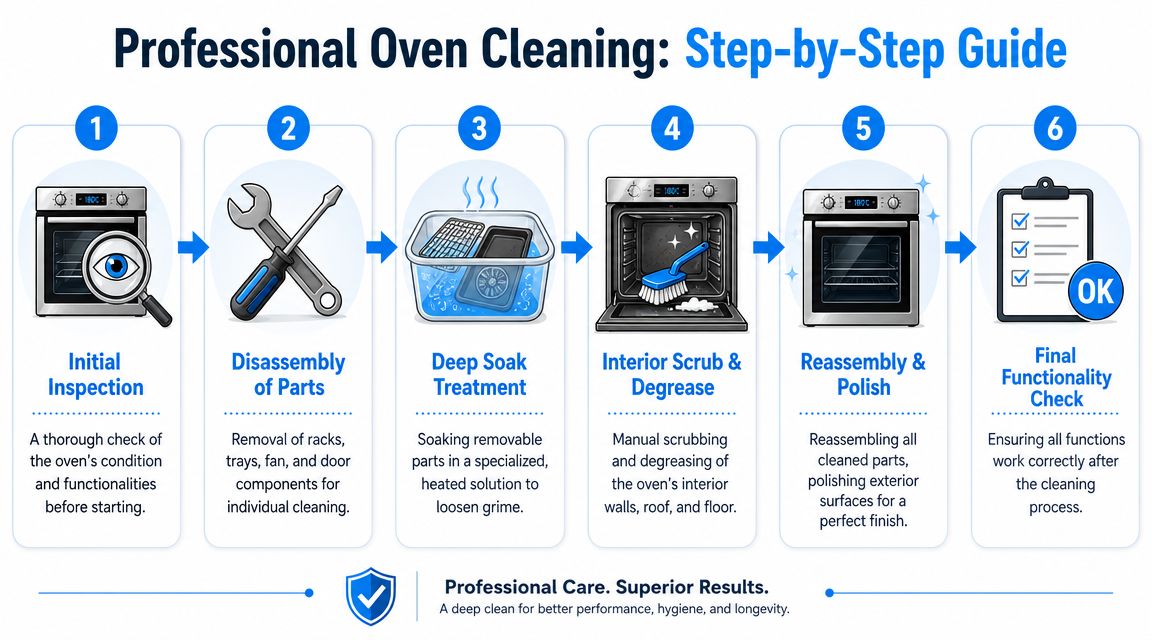
The parts that should be cleaned
A genuine service usually starts by checking the oven's condition and identifying what can be removed safely. That often includes racks, trays, side supports, and other removable components. The point isn't to take things apart for show. It's to expose the grime hidden behind the parts that block access.
A quality clean should cover:
- Racks and trays that need soaking and degreasing, not just wiping.
- Interior panels including the base, sides, roof, and back area where accessible.
- Door glass on the inside, plus the edges and frame where residue cakes up.
- Seals and grooves where grease collects and tends to get missed.
- Exterior surfaces and controls so the whole appliance presents clean, not half-finished.
Why disassembly matters
Most failed DIY cleans look fine with the door shut. The problems appear when the oven is opened fully.
That's why the service method matters more than the phrase “deep clean”. If removable parts stay in place, the cleaner can't properly reach the rails, channels, and edges where build-up sits. A tenant may think the oven is done because the centre of the door looks better, but inspectors often notice the corners and hardware first.
A proper end-of-lease oven clean should make the appliance look consistently clean from the front, the inside, and the parts you only see once the racks come out.
If you're booking a broader vacate clean, it helps to compare that oven work with what a full deep cleaning service in Melbourne typically includes. The standards overlap, but the oven usually needs more specialised attention than a normal kitchen wipe-down.
What a good finish looks like
A well-cleaned oven doesn't need to look brand new. That's not the true test. The true test is whether old residue, grease, and obvious staining have been removed to a standard that looks maintained rather than neglected.
You should expect:
- Clearer door glass, even if older glass still shows wear
- Degreased racks and tray surfaces
- No loose carbon or food debris on the oven floor
- Cleaner seals and edges without sticky residue
- A usable appliance that presents well at inspection
That level of detail is what turns a risky handover item into one less thing to worry about.
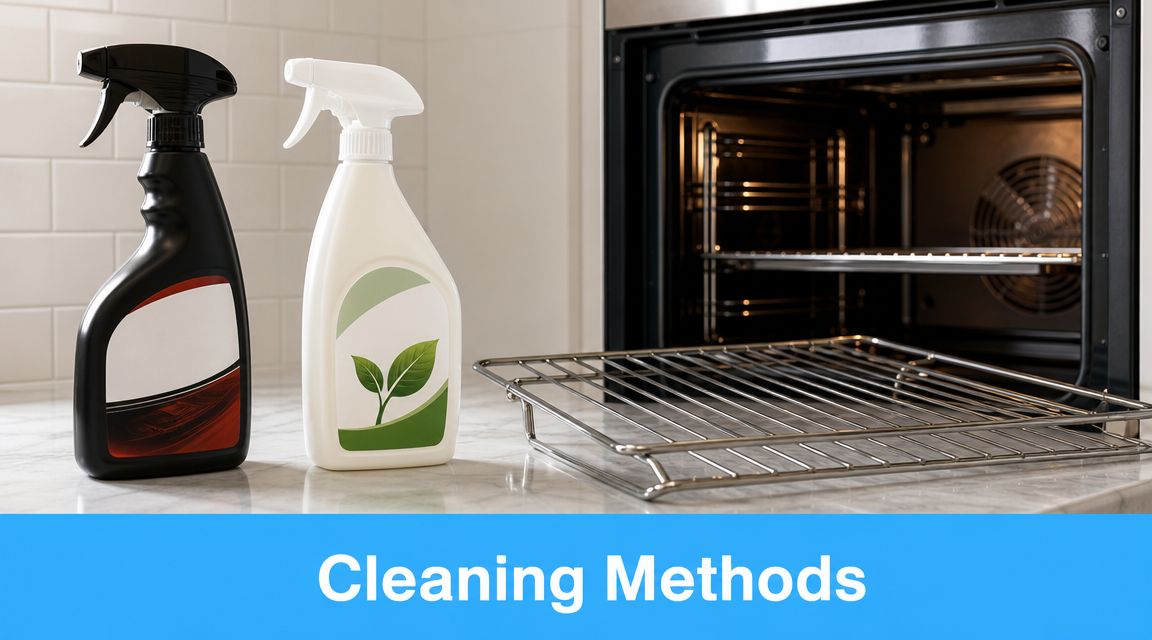
Cleaning Methods Explained Caustic vs Eco-Friendly
Not all oven cleaning methods are equal. Some cut through heavy carbon fast but carry more surface and fume risk. Others are slower but safer for households that are sensitive to strong products. The right method depends on the oven's condition, the surface type, and how much residue has built up over time.
Caustic cleaners and where they fit
The strongest retail and trade oven products are usually strongly alkaline. That high pH is what helps break down hardened grease and burnt deposits. It also means they can damage finishes if used on the wrong surface or left on too long.
Consumer guidance on safe oven cleaner use notes that these products should only be used where the product is certified for oven use and the manufacturer allows it. In practice, a competent technician checks surface compatibility first, uses ventilation, gloves, and eye protection, and avoids treating every oven like it can take the strongest chemical on the shelf.
DIY jobs often go wrong. People assume stronger always means better. It doesn't. A harsh product on the wrong enamel or coating can create a bigger problem than the grease.
Lower-odour methods and when they make sense
For routine grime and moderate build-up, lower-risk approaches often do the job well. Warm soapy water, baking soda paste, non-abrasive pads, wet cloth dwell time, and patience are less glamorous than “industrial strength” claims, but they're often the smarter option.
The same Consumer Reports guidance above notes practical methods such as:
- Soaking racks for at least 2 hours or overnight to loosen grease before scrubbing
- Applying a wet soapy cloth for 10 to 20 minutes on interior deposits to soften residue first
Those steps matter because they reduce the need for aggressive scraping. Less force means less chance of scratching enamel, damaging coatings, or roughing up the door finish.
What to ask before you book
If you're comparing cleaning oven services, don't just ask, “Do you use eco-friendly products?” Ask how they decide which method to use.
Useful questions include:
- Compatibility check. Do you confirm the cleaner is suitable for the oven's enamel and coatings?
- Ventilation approach. How do you manage fumes in smaller flats or homes with limited airflow?
- Manual technique. Do you rely mostly on chemical strength, or do you soak and detail removable parts properly?
- Household sensitivity. Can you use lower-odour methods if children, pets, or asthma are a concern?
If you're already reviewing kitchen cleaning more broadly, this guide on how to clean a range hood helps because the same principle applies. Grease removal isn't just about making surfaces shine. It's about choosing the right method for the material, the soil level, and the air inside the home.
Key Benefits Beyond a Sparkling Finish
A clean oven looks better. That's obvious. The more important benefits are the ones that show up in inspections, day-to-day air quality, and ongoing appliance care.
Bond protection starts with detail
At end of lease, the oven is one of the easiest places for an agent to justify a re-clean request. They don't need to argue over styling or personal standards. They can point to visible grease, residue, or food build-up and say the kitchen hasn't been returned properly.
That's why a professional oven clean often pays for itself in reduced friction alone. It narrows the grey area. If the door glass is clear, the racks are degreased, the base is free of carbon, and the seals aren't sticky, you've removed one of the most common weak points in a vacate clean.
Health and air quality matter too
The benefit isn't only cosmetic. Grease and food residue inside an oven can affect the air in the kitchen when the appliance heats up. Professional cleaning helps remove those deposits.
Guidance on oven cleaning and indoor air quality considerations highlights that removing grease and food by-products can support a healthier indoor environment, particularly in households with children, asthma, or chemical sensitivities. It also points to the value of low-odour, eco-friendly methods where ventilation or sensitivities are a concern.
A dirty oven doesn't just sit there quietly. Once heat hits old grease and burnt residue, the whole kitchen notices.
Better results without rough scrubbing
One of the hidden advantages of professional work is restraint. Good cleaners don't attack every stain with a metal scourer and the harshest spray available. They know when to soak, when to dwell, when to use a non-scratch pad, and when a mark is permanent wear rather than removable grime.
That protects:
- Enamel coatings from avoidable scratching
- Door glass edges from rough abrasion
- Seals and trims from chemical overexposure
- The presentation of the appliance as a whole
A cleaner oven is easier to maintain
After a proper reset, light maintenance becomes realistic again. Wiping a fresh spill from a clean cavity is straightforward. Wiping over old, layered grease isn't.
For households staying put rather than moving out, regular attention makes a big difference. General appliance guidance suggests 1 to 2 oven cleans per year, with 4 to 5 times annually more suitable for heavy use, according to GE Appliances' oven cleaning guide. The reason is simple. Repeated heating polymerises grease into a tougher film that becomes harder to remove later.
That's why leaving it “for one big clean someday” usually creates more work, more fumes, and more risk of surface damage.
DIY Cleaning vs Hiring a Professional
You're packing boxes, the agent has booked the final inspection, and the oven still has black build-up on the base and brown haze inside the glass. That is the point where DIY stops being a money-saving plan and starts becoming a bond risk.
A tenant can clean an oven well enough in some cases. The central question is whether the result will hold up under a Melbourne end-of-lease inspection, where “reasonably clean” usually means no greasy racks, no visible carbon flakes, no sticky residue around the door, and no obvious smoke or burnt smell when the door opens.
Modern self-cleaning ovens can help with light to moderate residue, but they are rarely convenient during a move. They still need preparation, the racks usually need separate attention, and the oven can be out of action for hours, as noted in Consumer Reports' advice on self-clean cycles.
DIY vs Professional Oven Cleaning at a Glance
| Factor | DIY Approach | Professional Service |
|---|---|---|
| Time | Prep, soaking, scrubbing, and re-cleaning missed spots can eat up half a day or more | Usually faster because the cleaner arrives with the right chemicals, tools, and a set process |
| Product choice | Easy to use a spray that is too harsh for enamel, seals, or trim | The method is chosen based on the oven's condition and surface type |
| Physical effort | High, especially on racks, shelf supports, corners, and baked-on grease | The labour is handled for you |
| Inspection confidence | Often falls down on hidden spots such as door edges, hinges, and grooves | Usually stronger because the clean is aimed at the areas property managers notice |
| Fume management | Depends on the product, ventilation, and how long residue is left inside | Easier to control when the operator uses the product correctly and removes residue properly |
| Risk to surfaces | Higher if you over-scrub glass, damage enamel, or soak parts incorrectly | Lower when the cleaner knows what can be cleaned aggressively and what needs a lighter approach |
When DIY is good enough
DIY can be enough if the oven only has light residue and you still have time to do it properly, then check it again the next day in full light.
It suits situations like these:
- The racks are dirty but not thick with grease
- The oven floor has light staining rather than heavy carbon build-up
- The inner door glass is mostly clear
- You know which products are safe for that appliance
- You can allow time for soaking, rinsing, drying, and a final wipe
That last part matters. Many DIY jobs fail the inspection standard because the oven looks better at first glance but still has chemical residue, streaks on the glass, or missed grease in the frame.
When professional help makes more sense
Professional cleaning makes more sense when the oven has been neglected for a while, the grime is baked on, or the key return date is close.
It also helps when you need a predictable result. For bond work, the goal is not a “pretty good” oven. The goal is an oven that won't give the property manager an easy reason to write down “requires further cleaning.”
Common triggers for hiring help are:
- Black residue on the base or back panel
- Brown staining between or around the door glass panels
- Greasy racks and trays
- Sticky residue on knobs, handles, or the oven surround
- Strong burnt smell once the door is opened
- No spare time to redo the job if your first attempt falls short
The trade-off is simple. DIY can save money if the oven is already in decent shape. A professional usually saves time, reduces surface-damage risk, and gives a clearer shot at passing inspection the first time.
If the oven is the one appliance you are hoping the agent won't look at too closely, that is usually the one worth outsourcing.
How to Choose a Reliable Oven Cleaner in Melbourne
Not every oven cleaner is a good fit for an end-of-lease job. Some are set up for routine domestic maintenance. Others understand vacate standards and know exactly what will draw attention during a final inspection.

Look for signs they understand bond cleaning
A reliable provider should talk clearly about condition, not just “making it sparkle”. If they can't explain what parts of the oven they clean, that's a warning sign.
Check for these basics:
- Clear scope of work. Ask whether racks, trays, door glass, seals, grooves, and exterior surfaces are included.
- Experience with vacate cleans. A cleaner who regularly works with tenants and property managers usually understands the difference between a casual clean and an inspection-ready finish.
- Transparent quoting. You want to know what's included before the job starts, especially if the oven is heavily soiled.
- Insurance and accountability. Public liability cover and a professional booking process matter.
Ask practical questions, not vague ones
You'll learn more from five direct questions than from a polished sales page.
Ask:
- What exactly do you clean on the oven?
- Do you remove and soak racks and trays?
- How do you handle strong residue on door glass and seals?
- What products do you use if the household is sensitive to fumes?
- Have you cleaned ovens for end-of-lease inspections in Victoria before?
The answers should sound specific. If the response is all generic reassurance and no process, keep looking.
Check how they communicate before the job
Good operators are usually organised before they ever touch the oven. They confirm the booking clearly, ask sensible questions about appliance type and condition, and tell you whether access or power is needed.
This kind of walkthrough helps when you're comparing providers:
Watch for these red flags
Some warning signs show up quickly:
- No clear inclusions and lots of “it depends”
- No mention of insurance or job process
- Overpromising that every old mark will disappear
- No understanding of vacate standards in Melbourne
- Hidden add-ons that appear after arrival
A dependable cleaner won't promise miracles. They'll inspect the oven, explain what's removable, tell you what can be improved, and be honest about wear that cleaning won't change.
That honesty is usually a better trust signal than a dramatic before-and-after claim.
Your Oven Cleaning Questions Answered
Is professional oven cleaning worth it for my bond
If the oven is one of the dirtiest parts of the property, yes, it often is. The reason isn't vanity. It's that ovens attract close inspection and tenants commonly miss the same spots: glass edges, seals, grooves, and racks. A targeted clean reduces the chance that the kitchen becomes the problem area in the final report.
Do I need to clean the oven if it still works fine
Yes. Function and cleanliness are different issues. An oven can heat perfectly and still fail the presentation standard expected at handover.
Should I use the self-clean setting before inspection
Usually only if you've got plenty of time, good ventilation, and you understand that the cycle may still leave residue to clean manually afterwards. It isn't a guaranteed shortcut for vacate cleaning.
What should I do before the cleaner arrives
Keep it simple:
- Remove personal items from around the oven
- Make sure power is available
- Point out any faults such as broken hinges, cracked glass, or a fan issue
- Have your condition report handy if you're worried about how clean it needs to be
Will a professional clean make an old oven look brand new
Not always. A good cleaner removes grease, food residue, and grime. They can't reverse permanent wear, pitting, discolouration, or damage. What you're aiming for is clean and presentable, not factory fresh.
Do I need a full vacate clean or just the oven
That depends on the rest of the property and your lease obligations. If the home is otherwise in good shape, an oven-only service can solve the main problem. If the kitchen, bathrooms, windows, and floors also need work, it usually makes more sense to book a full end-of-lease clean so the property is assessed as a whole.
What's the simplest way to choose the right service
Pick the company that gives the clearest scope, understands end-of-lease expectations, and answers direct questions without dodging them. For this kind of job, clarity is more useful than flashy claims.
If you need a practical vacate clean that includes proper oven work, End Of Lease Cleaning Melbourne offers end-of-lease and bond cleaning across Melbourne with oven cleaning included as part of broader exit-cleaning support. If you're unsure whether you need an oven-only service or a full bond clean, it's worth asking for a clear scope before you book.
