
You've wiped the glass twice, stepped back, and the windows still look worse in daylight than they did before. On a normal week, that's annoying. At the end of a lease, it can feel risky. Property managers notice streaks, dirty tracks, mineral spotting, and grime sitting in the corners long after tenants think the job is done.
That's why house window cleaning melbourne isn't just about making the place look nicer. It's about getting the finish right for an inspection, especially when your bond depends on the overall standard of the property. In Melbourne, the job gets harder because local windows deal with dust, pollen, traffic film, and hard water spotting that can cling to glass even after a basic clean.
After more than 20 years working across Melbourne homes, vacates, and detailed bond cleans, one thing is clear. Windows are one of the easiest areas to underestimate, and one of the easiest for an agent to flag if the result isn't sharp.
Your Guide to Crystal Clear Windows in Melbourne
If you're in a rental right now, there's a good chance the windows are on your mental list but not yet properly planned. People leave them until the last day, then realise the outside glass has mineral marks, the inside edges are dusty, and the tracks are holding grime that shows up the moment sunlight hits it.
Melbourne homes make window cleaning harder than it looks. Some properties cop heavy road dust. Others sit under trees and collect pollen and sap. In harder water areas, a basic hose-down can leave more visible spotting than the dirt you started with. That's why a bond-ready result usually comes from method, not effort alone.
This is also a mature trade, not a side task people casually guess their way through. The Australian cleaning services market was estimated at AUD 18.97 billion in 2025 and is forecast to grow at a 5.10% CAGR between 2026 and 2035, which reflects an established, competitive professional industry, according to Expert Market Research's Australia cleaning services market report.
What matters most for tenants
A clean window for a bond inspection usually means more than clear glass. It means the whole visible area presents well:
- Glass without streaks: especially on interior panes where afternoon light exposes every pass.
- Frames and sills wiped down: because dusty edges can make clean glass still look unfinished.
- Tracks checked: built-up dirt, dead insects, and mould around sliders are common inspection issues.
- Exterior spotting removed where accessible: especially if the property has traffic film or hard water marks.
Practical rule: If the window looks clean only from one angle, it isn't clean enough for an exit inspection.
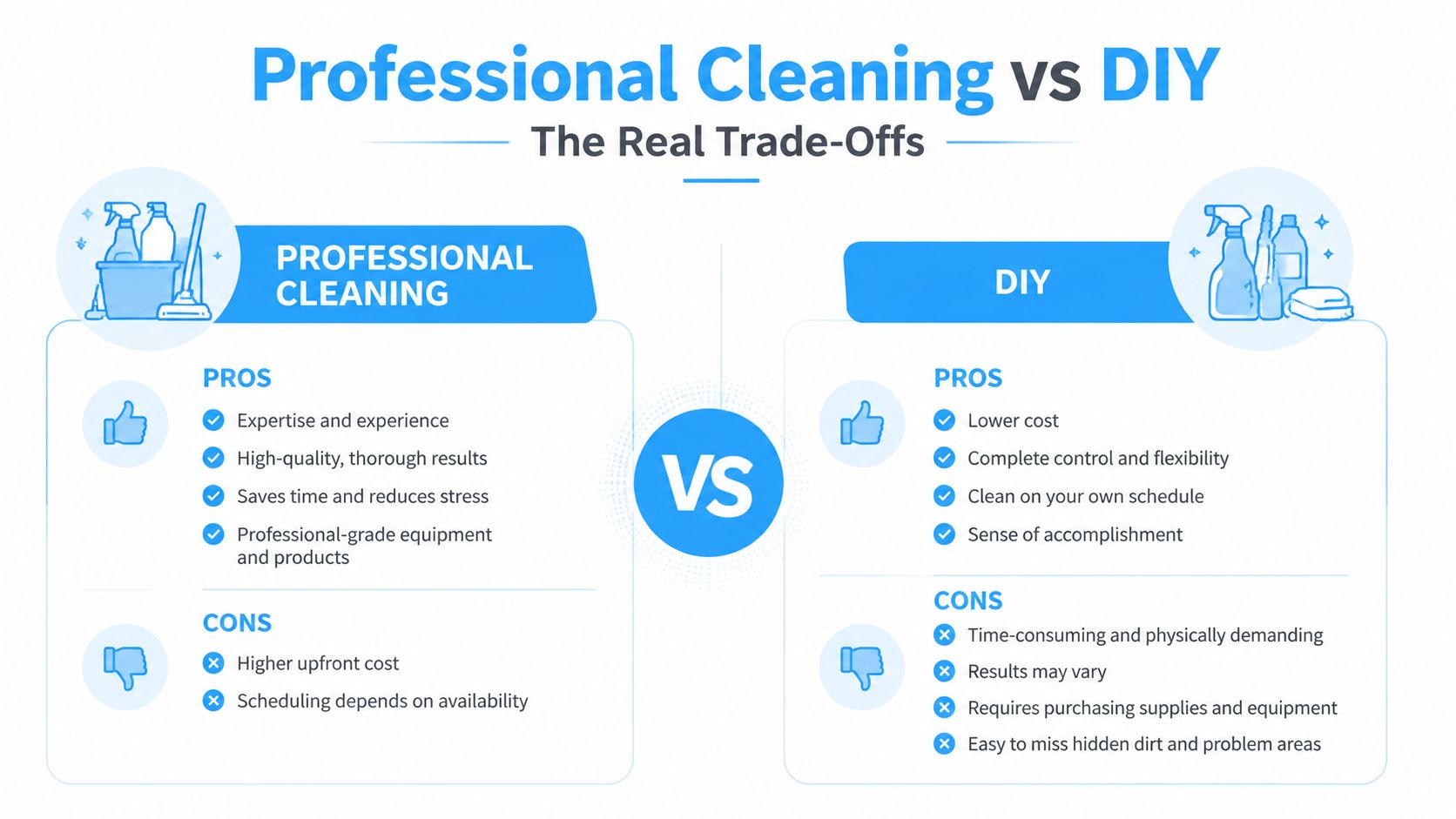
Professional Cleaning vs DIY The Real Trade-Offs
Most tenants start in the same place. Can I do this myself and save money, or is this one of those jobs where hiring someone avoids a bigger headache later?
The honest answer is that both options can work. It depends on the condition of the windows, how accessible they are, and how exact the finish needs to be. For a single-storey home with light dust and easy access, DIY can be enough. For upper windows, neglected tracks, or glass that needs to be inspection-ready, the trade-offs change quickly.
Where DIY works
DIY cleaning suits simple jobs where the goal is maintenance, not rescue. If the panes are reachable from ground level, the glass isn't heavily spotted, and you've got time to work carefully, you can get a respectable result.
DIY also makes sense when you can clean in stages rather than racing the clock before key return. That matters, because rushed window cleaning is where most streaks happen.
A decent DIY setup usually includes:
- A proper squeegee: not a supermarket sponge tool that drags water and leaves lines.
- Microfibre cloths: for edge detail and final touch-ups.
- A scrubber or mop: to loosen traffic film and fine dust before the squeegee touches the glass.
- A stable step platform for safe low-height access: not improvised balancing on furniture.
Where DIY falls short
The biggest problem isn't effort. It's technique. Professionals use a refined S-pattern squeegee method that's described as 98% more effective at removing water without streaks compared with simple vertical wipes, according to this window cleaning technique video. That difference shows up fast on large panes, sliding doors, and anything hit by side light.
DIY jobs also tend to miss the small areas that agents notice first:
- Corners of frames
- Bottom tracks
- Flyscreen dust transfer
- Dried drips on the sill
- Exterior marks on upper-storey panes
Then there's safety. The moment ladders, awkward reaches, or slippery paving come into it, a cheap clean can become an expensive mistake.
If you need to lean, stretch, or guess your footing, the job has already moved out of safe DIY territory.
What you're really choosing
This isn't just a cost decision. It's a decision about risk.
| Option | Best for | Main downside |
|---|---|---|
| DIY cleaning | Light upkeep, easy-access windows, flexible timing | Quality can be inconsistent |
| Professional cleaning | Vacates, multi-storey homes, inspection-focused finishes | Higher upfront spend |
| Mixed approach | DIY inside, pro outside or upper levels | Results may still vary across the property |
For end-of-lease work, the true value of a professional isn't just cleaner glass. It's removing uncertainty when the standard has to hold up under scrutiny.
What a Professional Window Clean Actually Includes
A proper window clean is never just someone spraying glass and wiping it down. On a Melbourne property, especially a rental that's been lived in for a while, the work usually starts with assessing what kind of dirt is present. Dust behaves differently from greasy film. Pollen lifts differently from mineral spotting. Post-renovation residue needs a different level of care again.
That's why a professional service should break the job into parts, not treat every pane the same way.

The basic inclusions that matter
When tenants ask what should be included, the practical answer is this:
- Interior glass cleaning: removing fingerprints, haze, cooking residue, and dust film
- Exterior glass cleaning: dealing with weather grime, water spotting, and road dust
- Frames and sills: wiped so the clean doesn't stop at the glass line
- Tracks on sliding windows and doors: where bonded dirt and insect debris tend to collect
- Spot treatment for stuck marks: done carefully, with the right blade and direction of use where appropriate
A lot of disappointment comes from assuming tracks or frames were part of the quote when they weren't. Always ask.
Why pure water makes a visible difference
In many Melbourne suburbs, water quality is the hidden problem. Tap water in hard water areas can contain 100 to 300 mg/L of dissolved minerals, while professional pure water systems reduce that to below 10 mg/L, which helps prevent the white spotting left behind after evaporation, as explained in this guide to cleaning windows like a pro.
That matters most on exterior glass. If someone rinses a window with mineral-heavy tap water and lets it dry naturally, the residue often stays on the pane. It can look like the job wasn't finished even when the dirt was removed.
The tools that separate a passable clean from a proper one
Professionals usually combine methods depending on access and condition.
Water-fed poles for exteriors
Water-fed pole systems are especially useful for upper-storey exterior windows. They allow the operator to scrub frames and glass from the ground using purified water, which dries spot-free when the filtration is working properly.
For many homes and apartment-style properties, this is safer and more consistent than dragging ladders through tight spaces. It also helps with areas above gardens, narrow side paths, and awkward rear access.
Squeegee work for detail areas
Interiors, large sliders, and detailed finish work are often better done with a hand squeegee and microfibre cloth. That's where edge control, blade pressure, and dry detailing matter most.
Clean frames first. If you wash the glass before the frame, dirty runoff can undo your finish.
Scraping with care
Paint specks, insect residue, and stuck contamination sometimes need scraping, but amateur jobs often go wrong at this stage. The blade, angle, and glass condition matter. Used badly, scraping creates damage that cleaning can't hide.
For exterior hard surfaces around the windows, heavy grime on paths and entries can also drag dirt back into the work area. If that part of the property is heavily soiled, it helps to understand how surrounding surfaces are handled too. Guides on pressure cleaning concrete can assist in planning the order of a full exterior refresh.
Questions worth asking before you book
Use this checklist when comparing providers:
- Are tracks included or priced separately?
- Do you clean both inside and outside glass?
- How do you handle upper-storey access?
- Do you use pure water for exteriors where needed?
- Will frames and sills be wiped as part of the service?
If the answers are vague, expect the result to be vague too.
Understanding House Window Cleaning Prices in Melbourne
The first useful pricing benchmark is simple. Australian residential window cleaning averages AUD 8 to AUD 12 per pane, according to Gitnux window cleaning industry statistics. That's a starting point, not a universal quote.
Some homes come in neatly around that guide. Others don't, because window cleaning prices depend far more on labour and access than people expect. A house with easy sliding windows on one level is a different job from a townhouse with high fixed panes, tight side access, dirty tracks, and exterior mineral spotting.
What changes the quote
The quote usually moves for practical reasons, not arbitrary ones.
Access changes everything
Ground-floor windows are faster and safer. Upper-storey panes, narrow side paths, awkward rear courtyards, and glass above stair voids all slow the work down. The cleaner may need extension poles, ladder setup, or a more careful work sequence.
Window style matters
Big flat panes are usually simpler than divided colonial windows, louvre-style layouts, or doors with multiple small sections. More edges mean more detailing and more chances for water to sit where it shouldn't.
Condition affects time
Light dust cleans quickly. Greasy film, built-up tracks, sticker residue, insect marks, and mineral spotting don't. If the property is being cleaned at vacate after years of basic upkeep, expect more labour than a regularly maintained home.
Melbourne Window Cleaning Cost Factors
| Factor | Impact on Cost | Notes for Melbourne Residents |
|---|---|---|
| Number of panes | Higher pane count usually increases the quote | Count glass sections, not just window frames |
| Accessibility | Difficult access raises labour and safety requirements | Upper levels and tight laneways often take longer |
| Window type | Detailed styles need more hand work | Small divided panes can take longer than large flat glass |
| Condition of glass | Heavy grime or spotting increases cleaning time | Hard water marks and traffic film are common local issues |
| Tracks and screens | Often priced separately or added to the scope | Ask directly so there's no mismatch on the day |
| Interior and exterior scope | Full-service cleaning costs more than exterior-only work | Bond cleans usually need both if both are dirty |
How to compare quotes properly
A cheap quote isn't automatically better value. You need to know what's included.
Ask these questions before accepting a price:
- Is the quote per pane or for the whole job?
- Are frames, sills, and tracks included?
- Is exterior-only cleaning being compared with a full inside-and-out service?
- Are hard-to-reach windows part of the quote?
If you're moving out, the best quote is usually the one that matches inspection expectations, not the one that strips out half the work.
How to Prepare for Your Window Cleaner's Arrival
A smooth window clean starts before anyone touches the glass. Ten minutes of prep from the resident can save a lot of stop-start work on the day, especially in occupied homes or last-minute vacates where every room is still full of boxes, furniture, cords, and loose items.
For tenants, this step also reduces the risk of missed windows. If access is blocked, cleaners often have to work around it or leave that section for later, which slows the whole job and can affect the finish.

The short pre-arrival checklist
Do these before the cleaner arrives:
- Clear the window sills: remove plants, candles, diffusers, picture frames, and loose décor.
- Move light furniture back: bedside tables, dining chairs, and sofas near full-height windows can block access.
- Open up curtains and blinds: tie them back or lift them out of the way so fabric doesn't brush wet glass.
- Secure pets: even calm pets can get stressed by movement around windows and doors.
- Check access points outside: make side gates accessible and ensure the cleaner can reach exterior areas.
- Note problem windows in advance: if one slider jams or a screen is fragile, mention it before work begins.
Small details that help a lot
If your property has roller blinds, don't ignore them. Dust from the blind can fall straight back onto freshly cleaned glass if it's disturbed afterwards. It helps to deal with both jobs together, or at least know the right order. This guide on how to clean roller blinds is useful if you're preparing the whole room for inspection.
A few extra checks also make the clean more efficient:
| Check | Why it matters |
|---|---|
| Working tap outside | Helps if exterior equipment needs water access |
| Parking access | Reduces delays carrying gear long distances |
| Good room ventilation | Speeds drying and makes interior work easier |
| Decluttered tracks and ledges | Lets the cleaner focus on dirt, not moving belongings |
The best prep is simple. Make every window easy to reach, easy to open, and easy to inspect.
If you're doing a bond clean at the same time
Try not to schedule windows after dusty work inside the home. If walls are being patched, floors are being swept aggressively, or blinds are being removed, fine dust can settle back onto glass and sills.
A sensible order is usually:
- Finish dusty tasks first
- Wipe blinds, ledges, and surrounding joinery
- Clean windows
- Do final room touch-ups only after the glass is dry
That sequence prevents you from cleaning the same area twice.
Get Bond-Proof Windows with End Of Lease Cleaning Melbourne
At end of lease, window cleaning stops being a cosmetic extra. It becomes part of how the whole property is judged. If the glass is streaky, the tracks are dirty, or the frames still hold grime, the place feels unfinished even if the rest of the home is decent.
That's why a bond-proof approach works better than a quick once-over. You need windows that hold up in daylight, from multiple angles, and under the kind of scrutiny that happens during a final inspection. The right method depends on access, glass condition, and local issues like hard water and pollen. The wrong method usually creates more work, not less.
Why choosing carefully matters
Cleaning businesses in Australia can be profitable, with building cleaning businesses averaging a 21% profit margin, according to the same market research noted earlier. That's one reason it pays to choose a provider with clear scope and transparent pricing rather than assuming every quote covers the same level of detail. In practice, the safest option is the company that explains what's included, what isn't, and how they'll handle the tricky parts.
For tenants, landlords, and property managers, the smartest move is to look for a service that understands end-of-lease standards rather than treating windows as a basic add-on.
What to look for in a bond-focused service
A reliable provider should offer:
- Clear inclusions: glass, frames, sills, and any track detail should be spelled out
- Real access capability: especially for upper-storey or awkward windows
- Consistent communication: booking, arrival times, and scope shouldn't feel vague
- A finish aimed at inspection: not just “good enough from the street”
If you're preparing a full vacate clean, it also helps to work from a proper end of lease cleaning checklist so windows aren't treated in isolation from the rest of the property.
For Melbourne renters, bond-proof windows are really about reducing arguments. When the glass, frames, and tracks present cleanly, you remove one of the common visual reasons an agent has to question the standard of the home.
Frequently Asked Questions About Window Cleaning
How often should house windows be cleaned in Melbourne
That depends on where you live and what hits the glass. Homes near busy roads, construction, or heavy tree cover usually need more frequent attention than quiet residential streets. In Melbourne, pollen in spring, dust in summer, and winter grime all leave different kinds of buildup, so many residents clean on condition rather than on a rigid schedule.
Is window cleaning included in an end-of-lease clean
Sometimes yes, sometimes only partly. Some vacate cleans include internal glass and basic window detailing, while exterior access, heavy spotting, screens, or tracks may be separate. Always check the written scope before booking, especially if you need the windows presented well for a bond inspection.
Are tracks and frames really that important for bond return
Yes. Dirty tracks and dusty frames can make otherwise clean glass look unfinished. Property managers often notice these edges quickly because they show whether the clean was detailed or rushed.
For inspections, the finishing details matter as much as the centre of the pane.
Can upper-storey windows be cleaned safely without ladders
Often they can, depending on the layout. Water-fed poles and purified water systems let cleaners reach many exterior upper windows from ground level. Some properties still need ladder access, but a good operator will decide that based on safety and access, not habit.
Should I clean blinds before or after the windows
Usually before. Dust and debris from blinds can fall onto wet or freshly cleaned glass. If you're doing both as part of a vacate, start with the dry dusting and fabric or blind cleaning, then move to the windows.
Do eco-friendly products still work on dirty windows
Yes, if the method is sound. The result usually comes down to tool choice, water quality, and technique more than harsh chemicals. For most home window cleaning, controlled soap use, microfibre, proper squeegee work, and purified water do the heavy lifting.
If you need bond-proof house window cleaning melbourne residents can trust, End Of Lease Cleaning Melbourne can help. With over 20 years of local experience, transparent quotes, eco-friendly products, flexible bookings, and a strong reputation for detailed vacate cleans, the team handles windows as part of the bigger goal: helping you leave the property inspection-ready and giving you the best chance of a smooth bond return.
