
In Melbourne, standard house cleaning commonly sits around A$30 to A$50 per hour per cleaner, and a 2 to 3 bedroom standard clean often lands around A$120 to A$280 per visit based on Australian pricing guides. For a regular house clean more broadly, practical benchmarks also place many invoices in the A$150 to A$400 range depending on home size and complexity, while deep and end-of-lease cleans are usually priced on a different scale because the scope is much heavier.
If you're reading this, you're probably doing one of three things. You've asked for a quote and felt surprised by the number. You're trying to compare a cheap cleaner with a more expensive one and can't tell what the difference is. Or you're moving out and wondering why a bond clean costs so much more than a normal tidy-up.
That confusion is fair. A lot of pricing pages lump everything together under “house cleaning” when those jobs are not the same service at all. A weekly maintenance clean, a once-off deep clean, and a bond clean each involve different labour, different expectations, and different risk for the company doing the work.
As someone who works in the Melbourne market, I'd put it this way: The right price isn't just about time on site. It's about scope, detail, access, condition, and whether the clean has to satisfy a property manager's inspection standard.
Decoding Your First House Cleaning Quote
You get two quotes for a two-bedroom flat in Melbourne. One is low enough to book on the spot. The other is much higher, and the cleaner starts asking about the oven, shower screens, carpet marks, balcony dust, and whether the agent wants a receipt for a bond return. Those numbers are not for the same job, even if both are labelled "house cleaning."
That is the first thing to understand about a cleaning quote. It is a price for a scope, not a price for an address.

What a Melbourne quote is really measuring
In Melbourne, the first-glance number usually reflects four practical questions. How much labour will the property need. How detailed does the job need to be. How easy is the home to clean. How much risk sits with the cleaner if the result is challenged.
I recently quoted a vacate job in Fitzroy where the tenant told us the place was "pretty clean already." It looked tidy in the photos. Once we asked a few better questions, the scope changed fast. There was grease inside the oven, soap scum in two bathrooms, pet hair along skirting boards, and the agent expected an end-of-lease standard. That was never going to price like a normal once-off clean.
Many customers get caught here, especially renters. A standard clean is about presentation and upkeep. A bond clean is priced higher because the cleaner is working to inspection standard, with more detail, more time in problem areas, and a higher chance of needing to return if something is disputed. That bond clean premium is real in the Melbourne market, and it exists because the service carries a different workload and a different expectation.
What to check before you compare two quotes
A quote is easier to judge when these points are clear:
The service type
Regular upkeep, one-off standard cleaning, deep cleaning, and bond cleaning are different scopes with different labour demands.The exact inclusions
Check kitchens, bathrooms, internal glass, skirting boards, cobweb removal, inside cupboards, and oven cleaning. If the quote just says "general clean," ask for more detail.The condition of the property
A maintained home in Carlton with clear benches and weekly upkeep prices very differently from a catch-up clean in Werribee after months of buildup.The inspection risk
If the clean is tied to a rental exit, agent handover, or bond return, the quote should reflect that standard.
Practical rule: If two quotes do not describe the same tasks, they are not comparable, even if the homes are similar on paper.
Why the cheapest number often changes later
Low quotes usually come from one of two places. The cleaner has assumed a light job, or the scope has been trimmed so far that the hard work sits outside the price.
That is why customers feel blindsided on the day. They expected limescale removal, rangehood degreasing, detailed shower work, wiped skirtings, and marks removed from doors. The quote allowed for benches, floors, and a quick bathroom once-over.
A fair quote should make those trade-offs visible before anyone books. If it is a standard clean, it should say so. If it excludes inside the oven or internal windows, that should be written down. If it is a bond clean, the premium should be explained clearly, because you are paying for a more demanding result, not just extra time on site.
The Four Main House Cleaning Pricing Models
Some cleaners quote by the hour. Some quote by the property. Others work from room count or floor area. None of these models is wrong in itself. The issue is whether the model matches the job you need done.

Hourly pricing
Hourly pricing is the easiest model to understand. You're paying for labour time, usually with cleaning products and equipment either included or clarified in advance.
This model works well when the home is occupied, the tasks may change, or you want flexibility. For example, a customer might say, “Focus on bathrooms and kitchen first, then use the remaining time on floors and dusting.”
Good fit for:
- Flexible priorities when not every room needs the same attention
- Regular maintenance where the cleaner already knows the property
- Smaller jobs that don't justify a large fixed package
Watch for:
- Unclear expectations if you expect a full-home result from limited hours
- Budget uncertainty if the home is more cluttered or dirtier than described
Flat-rate pricing
Flat-rate pricing gives you one number for the agreed scope. Customers usually prefer this for once-off jobs because it creates certainty.
It's especially useful when the task list is clear. If the company has enough detail, a fixed quote protects both sides better than an open-ended hourly arrangement.
| Pricing model | Best use case | Main benefit | Main drawback |
|---|---|---|---|
| Hourly | Regular or flexible cleans | Adaptable | Final cost can shift |
| Flat-rate | One-off or clearly defined jobs | Budget certainty | Can be poor value if your home is already easy |
| Per-room | Homes with obvious room-based scope | Simple to understand | Doesn't capture condition well |
| Per-square-metre | Empty properties or broad estimating | Useful for large spaces | Misses detail-heavy problem areas |
A short visual can help if you're comparing quote styles from different companies:
Per-room pricing
Per-room pricing sounds tidy on paper. In practice, it can work for simple homes and fail badly on bathrooms, kitchens, and multipurpose spaces.
A spare bedroom with bare floors is not equal to a family bathroom with soap residue, grout, mirrors, fittings, and toilet detail. So this model is only helpful when the room categories are weighted properly.
A quote that charges “one room equals one room” usually underestimates wet areas and overestimates easy spaces.
Per-square-metre pricing
This model appears more often on empty properties, larger homes, or commercial-style jobs. It can be a useful first-pass estimate because floor area does matter.
But floor area alone doesn't tell you enough about cleaning difficulty. A compact townhouse with two bathrooms, an oven, internal glass, and detailed joinery can take more effort than a larger, sparsely furnished property.
For customers, the best model is usually simple:
- Choose hourly if you want flexibility
- Choose flat-rate if the task list is clear
- Treat per-room and per-square-metre as estimating tools, not guarantees
Key Factors That Influence Your Final Quote
A cleaner doesn't just see size. They see a difficulty score. Two homes with the same number of bedrooms can price very differently if one is maintained weekly and the other hasn't had proper attention for months.
In the Melbourne market, providers commonly quote standard home cleaning from about A$30 to A$50 per hour per cleaner, while a 2 to 3 bedroom standard clean can land around A$120 to A$280 per visit. Australian service pages also commonly note that deep cleaning often starts around A$200 to A$400+ and move-out cleaning around A$250 to A$500+, because those jobs require slower task execution and more detail, as outlined in this Australian cleaning cost breakdown from eMaids.

Size matters, but not in the way people think
Bigger homes usually cost more because there are more surfaces, more floor area, and often more bathrooms. But size is only the starting point.
A large home with minimal furniture, open access, and regular upkeep can be quicker to clean than a smaller place packed with belongings. Cleaners lose time moving around clutter, working around fragile items, and trying to reach surfaces that should have been accessible from the start.
Condition changes everything
Here, quotes move fast.
If grease has built up in the kitchen, soap scum has hardened in showers, dust is sitting on skirting boards, and internal glass hasn't been touched in months, the work slows down. The same room needs more passes, more product, and more hand-detailing.
That's why customers often feel shocked by a deep-clean quote. They're picturing square metres. The cleaner is pricing removal effort.
- Light upkeep condition means faster wiping, vacuuming, and mopping
- Moderate buildup means extra scrubbing in bathrooms and kitchen detail
- Heavy buildup usually pushes the job toward deep-clean territory
- Vacate condition adds inspection-sensitive work, especially in ovens, windows, and edges
If you want a tighter quote, send clear photos of bathrooms, the oven, kitchen splashback, floors, and windows. That reduces guesswork more than a long text description ever will.
Frequency and add-ons
Regular customers often get better value because the home stays under control. The cleaner isn't resetting the property every visit. They're maintaining a standard.
One-off bookings cost more per visit because the home usually needs more correction. Add-ons also matter. Oven interiors, inside windows, wall marks, blinds, and upholstery all change the labour mix. If soft furnishings are part of the job, specialist work such as sofa steam cleaning in Melbourne may need to be priced separately rather than bundled into a standard house clean.
A fair quote usually reflects four things at once: access, current condition, detail level, and whether you want maintenance or restoration.
Standard vs Deep vs Bond Clean What You Get for Your Money
Customers often use these terms interchangeably. The industry can't afford to. The gap between a standard clean and a bond clean is where most pricing confusion happens.
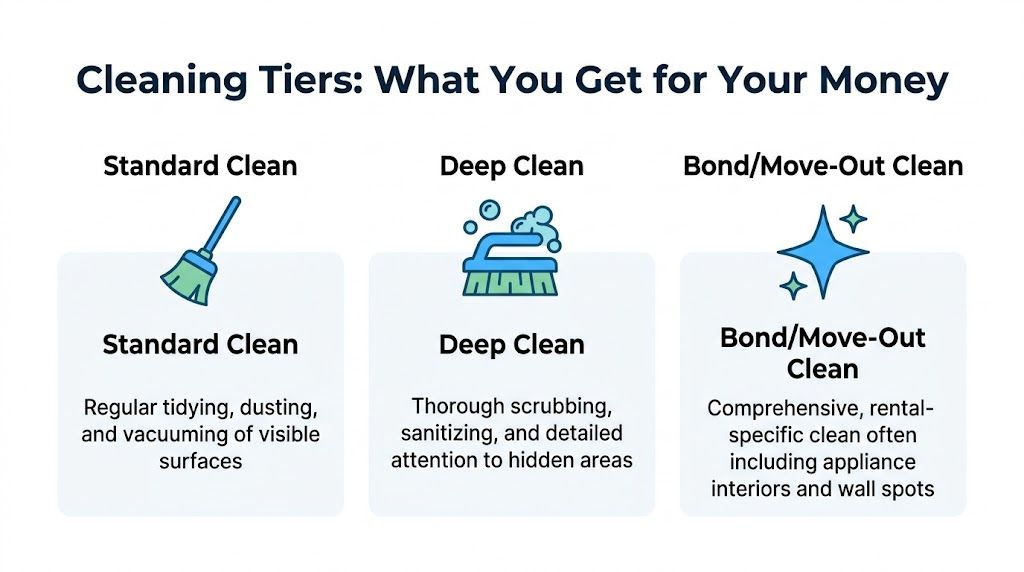
The short version is this. A standard clean keeps a home presentable. A deep clean corrects buildup and detail problems. A bond clean is a vacate-focused service designed around property condition reports, inspection standards, and the risk of re-cleans.
Why bond cleaning carries a premium
Many pricing pages miss the point that matters most to tenants. Bond-clean pricing is driven by property type, inclusions, and re-clean risk, not just hours, and the question of why a vacate clean costs more is often about liability and scope control, not only cleaning intensity, as explained in this discussion of cleaning cost structures on Care.
That matches what happens in real bookings. A vacate clean has to satisfy someone else's checklist. It often includes ovens, bathrooms, windows, skirting boards, and edge work that isn't part of the lowest standard-clean quotes. It also needs clearer scope because if the agent flags missed items, the cleaner may be asked to return.
Cleaning Service Comparison What's Included
| Task | Standard Clean | Deep Clean | Bond Clean |
|---|---|---|---|
| Floors vacuumed and mopped | Yes | Yes | Yes |
| Surface dusting and wiping | Yes | Yes, with more detail | Yes |
| Bathrooms cleaned | Yes | Yes, with heavier scrubbing | Yes, inspection-focused |
| Kitchen bench and sink | Yes | Yes | Yes |
| Skirting boards | Usually limited or excluded | Commonly included | Commonly expected |
| Oven interior | Usually excluded or add-on | Often add-on or included by scope | Commonly expected |
| Internal windows | Often limited | May be included by scope | Commonly expected |
| Cupboards and drawers inside | Usually excluded | Sometimes by request | Often included if vacant |
| Wall marks and spot cleaning | Limited | By request | Often addressed where practical |
| Re-clean risk after inspection | Low | Moderate | Highest |
What each service is really buying
A standard clean buys maintenance. It's best for homes that are already under control and need routine dusting, bathrooms, kitchen surfaces, and floors.
A deep clean buys detail and recovery. It makes sense when the property has fallen behind or when you want a proper reset before returning to maintenance visits.
A bond clean buys scope certainty under inspection pressure. If you're moving out, it's worth reading a more detailed guide to end of lease cleaning in Melbourne so you can match the booking to the agent's expectations before handover.
Bond cleaning isn't just “a bit more cleaning”. It's a service built around handover standards, detailed inclusions, and the possibility of being called back if the inspection fails.
How to Calculate a Rough Estimate for Your Home
A Melbourne tenant in a 3-bedroom townhouse often rings for a “house clean” quote, then gets a shock when the vacate price comes back much higher than expected. The gap usually comes from service type, not from a cleaner making numbers up. A standard clean is priced around upkeep. A bond clean is priced around handover detail, broader inclusions, and the risk of a return visit if the agent flags something.
The quickest way to get a rough estimate is to work from labour, then add the items that change the scope.
A simple way to build your estimate
Use this worksheet:
Start with the service type
Choose standard, deep, or bond clean based on the result you need. If you are moving out, start with bond clean. That avoids comparing a maintenance service with an inspection-focused one.Count the work zones, not just the bedrooms
Bedrooms matter less than kitchens, bathrooms, laundries, toilets, stairs, and extra living areas. A 2-bedroom, 2-bathroom apartment can take longer than a 3-bedroom, 1-bathroom unit if the wet areas are heavy.Grade the condition fairly Use a simple rating:
- Light: regularly maintained, little buildup
- Moderate: missed details, soap scum, kitchen grease, dusty edges
- Heavy: thick buildup, hard water marks, neglected showers, grease, marks inside cupboards
List add-ons separately
Oven interior, internal windows, inside cupboards and drawers, walls, balcony, garage, blinds, fridge, and carpet work should sit outside your base assumption unless the quote says they are included. If carpets need treatment for a vacate, steam cleaning for carpet is often quoted as a separate line item.Allow for access and occupancy
Empty homes are usually faster for detailed work. Occupied homes slow things down because cleaners work around furniture, belongings, and restricted access.
A rough estimating formula
Use this basic formula:
Estimated price = service level + number of wet areas + condition loading + add-ons + access complexity
That sounds simple because it is. Good quoting usually comes back to those five inputs.
Here's how to apply it in practice.
Example 1. Regular clean in a small apartment
A tidy 2-bedroom, 1-bathroom apartment with no extras usually sits near the lower end of your own estimate because the condition is controlled and the scope is predictable. If it will be cleaned regularly, the first visit may cost more than later visits. After the reset, time drops because less buildup returns each time.
Example 2. One-off deep clean in a family home
A 4-bedroom home with two bathrooms, a powder room, and a greasy kitchen often costs more than owners expect because the time goes into detail work, not floor area alone. Skirting boards, shower glass, taps, splashbacks, and neglected corners add hours quickly. Underquoting happens most often in these situations. People describe the home by size, but the labour is driven by condition.
Example 3. Bond clean before handover
A bond clean carries a premium because the cleaner is not just making the place presentable. The job is closer to a checklist-driven handover service. Inside cupboards, oven detailing, internal glass, edges, bathroom scale removal, and inspection-sensitive finishing all push the quote up. In Melbourne, this is the point many tenants miss. They ask for a house cleaning estimate when they need an end-of-lease scope.
A fast reality check before you approve a quote
Ask these five questions:
- What service level is this priced for
- Are oven, windows, cupboards, and walls included or excluded
- Was the condition assessed from photos, inspection, or room count only
- Is the property vacant or occupied
- For bond cleaning, what happens if the agent requests a re-clean
If a quote looks unusually cheap, one of those items is often missing. The better quote is the one that matches the result you need and states the scope clearly in writing.
Answering Your Top Cleaning Cost Questions
Why is my bond clean quote so much higher than a regular clean
Because the deliverable is different. A regular clean is about presentation and hygiene. A bond clean is about meeting vacate expectations with broader inclusions and tighter scope. The price usually reflects detail work, appliance interiors, windows, edges, and the chance of a return visit if the inspection flags something.
Can I save money by supplying my own products
Sometimes, but not always. If the cleaner already uses a system they trust, switching products can slow the job or reduce consistency. The bigger savings usually come from reducing clutter, making the property accessible, and booking the right service level the first time.
How do I know if I'm getting fair value
Look past the top-line number. Fair value comes from a quote that clearly states what is included, what is excluded, and what condition the price assumes. If two quotes are far apart, ask each company to confirm ovens, windows, bathrooms, skirting boards, and re-clean terms in writing.
The best quote is rarely the cheapest one. It's the one that most accurately matches the result you actually need.
What usually leads to surprise charges
Three things cause most problems:
- Missing add-ons such as oven interiors, internal glass, or walls
- Understated condition when buildup is heavier than described
- Scope drift when extra rooms or tasks get added on the day
What should I send when asking for a quote
Send the property type, bedroom and bathroom count, whether it's occupied or empty, your preferred service type, and clear photos of bathrooms, kitchen, oven, floors, and any problem areas. That gives a cleaner enough detail to quote properly instead of padding the job or guessing low.
If you need a vacate or house-cleaning quote in Melbourne, End Of Lease Cleaning Melbourne offers end-of-lease, deep, and regular cleaning services with scope-based quoting. If you're comparing providers, ask for a written inclusions list first, then choose the team whose quote matches the result you need.
