
You're at the end of the lease, the removalists are booked, the cupboards are empty, and most of the place looks manageable. Then you open the oven door properly.
What looked “not too bad” during day-to-day living suddenly shows every splash of grease on the glass, every blackened edge on the racks, and that baked-on film around the seals and corners. Confronted with this, many Melbourne tenants often get stuck. The oven is small enough to underestimate and messy enough to eat half a day if you tackle it badly.
A rushed wipe-down rarely fixes the problem. Property managers and final inspectors don't judge the oven by whether the middle shelf looks passable from a standing position. They look at the door glass, trays, racks, grease around the frame, residue on the base, and whether the appliance feels clean rather than just recently sprayed.
The End-of-Lease Cleaning Hurdle You Can't Ignore
A common end-of-lease mistake is treating the oven as the last quick job. Tenants leave it until the night before inspection, spray a supermarket cleaner inside, wipe the obvious areas, and hope the door stays shut during the walkthrough. That approach usually fails where it matters most. The oven is one of the easiest places for an agent to check and one of the hardest places to fake.
In Melbourne rentals, the oven often becomes a point of friction because it holds onto visible evidence of use. Bathrooms can be rinsed. Floors can be vacuumed. But baked grease, carbon, cloudy glass and sticky rack runners don't disappear with surface cleaning. If the rest of the property looks tidy and the oven doesn't, the oven stands out even more.
That's why tenants doing their final prep often work from a proper end-of-lease cleaning checklist for Melbourne rentals. It helps stop the classic problem of cleaning what feels important instead of what gets checked.
Why the oven gets so much attention
Inspectors usually focus on areas that show neglect fast and clearly. Ovens do both.
- Grease is visible: On glass, around seals, and on side supports.
- Carbon looks like damage: Even when it's “just dirty”, it can read as poor upkeep.
- Smells give it away: A recently sprayed oven with residue often smells chemical or burnt when opened.
- Accessories matter: Dirty trays and racks can trigger the same objection as a dirty cavity.
A bond dispute often starts with something simple. “The oven wasn't left reasonably clean” is a much more common issue than tenants expect.
The stress comes from not knowing what standard counts. The primary concern isn't to present a showroom kitchen. Instead, the focus is on handing back a property without giving the agent an easy reason to raise a cleaning issue. For the oven, that means clean glass, clean racks, no greasy film, and no leftover residue that suggests the job was only half done.
What a Professional Oven Clean Actually Involves
A proper oven cleaning service is a technical clean, not a quick spray-and-wipe. The work involves removing hardened grease and carbon without damaging enamel, seals, liners, fan housings or coated surfaces. When done properly, the result isn't just visual. The oven should be grease-free, residue-free and usable straight away.
The practical sequence matters. Good cleaners inspect the appliance first, remove what can be safely removed, clean those components separately, then work through the cavity, door glass, edges and finishing details by hand. According to guidance on professional oven deep-cleaning methods, that process should include inspection, separate cleaning of racks and trays, careful product choice, hand scrubbing, thorough wiping, reassembly and a final function check.
The parts that should be cleaned separately
The biggest difference between DIY and professional work is that professionals don't try to clean everything in place.
Removable parts are usually taken out first so each surface can be treated properly:
- Racks and shelves: These collect thick baked grease and carbon and usually need separate soaking.
- Trays and grill pans: These often hold the worst residue and can't be restored with a surface wipe.
- Side runners or supports: If removable, these should be cleaned off the appliance.
- Accessible internal panels: Depending on the model, some components can be removed for safer access.
That separate treatment is one reason the finish looks more complete. You're not working around obstacles. You get to the areas where grime hides.
Why hand work still matters
There's no magic spray that safely fixes a neglected oven on its own. The difficult grime is usually pyrolysed grease and carbon that has been heated again and again. It needs dwell time, agitation, careful wiping and patience.
A useful benchmark comes from this explanation of professional oven cleaning practice, which notes that a professional oven clean is designed to restore performance and hygiene by disassembling removable parts for separate soaking and using non-caustic formulas for manual scrubbing. That process removes hardened carbon build-up that can cause uneven heat, lingering smells and visible defects that often trigger bond issues. The goal is to return the racks, glass and cavity to a grease-free state without chemical residue.
Practical rule: If someone says they can deep clean an oven properly without removing racks, trays or addressing the inner door glass, ask more questions before you book.
A detailed service should also clarify whether it includes nearby extras. Range hood filters, splashback grease, control-panel edges and hob surfaces are often related to the same cooking residue, but they may sit outside the base oven scope. If you need those done too, it helps to ask early. Some tenants pair the job with a range hood cleaning guide and checklist so the whole cooking area presents consistently at inspection.
Professional Service vs DIY The Real Costs and Risks
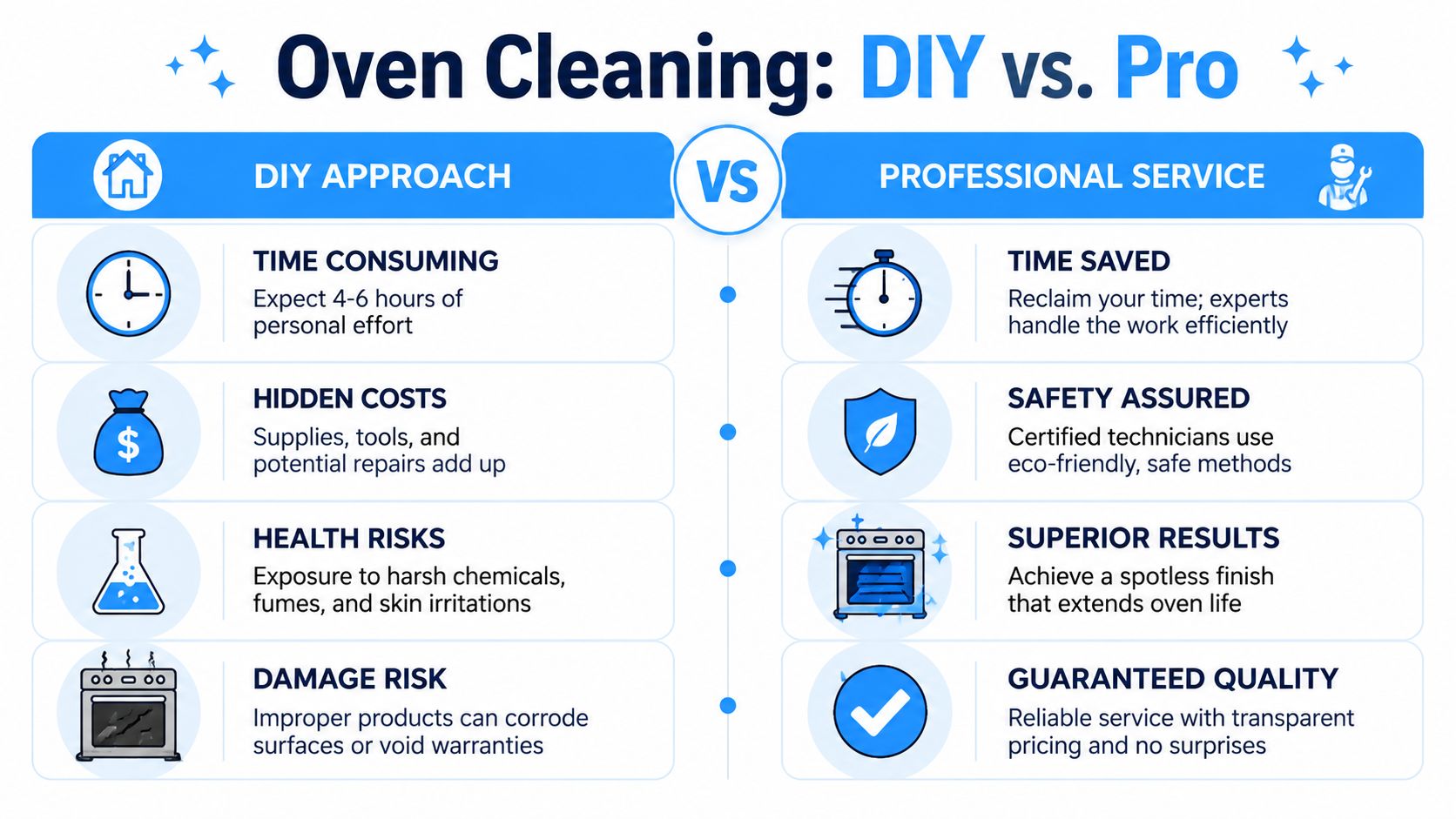
DIY oven cleaning looks cheaper at the start because the only obvious cost is the product on the shelf. The hidden cost is your own time, the mess, the chance of using the wrong chemical, and the risk of still ending up with an oven that fails inspection.
For some people, DIY is reasonable. If the oven has been maintained throughout the tenancy and only needs light degreasing, a careful clean may be enough. But when the glass is opaque, the racks are blackened and the cavity has hardened carbon, you're no longer doing light maintenance. You're doing restoration work under time pressure.
What usually goes wrong with DIY
The most common DIY problems aren't dramatic. They're small errors that leave obvious evidence behind.
- Wrong product for the finish: Some interiors, liners and enamel surfaces don't tolerate aggressive chemicals.
- Incomplete rinsing: The oven looks cleaner but leaves a caustic smell or streaky residue.
- Missed edges: Around hinges, seals, screws and the frame.
- Scratched surfaces: Especially on glass and coated interiors.
- Time blowout: What starts as a one-hour task turns into a long, unpleasant half-day.
Self-cleaning functions also have limits. As noted in guidance on oven cleaning services and household safety, many self-cleaning pyrolytic cycles can produce smoke and fumes in small apartments, while Fire Rescue Victoria public advice highlights grease build-up as a major kitchen fire risk. That makes the decision less about convenience and more about risk management in a live household.
DIY vs Professional Oven Cleaning
| Factor | DIY Approach | Professional Service |
|---|---|---|
| Time | Usually takes a significant part of your day, especially if residue is baked on | The technician handles the full process while you focus on moving tasks |
| Cleaning depth | Often good enough only for light maintenance | Better suited to carbon, grease film, racks, trays and detailed edges |
| Chemical handling | You choose, apply and rinse the product yourself | Product choice and application are handled by trained cleaners |
| Risk to surfaces | Higher if you use abrasive pads or unsuitable chemicals | Lower when the method is matched to the appliance finish |
| Inspection readiness | Easy to miss the exact points agents notice | More likely to produce an inspection-ready finish across visible components |
| Stress level | High when time is short and the result is uncertain | Lower because scope and outcome are clearer before inspection |
If your lease end date is close and the oven is heavily soiled, DIY often stops being a money-saving choice and becomes a bond-risk choice.
Health Safety and Eco-Friendly Cleaning
The safety issue with oven cleaning gets ignored until something goes wrong. Many off-the-shelf oven cleaners are harsh enough that you need gloves, ventilation and careful handling from the moment the can is opened. In a small apartment, that matters. In a home with children, pets, or anyone sensitive to fumes, it matters even more.
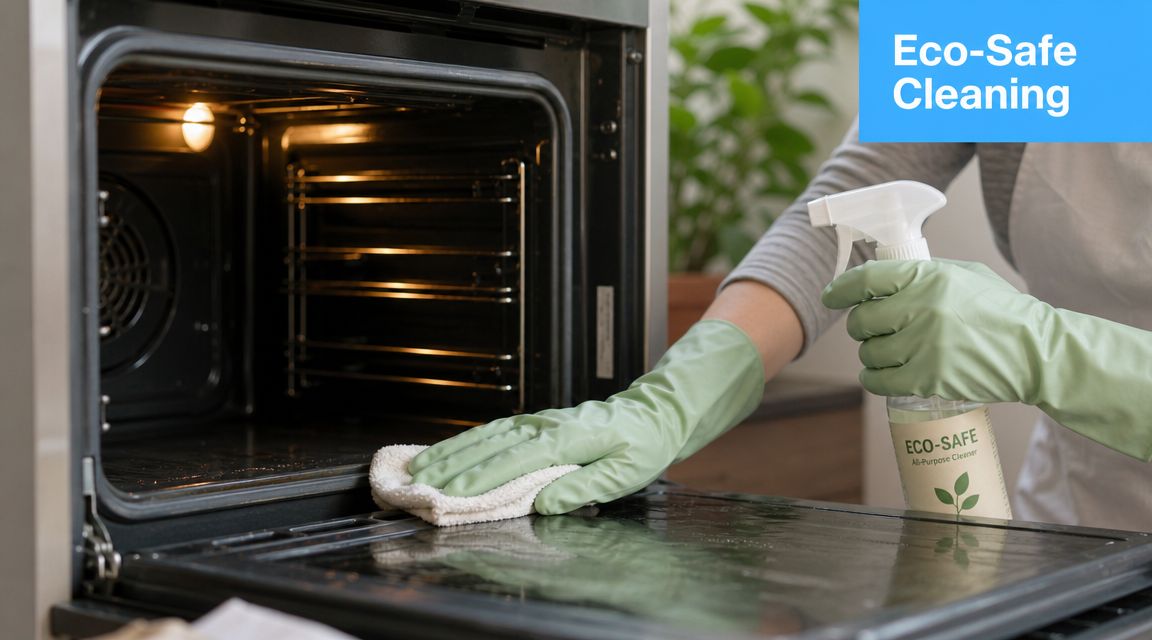
The chemical risk isn't theoretical. An Australian poison-centre study recorded 796 enquiries involving 780 patients exposed to oven cleaners, and 96% of the products involved contained sodium hydroxide and/or potassium hydroxide, both highly corrosive substances. The same study reported that 71% of exposed patients developed some features of toxicity. Exposure happened through ingestion, skin contact, inhalation, eye contact and multiple routes, which is why strong oven-cleaning chemicals deserve real caution, not casual use. Those findings are detailed in the Australian poison-centre study on oven cleaner exposure indexed in PubMed.
Why safer methods matter in occupied homes
Professional work is safer when the cleaner controls both product choice and residue removal. The key issue isn't just getting grease off. It's doing it without leaving caustic film behind on surfaces used around food preparation.
A careful oven cleaning service should prioritise:
- Low-fume or non-caustic formulations where suitable
- Manual scrubbing instead of over-reliance on aggressive chemistry
- Thorough wipe-down and rinse removal
- Attention to seals, corners and door edges where residue can sit
That approach is especially useful in apartments where ventilation is limited. It also suits households where self-clean cycles are impractical because smoke and smells carry through the whole property.
What eco-friendly cleaning should mean
“Eco-friendly” shouldn't mean weak. It should mean the cleaner has chosen methods that reduce unnecessary chemical exposure while still removing grease properly. In practice, that means more labour, more wiping, and more careful handling of parts.
Here's a visual example of the kind of practical process people often compare before deciding whether to DIY or book help:
A responsible cleaner also knows when not to use a product. That matters on delicate liners, around certain finishes, and on ovens with manufacturer restrictions that can be overlooked in a rushed end-of-lease clean.
Your Pre-Service Checklist for a Flawless Clean
If you've booked a professional oven cleaning service, a little prep makes the job smoother and gives you better evidence for the final inspection. This doesn't mean pre-cleaning the appliance. It means removing obstacles, flagging any issues, and documenting the condition properly.
The biggest missed step is photo evidence. In Victoria, bond questions usually turn on whether the property was left reasonably clean, not whether it looks brand new. Clear documentation helps if the oven becomes a discussion point later. A useful practical standard is set out in this guidance on documenting oven condition with before and after photos, which recommends keeping clear images of racks, door glass and the interior so they can be compared against the original condition report.
What to do before the cleaner arrives
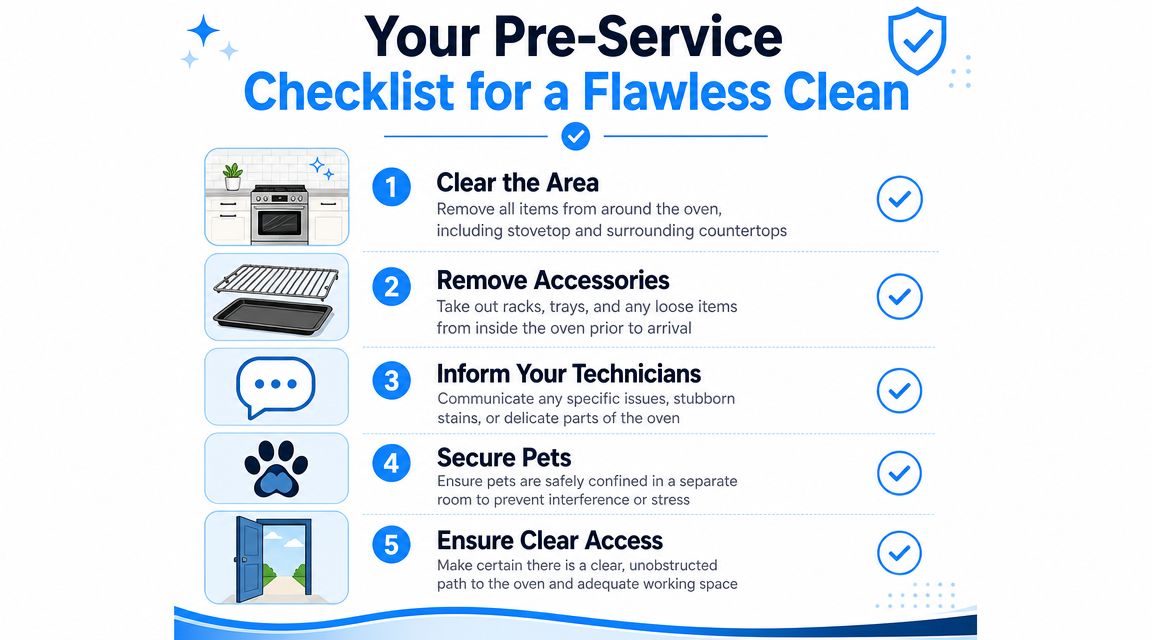
A simple pre-service routine works well:
Empty the oven fully
Remove trays, thermometers, foil, liners, baking paper and anything stored inside. Tenants often forget the grill pan or old foil at the base.Clear the surrounding work area
Move kettle cords, chopping boards, spice racks and anything sitting close to the appliance. Cleaners need room to open doors fully and place parts safely.Mention known problems early
If the inner glass is loose, the seal is damaged, a knob is cracked or the fan cover seems delicate, say so before work begins.Secure pets and reduce interruptions
The oven door may stay open during parts of the service, and removed components need a clear working zone.
The photos worth taking
Don't just snap one photo of the closed oven from across the kitchen. Take inspection-style images.
- Door glass: Front view and angled view for streaks or haze
- Racks and trays: Flat, well-lit images
- Interior cavity: Include base, side walls and back panel where visible
- Door frame and seals: Close enough to show grease residue or its removal
Keep your photos in the same folder as your outgoing condition report, cleaning invoice and any messages about the service scope. If there's a query later, you'll want everything in one place.
What to confirm after the job
Before the cleaner leaves, check the details that agents often notice first.
| Checkpoint | What you should see |
|---|---|
| Racks and trays | No greasy film, loose carbon or sticky residue |
| Door glass | Clear enough to see through properly, without heavy haze |
| Seals and frame | No obvious grease lines around the edge |
| Interior smell | Clean, not strongly caustic or chemically sharp |
Key Questions to Ask Your Oven Cleaning Provider
Not every oven cleaning service offers the same level of detail. Some businesses include racks, trays, door glass and surrounding edges in the base service. Others quote a low headline price and treat half the appliance as an add-on. The safest way to compare providers is to ask direct questions before booking.
Ask about scope, not just price
A cheap quote can still cost you if it excludes the exact parts your property manager will inspect.
Ask these questions plainly:
What's included in the oven clean?
Make them list the cavity, racks, trays, door glass, seals and removable parts.Do you clean between or inside glass panels where accessible?
Some doors allow deeper cleaning access. Some don't. You want clarity, not assumptions.Are range hood filters, splashback grease, or the stovetop included?
Cooking grime spreads. If those areas still look dirty, the oven may not appear fully reset.Will you tell me upfront if any staining is permanent?
Good operators know the difference between removable residue and wear that won't come off safely.
Ask about methods and product safety
This matters more than people think, especially in rentals where damage becomes your problem.
Questions worth asking include:
- Do you use non-caustic or low-fume products where possible?
- How do you avoid damaging enamel, seals and specialist liners?
- Do you match the method to the oven type and manufacturer restrictions?
- Will the oven be free of residue and ready to use after cleaning?
A trustworthy cleaner doesn't just promise a “deep clean”. They explain how they'll clean safely and what they won't do if a method risks damage.
Ask about evidence and end-of-lease suitability
If your goal is bond return, the service should support that goal in practical ways.
Look for answers to these:
- Can you provide an invoice that clearly states oven cleaning was completed?
- Will you take or allow after photos for my records?
- Do you regularly handle end-of-lease jobs in Melbourne?
- If something is outside scope, will you note that before starting?
One local option tenants often use is End Of Lease Cleaning Melbourne's complete Melbourne vacate cleaning guide, because it places oven cleaning within the broader handover standard agents expect rather than treating it as an isolated add-on.
Why Choose End Of Lease Cleaning Melbourne
By the time you're comparing providers, the decision usually comes down to three things. Will the cleaner handle the oven properly, will the scope be clear, and will the result help at final inspection rather than create another problem.
End-of-lease work is different from general domestic cleaning because the standard is evidence-based and detail-heavy. It's not enough to leave the place looking better than before. The property needs to present as reasonably clean across the areas agents check closely, and the oven sits high on that list.

For tenants who want a local provider with bond cleaning experience, End Of Lease Cleaning Melbourne offers oven cleaning as part of its broader vacate cleaning service, alongside other final-inspection items such as bathrooms, skirting boards, windows and finishing details. The business is family-owned, services Melbourne and greater Victoria, supplies its own equipment and eco-friendly products, and also accommodates regular house cleaning, deep cleaning and NDIS-supported service needs based on the company information published on its website.
What matters most in practice
The value isn't just that someone else does the scrubbing. The value is that the cleaner understands how ovens are judged at handover.
That means paying attention to:
- Glass clarity instead of just surface shine
- Racks and trays, not only the cavity
- Residue removal, not a perfumed mask
- Documentation that supports the outgoing condition
Melbourne tenants usually don't need perfection. They need a clean that stands up to inspection and a record that shows the job was done properly. That's the difference between “it looked fine to me” and “here are the photos and invoice”.
Booking with fewer surprises
A good booking process should be simple. Ask for a clear quote, confirm exactly what the oven clean includes, mention any appliance issues, and keep your before-and-after photos with your lease documents. If you're moving on a tight schedule, that kind of organisation matters as much as the cleaning itself.
The oven is rarely the only moving-out task causing stress. It's just one of the easiest places for that stress to turn into a bond question if it's handled badly.
If you need help with an oven cleaning service as part of your vacate clean, End Of Lease Cleaning Melbourne can be booked online or by phone for Melbourne properties. Ask for a clear scope, keep your inspection photos, and treat the oven as a bond-protection task rather than a last-minute chore.
