
You’re probably reading this with a deadline hanging over you.
Maybe the agent has booked the final inspection. Maybe the removalists have left, the place suddenly looks bigger, and every mark on the skirting boards now feels personal. Or maybe you’re not moving at all. You’re just tired of spending your weekends catching up on bathrooms, floors, and kitchen grime that never seems to stay gone.
That’s where residential cleaning services melbourne becomes less of a luxury and more of a practical decision. Melbourne homes vary wildly. Inner-city apartments, family houses in the suburbs, student rentals, disability-supported homes, and investment properties all need different standards, not just different effort.
Your Complete Guide to Melbourne Residential Cleaning
A lot of people assume cleaning is simple until they need the result to stand up to scrutiny. Regular upkeep is one thing. A vacate clean that has to satisfy an agent or landlord is something else entirely. The same goes for households that need a higher hygiene standard because of disability support, allergies, or health concerns.
Australia’s residential cleaning sector has grown because more households are outsourcing the work. According to IBISWorld’s overview of residential cleaning services in Australia, the industry reached 17,676 businesses in 2025, with projected revenue of $1.4 billion and 8.3% CAGR in business numbers from 2020 to 2025. In Melbourne, that growth reflects real life. Busy professionals want consistency. Families want help staying on top of the house. Tenants need detailed end-of-lease work done properly.
What matters isn’t just booking a cleaner. It’s booking the right type of clean for the job in front of you.
Practical rule: A general house clean keeps a home presentable. It won’t automatically prepare a rental for final inspection.
This guide is written from the practical side of the trade. Not the glossy version. The version where ovens take longer than expected, bathroom grout can make or break a result, and unclear quotes cause most of the frustration.
What people usually get wrong
Many Melbourne renters leave the clean too late. Homeowners often book a standard service when the house really needs a deep clean. Landlords sometimes expect bond-clean detail from a basic package. None of that ends well.
A good outcome starts with matching the service to the property, the condition, and the standard you need to meet. Once you understand that, the rest gets easier.
Who this guide will help
This is for:
- Tenants preparing to move out and wanting the best shot at a full bond return
- Landlords and property managers who need a reset before new occupants move in
- Homeowners and busy households looking for regular or one-off help
- NDIS participants, carers, and coordinators who need reliable, suitable in-home cleaning support
Decoding the Different Types of Cleaning Services
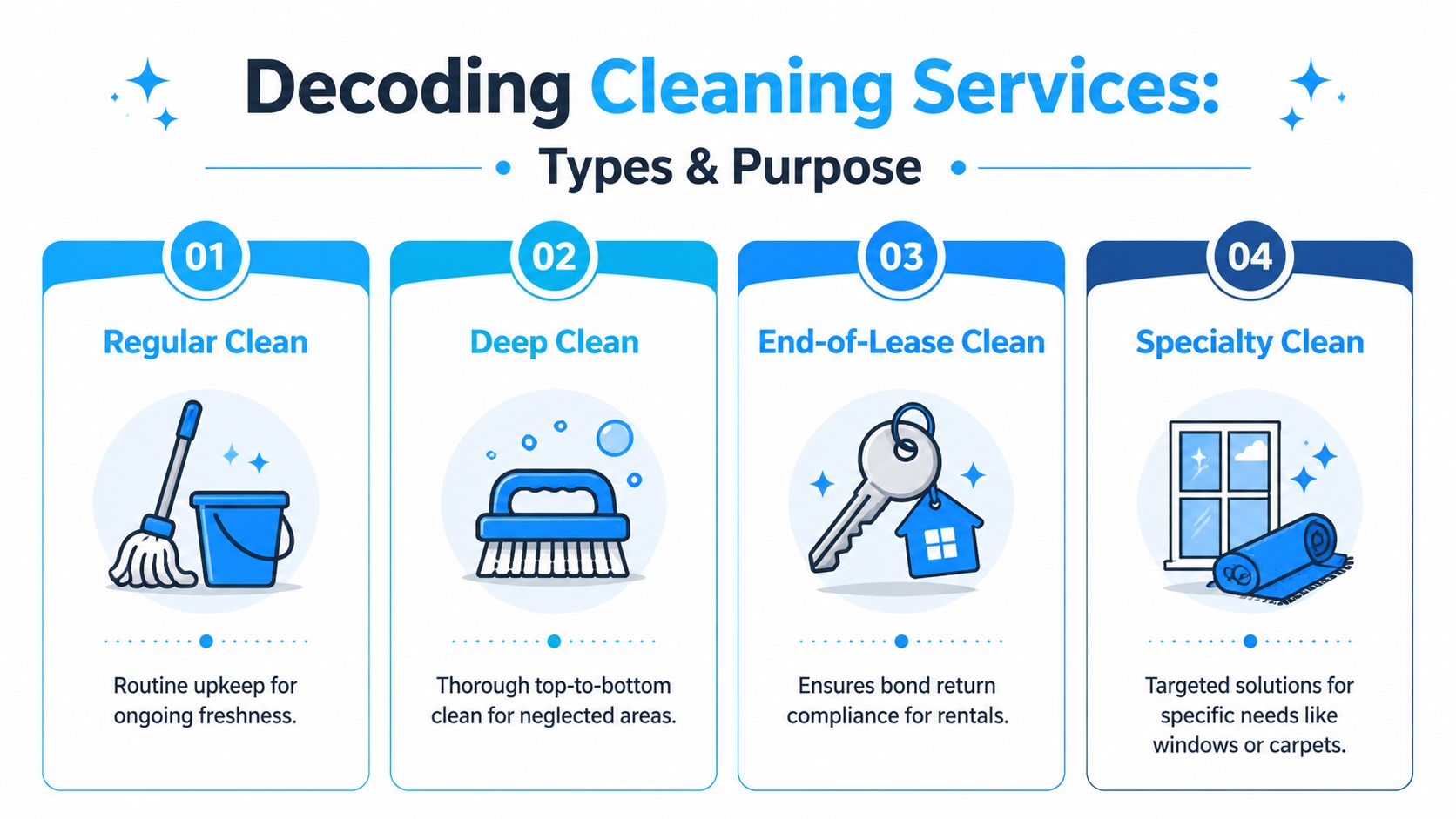
The term “house cleaning” gets used too broadly. In practice, there are big differences between a maintenance clean, a deep clean, an end-of-lease clean, and a service designed for disability support. If you book the wrong one, the cleaner may do exactly what was quoted and you may still be disappointed with the outcome.
Regular cleaning
This is the service most households use to stay on top of day-to-day mess. Think vacuuming, mopping, dusting, bathroom wipe-downs, kitchen surfaces, bins, and general tidying of cleaned areas. It suits homes that are already in fair condition and need routine upkeep.
Regular cleaning works best when the property isn’t carrying built-up grime. It maintains a standard. It doesn’t recover one.
Deep cleaning
A deep clean is for homes that need more attention than a weekly or fortnightly service can give. That usually means neglected bathrooms, greasy kitchens, skirting boards, interior glass, more detailed dust removal, and harder-to-reach spots.
This is often the right choice before hosting guests, after a busy period, or when a house hasn’t had professional attention for some time. If you’ve been saying, “It’s clean enough, but it still feels dirty,” you’re usually describing the need for a deep clean.
End-of-lease cleaning
This is the most misunderstood category. It’s not just a bigger regular clean. It’s a detail-heavy service tied to a real financial outcome. The aim is to present the property to inspection standard, with close attention to kitchens, bathrooms, floors, internal windows, fittings, cupboards, and marks left by everyday tenancy use.
If you’re moving out, a vacate clean should be judged against the agent’s checklist, not your own idea of “pretty clean”.
NDIS cleaning
NDIS home cleaning needs more care in both service delivery and hygiene expectations. It’s not enough to send a standard cleaner into a support setting and hope the result suits the participant’s needs.
For Melbourne participants, provider choice matters. This page on NDIS cleaning services in Melbourne is useful background if you’re comparing support options. The bigger point is that specialist knowledge makes a difference. Verified data shows over 15,000 Victorians use NDIS cleaning supports, 40% report access barriers due to unapproved providers, and 22% of standard deep cleans fail to meet NDIS hygiene standards without specialised training, as noted in this NDIS-related cleaning reference.
In disability-supported homes, flexibility matters. So does understanding what “clean” needs to mean for that person’s daily living.
Comparing Residential Cleaning Services in Melbourne
| Service Type | Best For | Typical Frequency | Key Focus Areas |
|---|---|---|---|
| Regular Clean | Busy households, working professionals, families | Weekly, fortnightly, monthly | Floors, bathrooms, kitchen surfaces, dusting, general upkeep |
| Deep Clean | Homes with build-up, seasonal resets, pre-event preparation | One-off or occasional | Detailed bathrooms, kitchen grime, skirting boards, neglected areas |
| End of Lease | Tenants, landlords, property managers | One-off at move-out or pre-tenancy | Inspection standard detail, cupboards, appliances, windows, bathrooms |
| NDIS | Participants, carers, support coordinators | Ongoing or as needed | Hygiene-sensitive cleaning, tailored routines, accessible scheduling |
The End-of-Lease Clean Your Guide to Bond Security
If you’re leaving a rental in Melbourne, this is the clean that carries the most risk if it’s handled casually. A tenant can do many things right during a tenancy and still lose part of the bond because the final clean didn’t meet the standard expected by the landlord or agent.

Victoria’s legal language doesn’t help much. The Residential Tenancies Act 1997 (Vic) requires “reasonable cleanliness”, but that phrase leaves room for argument. According to this Victorian bond-cleaning reference, cleaning issues account for over 25% of rental bond disputes in 2024-25. That tells you two things. First, this is common. Second, “good enough” often isn’t agreed on by both sides.
Why standard cleaning often fails at move-out
A standard service focuses on presentation. A bond clean focuses on inspection points.
That means the cleaner must think like a property manager walking through with a checklist. They’ll notice grease inside the rangehood filters, soap residue in shower tracks, hair in exhaust covers, grime on light switches, dust on skirting boards, and fingerprints inside cupboards. Tenants often clean what they see at eye level. Inspections usually fail on edges, internals, and overlooked fixtures.
What usually costs tenants money: not the obvious mess, but the small neglected areas that signal the property wasn’t cleaned thoroughly.
What a VCAT-minded clean looks like
VCAT matters because disputes can end up there, and the standard needs to be defendable. That doesn’t mean every property needs a theatrical deep restoration. It means the clean should be methodical, documented, and aligned with the condition expected at handover.
A practical end-of-lease approach should include:
- Kitchen internals: inside cupboards, drawers, splashbacks, benchtops, sink, stovetop, rangehood exterior, and appliance surfaces
- Oven attention: racks, glass, trays, interior panels, and baked-on grease
- Bathrooms: screen, tiles, taps, basin, vanity, toilet, mirror, grout condition, and soap build-up
- Bedrooms and living areas: wardrobes, ledges, switches, skirting boards, floors, and cobweb removal
- Windows and tracks: internal glass, frames where included, and visibly dirty tracks
- Laundry and utility spaces: trough, taps, cabinet fronts, and floor edges
Reasonable cleanliness is not vague in practice
In law, it may sound broad. On inspection day, it becomes very specific.
If the oven still smells of burnt grease, if shower glass is cloudy, if lint is packed around the laundry area, or if cupboard crumbs are left behind, the conversation won’t be about effort. It will be about whether the property was returned in a reasonably clean state.
A good cleaner should ask for the agent checklist before work starts. If they don’t, that’s a concern. The checklist is often where expectations become concrete.
This walkthrough gives a useful visual sense of how detailed vacate work needs to be:
How tenants protect themselves
Don’t rely on verbal assumptions. Get the scope in writing. Confirm whether the quote includes inside the oven, inside cupboards, internal windows, wall spot cleaning, and any reclean policy if the agent raises issues tied to the agreed scope.
For landlords and property managers, the same principle applies. If you want handover-ready detail, ask for a checklist-driven vacate clean, not a generic house clean. Clear scope prevents arguments later.
What to Expect A Breakdown of Inclusions and Exclusions
Most problems between cleaners and clients come from assumptions. One side thinks a task is standard. The other treats it as an add-on. The fix is simple. Ask what’s included before the booking is locked in.
Standard inclusions
A typical residential service usually covers the visible, routine areas that keep a home feeling fresh and orderly. In most homes that means:
- Floors: vacuuming carpets and rugs, then mopping hard floors
- Bathrooms: toilet, shower, bath, vanity, taps, mirrors, and surface wipe-downs
- Kitchen surfaces: benchtops, sink, stovetop exterior, splashback, and cabinet fronts
- Dusting: reachable furniture surfaces, shelves, ledges, and skirting boards if included in the package
- General finishing: bin emptying, light straightening, and touch-point wiping
For a regular clean, that’s usually enough. For a deeper result, clients often need to ask for internals and detail tasks specifically.
Common exclusions
Many customers are surprised by what doesn’t automatically come with a quote. Exclusions vary by provider, but these are the usual ones:
- Inside appliances: ovens, fridges, dishwashers, and microwaves may be extra
- Exterior access work: outside windows, high glass, balconies with heavy debris, or pressure washing
- Wall washing: spot marks may be addressed, but full wall washing is often separate
- Heavy clutter or hoarding conditions: cleaners need access to surfaces to clean them properly
- Mould, biohazards, or damage-related issues: these can need specialist treatment rather than standard cleaning
If a quote seems unusually cheap, it often excludes the labour-heavy items people care about most.
Ask one direct question before booking: “What tasks do people usually assume are included, but aren’t?”
Popular add-ons that change the result
Add-ons are where a decent clean often becomes a more thorough one. Oven cleaning is a common example. Carpet work is another, especially in rentals, and it’s worth understanding when steam cleaning for carpet is expected or helpful.
For homes needing a higher hygiene standard, some providers use electrostatic disinfection as part of a deeper service. According to this pricing and service reference, professional deep cleans can use electrostatic disinfection to deliver 99.9% microbial reduction, compared with 85-90% from manual wiping. That matters most in settings where hygiene verification is important, including some NDIS-supported homes.
What works and what doesn’t
What works is a written scope matched to the property condition. What doesn’t work is booking a basic package for a home with months of build-up and expecting bond-clean detail for the same price.
Professional cleaning is straightforward when expectations are clear. It gets messy when nobody defines the edges of the job.
How to Choose a Reputable Melbourne Cleaning Provider
A good cleaning company isn’t just the one with the lowest quote. It’s the one that turns up on time, works to scope, communicates clearly, and deals with problems without becoming hard to reach. In this trade, reliability is a quality marker, not a bonus.
Read reviews like a local, not like a shopper
Five-star reviews alone don’t tell you much. Look for patterns in the wording. You want repeated mentions of punctuality, consistency, detail, and how the business handled follow-up issues.
If there are negative reviews, read the response. A reputable provider usually answers calmly and specifically. Defensive or vague replies can tell you more than the original complaint.
Check the non-negotiables
Some basics shouldn’t be optional when someone is entering your home or preparing a rental handover.
- Insurance: Ask whether the company carries public liability cover.
- Vetted staff: Police checks and staff screening matter, especially for ongoing residential work.
- Clear quoting: You should know what is included, excluded, and charged extra.
- Equipment supply: Confirm whether they bring their own products, vacuums, cloths, and mops.
- Reclean policy: For end-of-lease work, ask what happens if an agreed item is missed.
Ask questions that reveal how they operate
You don’t need a long interview. A few pointed questions will do the job.
Try these:
- “How do you quote a vacate clean?” Good providers ask about property size, condition, and extras.
- “Do you work from an agent checklist?” Strong operators usually welcome one.
- “Who do I contact if something needs attention after the clean?” You want a direct process, not silence.
- “Are your bookings time-based or task-based?” This affects expectations immediately.
A professional cleaner doesn’t just sell a result. They explain the limits, the likely problem areas, and what they’ll need from you to do the job properly.
Watch for these warning signs
Be careful if a provider avoids written confirmations, gives a quote without asking basic property questions, or promises everything without discussing exclusions. In Melbourne, where property styles and tenancy expectations vary, overpromising usually creates the biggest disputes.
The best companies are rarely the ones making the grandest claims. They’re the ones who are organised, realistic, and easy to deal with from the first enquiry onward.
Preparing Your Home for a Professional Clean
A cleaner can only work efficiently if the property is ready to be cleaned. Preparation doesn’t mean doing the cleaner’s job. It means removing the things that slow them down or block access to the areas you want done well.

A short pre-arrival checklist
Before the team arrives, it helps to do a few simple things:
- Declutter benches and floors: cleaning around piles takes longer and lowers the finish
- Put away personal items: toiletries, paperwork, chargers, and loose clothing create delays
- Secure pets: even friendly pets can make access harder and increase stress for everyone
- Check power and water access: cleaners need both to work through the home properly
- Flag fragile or high-priority areas: if there’s delicate décor or a room that matters most, say so early
For move-outs, remove everything that belongs to you before the clean begins. A proper vacate clean is easier when cupboards, drawers, and floors are empty. If you need a practical reference before booking, this end-of-lease cleaning checklist is a useful starting point.
Small prep, better result
The best cleans happen when the client and cleaner are working from the same picture. If something worries you, mention it. Burnt oven trays, hard-water build-up, pet hair, shower mould, and wall scuffs should never be a surprise discovered halfway through the job.
A few minutes of preparation can make the booked time work much harder for you.
Frequently Asked Questions About Cleaning Services
How is pricing usually worked out
Most companies use either an hourly structure or a flat quote based on the property and the scope. Regular cleaning is often time-based. End-of-lease and deep cleaning are more commonly quoted by the job because the detail matters more than the clock.
Do cleaners bring their own products and equipment
Many professional cleaners do, but you should always confirm it before booking. If you want eco-friendly products or need certain chemicals avoided, mention that at the start.
How far in advance should I book
For routine cleaning, a few days’ notice is often enough. For move-out dates, school holidays, weekends, and month-end bookings, earlier is better because those times fill quickly.
Can I book a one-off clean instead of regular service
Yes. One-off cleaning is common for vacates, inspections, seasonal resets, post-party clean-ups, and preparing a home for sale or guests.
Will a cleaner guarantee my bond return
No honest cleaner can guarantee what a landlord, property manager, or agent will decide in every situation. What a reputable company can do is clean to an agreed scope, work from the agent checklist where available, and offer a reclean policy for issues that fall within that scope.
Do I need to be home during the clean
Not always. Many clients provide access and return later. The main thing is arranging clear entry instructions and making sure the cleaner can secure the property when they leave.
Do cleaning companies service all of Melbourne
Many service inner suburbs, middle-ring suburbs, and broad metro areas, but coverage varies. Ask whether your postcode is included before confirming a booking, especially if you’re on the edge of greater Melbourne or in a regional-facing corridor.
If you need a reliable team for vacate cleaning, regular house cleaning, deep cleaning, or NDIS-supported services, End Of Lease Cleaning Melbourne offers practical, detail-focused help across Melbourne and greater Victoria. As a family-run company with over 20 years of experience, they understand what tenants, homeowners, landlords, and support coordinators need: clear quotes, punctual service, and a clean that holds up where it counts.
