
You ask for a deep clean on a Melbourne three-bedroom home, get a price that sounds reasonable, and then the quote changes once the cleaner hears “oven, shower glass, window tracks, skirting boards, and property-manager standard.” That happens all the time.
In Melbourne, a general deep clean and an end-of-lease clean are close enough in wording to confuse people, but they are not the same job and they are rarely priced the same. A deep clean usually means bringing a lived-in home back to a high standard. A bond clean is more rigid. It is built around handover expectations, inspection points, and the areas agents and landlords are likely to check closely.
That distinction matters more here than national averages suggest. Australian pricing guides can give you a rough reference point, but Melbourne quotes often come in higher once parking, apartment access, older bathrooms, hard-water scale, grease buildup, or neglected grout enter the picture. If the home has problem tile joints, this guide on how to clean floor tile grout properly shows why that part alone can add time.
The practical mistake is budgeting for a “deep clean” when the property really needs bond-clean detail. That is where cost blowouts start. A cleaner may have allowed for a detailed house clean, while you expected inside appliances, rangehood filters, marks on walls, tracks, and the finish level needed for a rental handover.
How Much Should You Budget for a Deep Clean
You walk through the property thinking it needs a solid clean, then start listing what you want done. Oven. Shower glass. Skirting boards. Window tracks. Inside cupboards. At that point, the budget usually shifts, because the job has shifted.
For a Melbourne home, the safest approach is to budget for labour, not for a headline price. A true deep clean often starts in the low to mid-hundreds for a smaller, reasonably maintained property, then climbs once the work includes built-up grease, hard-water scale, inside appliances, or areas that need hand-detailing rather than a fast pass. Older bathrooms, tighter apartment access, and homes that have gone too long between proper cleans also push the price up.
The main cost difference comes from time on detail work.
What you're really paying for
A proper deep clean means slower, more technical cleaning in the areas that hold grime longest and take the most effort to restore.
- Kitchen detail work often covers oven scrubbing, splashback degreasing, rangehood filters, cupboard fronts, and grime around handles and kickboards.
- Bathroom work usually includes soap scum removal, taps, drains, shower-screen descaling, and extra attention on grout lines and corners.
- Edges and neglected surfaces can include skirting boards, switches, tracks, door frames, and dust buildup behind or under accessible furniture.
- Floor recovery may involve extra vacuuming and mopping passes, hand-cleaning along edges, or separate treatment for grout or carpets.
In my experience, customers get caught out when they budget for a general deep clean but expect the finish level of a bond clean. Those are different scopes. If you need a home to feel clean and sanitary, the quote can stay tighter. If you need it ready for an agent, landlord, or final inspection, the scope needs to be spelled out line by line.
One way to control cost is to separate standard deep-clean tasks from restoration-style work. Grout is a good example. Heavily stained grout can add a surprising amount of labour, and a quick once-over rarely fixes it. This guide on how to clean floor tile grout properly shows why that part of the job often needs extra time and a different approach.
A fair budget leaves room for the actual condition of the property, not the condition you hoped it was in.
What Is the Average Deep Cleaning Cost in Australia
A client in Melbourne might read a national price guide in the morning, book a “deep clean” that afternoon, and then feel blindsided when the local quote comes in higher. The gap is usually not padding. It comes down to scope, labour time, and Melbourne job conditions that broad national guides do not capture well.
Industry pricing roundups published by cleaning marketplaces such as Oneflare's house cleaning cost guide show that Australian cleaning prices are often presented as hourly rates, per-room ranges, or service tiers rather than one universal figure. That matters because a “deep clean” in one quote may mean extra detail in kitchens and bathrooms, while another may include inside cupboards, interior windows, heavy soap scum removal, or appliance internals.
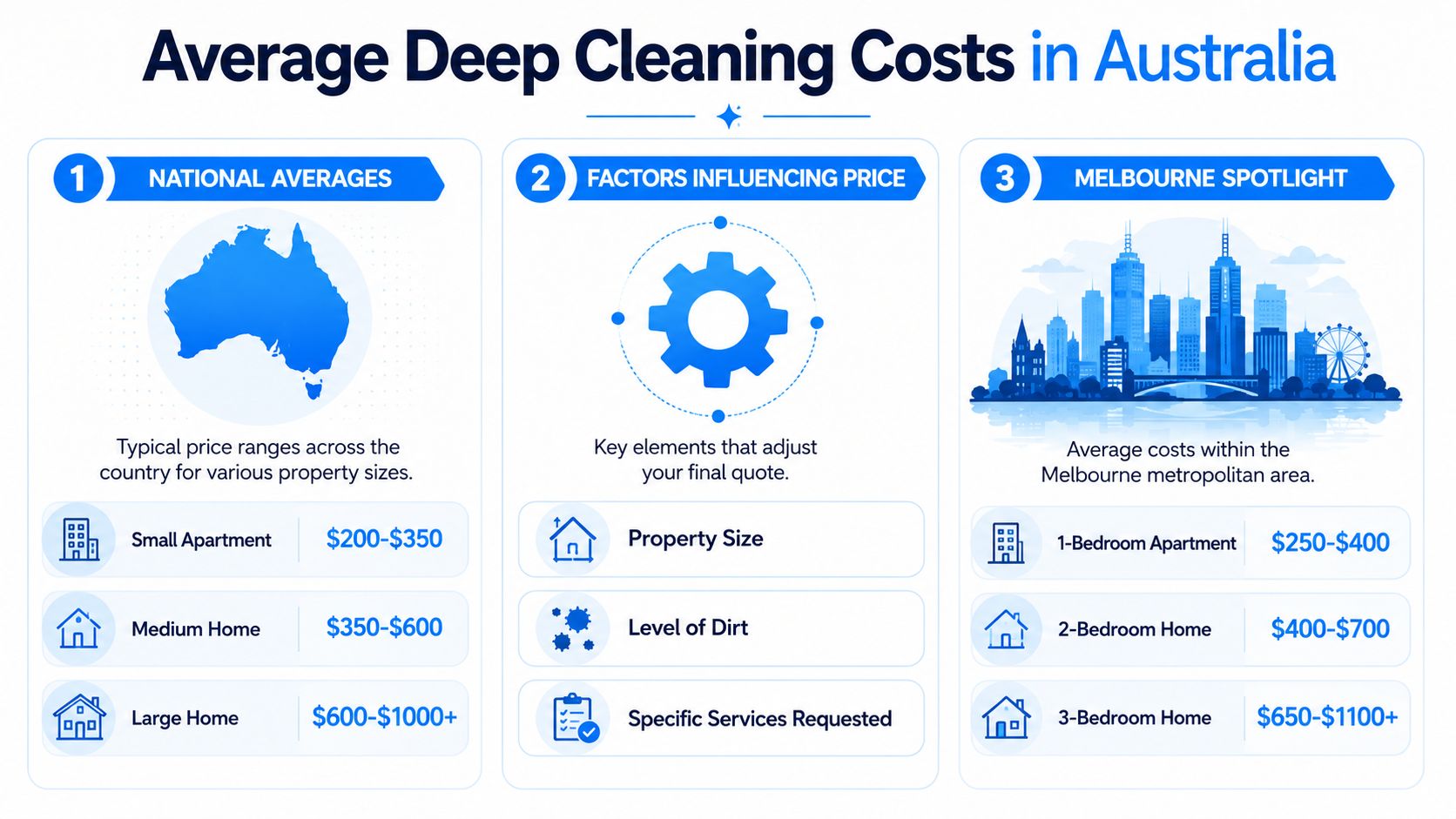
In practice, national averages are best used to set a rough budget band, not to predict the final invoice.
How national averages are usually presented
Across Australia, cleaning companies and marketplaces commonly frame pricing in three ways:
| Pricing view | What it helps with | Where it falls short |
|---|---|---|
| Hourly rate | Useful for estimating smaller or uncertain jobs | Tells you very little about total cost if the property condition is poor |
| By property size | Helps compare homes with similar layouts | Misses access issues, bathrooms in bad condition, and detailed extras |
| By service type | Better for separating standard, deep, and vacate cleans | Definitions vary between companies, so two “deep cleans” may not match |
That last point causes a lot of confusion. A national average may be based on a broad service label, but local operators quote on the actual work required.
What a general deep clean usually includes
A general deep clean usually means more detail in the same rooms you already use every day. It does not automatically mean every bond item, every appliance interior, every window, or every wall mark.
A typical deep clean commonly covers:
| Area | Usual deep clean focus |
|---|---|
| Kitchen | Benches, sinks, cabinet exteriors, stovetop, splashback, visible grease |
| Bathrooms | Toilets, showers, basins, mirrors, fittings, floor cleaning |
| Living areas | Dusting, vacuuming, mopping, wiping reachable surfaces |
| Bedrooms | Wardrobes externally, dusting, floors, skirting detail where included |
A bond clean sits in a different category. It usually carries stricter expectations, a longer checklist, and less tolerance for missed detail because the result is being judged by an agent, property manager, or landlord. That is why customers in Melbourne often think they are comparing like for like when they are not.
A quick visual can help if you're comparing general ranges before requesting a quote.
Why Melbourne often sits above broad national guides
Melbourne jobs regularly involve factors that national averages flatten out. Apartment access can add time. CBD parking can add cost. Key pickup, lift bookings, limited loading zones, and tighter scheduling windows all affect labour.
Condition matters just as much. A well-kept family home in the eastern suburbs may fit neatly into a standard deep-clean allowance. A neglected rental in the inner north with baked-on grease, hard-water staining, pet hair, and bathroom buildup is a different job entirely, even if the floorplan is similar.
That is why I tell customers to use Australian averages as a starting point only. For Melbourne, the safer question is not “what is the average?” It is “what standard am I paying for, and what is included at that price?”
Understanding Deep Cleaning Pricing Models
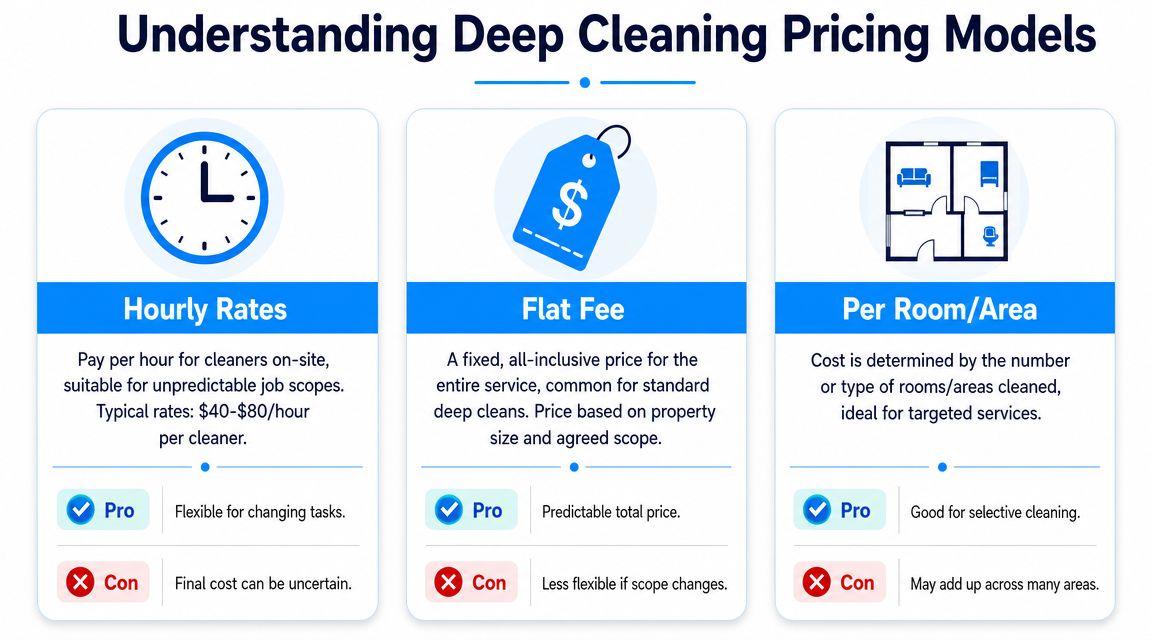
A Melbourne customer might ring three cleaners for the same two-bedroom apartment and get three very different prices. That usually comes down to the pricing model, not just the hourly rate or the company name.
Some businesses quote by the hour. Some price the full job after reviewing the scope. Others use room counts, then add charges for labour-heavy tasks. Industry guides such as Oneflare's house cleaning price guide also separate regular cleaning from deeper, more detailed work, which reflects how cleaners cost these jobs in practice.
Hourly pricing
Hourly pricing charges for time on site, usually per cleaner or per team. It suits homes where the condition is uncertain, access is awkward, or the client wants the cleaners to work through a priority list instead of following a fixed scope.
What works well:
It gives flexibility. If the bathroom needs extra attention but the spare room can be left light, the team can adjust on the day.
What to watch:
The final bill can move. In Melbourne, delays from lift access, poor parking, heavy buildup, or waiting for keys all add time, and time is the product being sold.
Flat-rate pricing
Flat-rate pricing gives one total price for an agreed list of tasks. This is usually the easier model for customers who want budget certainty before booking.
It works best when the quote is based on clear information, ideally photos or an inspection. Without that, a flat fee can look sharp on paper and still exclude the work people often assume is included, such as inside cupboards, interior windows, wall spot cleaning, balcony detailing, or appliance interiors.
Owner's view: A proper flat quote should read like a scope of works. If it is only one line with a price, ask more questions.
Room or area-based pricing
This model uses bedroom count, bathroom count, square metre ranges, or a mix of those. It is fast to quote and often suits newer homes in tidy condition.
Its weakness is obvious once the job starts. A two-bathroom apartment with light dust is not priced accurately the same way as a two-bathroom rental with soap scum, scale, hair buildup, and mould staining. Room count tells you the layout. It does not tell you the labour.
| Model | Good for | Watch out for |
|---|---|---|
| Hourly | Uncertain condition, flexible priorities | Final bill can rise with extra time |
| Flat fee | Clear scope, budget certainty | Missing inclusions if the scope is vague |
| Room or area based | Simple layouts, fast quoting | Can miss the real workload |
In Melbourne, the most accurate deep-clean quotes usually blend these methods. A cleaner may start with property size, then adjust for the actual tasks that slow the job down, such as ovens, shower descaling, window tracks, greasy splashbacks, balconies, or carpet steam cleaning requirements for rentals and deeper resets.
This is also where customers get caught out between a general deep clean and a bond clean. A general deep clean may use one of the models above with some flexibility. A bond clean is usually scoped more tightly, checked against a longer list, and priced with less room for assumptions. If you compare those two quotes side by side without checking the inclusions, the cheaper number can be misleading.
Key Factors That Influence Your Final Quote
Two homes can have the same number of bedrooms and end up with very different prices. That's normal. Deep-clean pricing in Australia is usually driven by labour intensity, because moving from maintenance cleaning to deep cleaning adds work on surfaces like skirting boards, grout, and oven interiors, which increases labour minutes per room. That's why price can rise faster than floor area alone would suggest when one home has heavy grease or scale and the other doesn't.

A useful way to think about it is a car service. Two cars can be the same model and age, but the neglected one costs more to bring back into shape because the mechanic has to undo months or years of missed care. Cleaning works the same way.
The five cost drivers that matter most
Property size
More rooms usually means more surfaces, more floors, and more bathrooms. That part is obvious. What clients often miss is that size creates cost mainly when it adds detail, not just square metres.Starting condition
Light dust is quick. Grease film, hard-water buildup, soap scum, and sticky residue are slow. If your shower screen is cloudy, your rangehood is greasy, or your skirting boards haven't been touched in months, the quote will reflect that.Requested extras
Inside oven, inside windows, balcony wash-downs, wall spot cleaning, blind dusting, and carpet treatment all change the scope. A quote that sounds cheaper may exclude them.Access and logistics
Apartment lifts, loading restrictions, no nearby parking, limited water access, or strict building booking times all affect how efficiently a team can work.Urgency
Same-day and tightly scheduled vacate cleans often cost more than flexible bookings because the business has less room to route staff efficiently.
What helps reduce the bill
You usually can't change the actual condition overnight, but you can reduce wasted time.
- Declutter first so the cleaners can reach surfaces without spending half the booking moving items.
- Be honest about the problem areas such as mould staining, oven grease, pet hair, or hard-water marks.
- List priorities in order if your budget won't cover everything.
- Bundle specialist items sensibly. For example, if carpets are part of the issue, separate carpet treatment from general cleaning so each quote is easier to compare.
If carpet condition is affecting the overall result, it's worth understanding when extraction or steam treatment is needed. This overview of steam cleaning for carpet is helpful when you're deciding whether that should sit inside the same booking or be quoted separately.
Deep Clean vs Bond Clean What Is the Difference in Cost
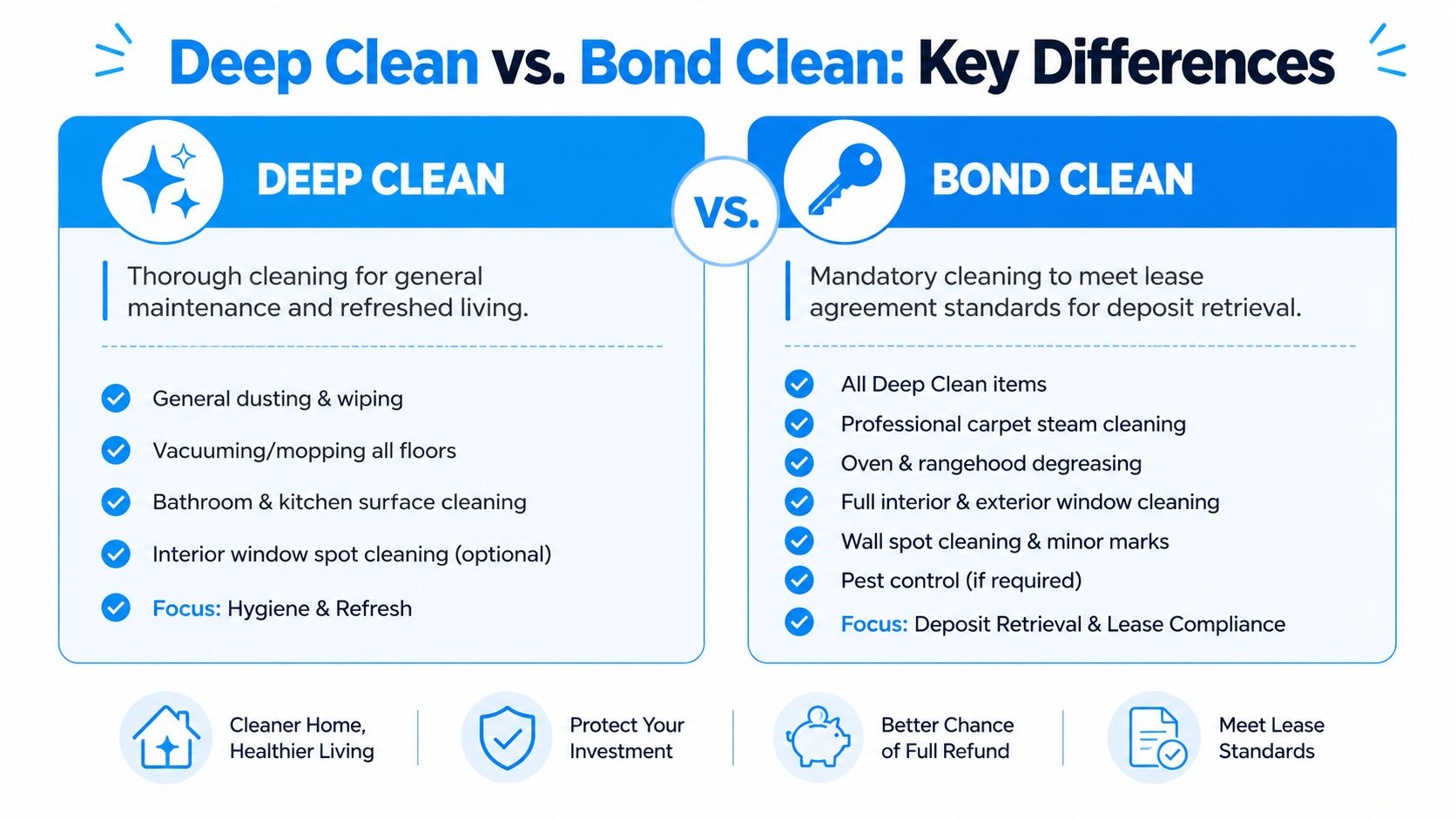
Differing cleaning expectations often lead to budget surprises. A deep clean is usually about hygiene, presentation, and resetting the home. A bond clean is about meeting the lease standard and satisfying an inspection checklist.
Those are not the same objective. One is personal. The other is contractual.
Why a bond clean usually costs more
A bond clean is stricter because the cleaner isn't just trying to make the property feel fresh. They're trying to remove defects a property manager or landlord will note during handover.
That often means work such as:
- Inside appliance cleaning including oven interiors and rangehood degreasing
- Detailed wet-area work like descaling shower glass, taps, grout lines, and screens
- Tracks, ledges, and joinery where dust and grime collect and are easy to spot in inspections
- Wall marks and touch-point detail around switches, doors, frames, and handles
- Window-related tasks that may go beyond spot cleaning, depending on access and scope
- Carpet or pest-related requirements where the tenancy agreement calls for them
If your agent expects an end-of-lease standard, booking a general deep clean to save money often costs more later when you need rectification.
A simple comparison
| Service | Main purpose | Cost behaviour |
|---|---|---|
| Deep clean | Restore cleanliness and comfort | Depends on condition and selected detail work |
| Bond clean | Meet vacate standards and reduce bond issues | Usually broader in scope and more exacting |
For Melbourne renters, the safer move is to ask for the quote in bond-clean language if the property is being handed back. Don't ask, “How much for a deep clean?” Ask, “What's included for end-of-lease cleaning, and what's excluded?”
If you want a detailed breakdown of vacate expectations, this guide to end of lease cleaning in Melbourne covers the practical checklist more closely.
How to Get an Accurate Quote and Avoid Hidden Fees
A Melbourne renter gets a quote for a “deep clean,” books the cheapest option, then finds out on the day that the oven, balcony, wall marks, and carpet steam cleaning were never included. That is how a modest quote turns into a bigger bill.
The cleanest way to avoid that problem is to ask for the quote by task, not by label. “Deep clean” means different things to different companies. In Melbourne, that gap gets expensive fast, especially in apartments with parking limits, lift access, and agent handover deadlines.
Ask for the quote in checklist form
Give the cleaner enough detail to price the job properly the first time. A short message with the address and bedroom count is rarely enough.
Include:
- Property type such as apartment, townhouse, terrace, or freestanding house
- Room count including bathrooms, separate toilet, laundry, study, and balcony
- Current condition such as grease in the oven, soap scum on shower glass, pet hair, or heavy dust
- Specific tasks you want priced such as inside windows, inside cupboards, wall spot cleaning, or carpet steam cleaning
- Access details such as stairs, lift booking, no on-site parking, or key collection from an agent
That last point matters in Melbourne more than many clients expect. A cleaner circling Carlton or Southbank for parking, or waiting on a building manager for lift access, is still losing working time. Some companies build that into the quote. Others add it later.
Compare the scope, not just the total
The total price matters, but the inclusion list matters more.
Ask these questions before you book:
- Does the price include the oven, cooktop, and rangehood interior?
- Are windows included, and is that glass only or also tracks and sills?
- Are skirting boards, door frames, switches, and built-in wardrobes included?
- Are balconies, blinds, walls, and carpets priced separately?
- What counts as an extra on the day?
A low quote is often missing the slowest jobs. That is usually where hidden fees come from. It is not always dishonest. Sometimes the company is pricing a lighter clean than the client expects.
Ask what can change the price after inspection
Good operators will tell you upfront what may increase the bill. Heavy mould, thick calcium buildup, grease that has baked on for years, or a property that is far dirtier than described can all change labour time.
I tell clients to look for plain wording here. If a quote says “subject to condition” but never explains what that means, ask for examples in writing.
What a solid quote should show
| Quote element | What you want to see |
|---|---|
| Rooms covered | Each room or area listed clearly |
| Tasks included | Exact detail work, not just “deep clean” |
| Exclusions | Walls, carpets, exterior windows, mould treatment, pest control, or rubbish removal if not included |
| Access assumptions | Parking, stairs, lift access, furnished or vacant, key pickup |
| Price change triggers | Heavy buildup, extra rooms, added services, or incorrect property condition |
For Melbourne homes, this matters even more if the property is being vacated. A general deep clean quote can look cheaper than an end-of-lease quote because it leaves out inspection-sensitive items. If the place is going back to an agent or landlord, ask the cleaner to quote to that standard in writing so you are not comparing two different services under similar names.
Frequently Asked Questions About Deep Cleaning
How long does a deep clean usually take
A Melbourne client will often ask this after booking around a two-hour window, then realise the job is much larger once the cleaner starts pulling grease from the rangehood, soap scum from shower glass, and dust from skirting boards. Deep cleaning takes as long as the property condition demands.
A small, well-kept apartment can be finished in one visit without much trouble. A larger family home, or any place with neglected bathrooms, built-up kitchen grease, pets, or a lot of furniture to clean around, can take most of the day. Vacant homes are usually faster. Furnished homes with clutter, fragile items, and limited access are slower.
If you are booking around an agent inspection or handover, ask for a time range, not a fixed promise.
Is deep cleaning worth the cost
It is worth paying for when regular cleaning has fallen behind, or when you need detail work that a maintenance clean does not cover. The value is not in the label. It is in the labour.
A proper deep clean deals with the jobs clients notice straight away but often underestimate before getting a quote. Oven interiors, shower screens, grout lines, skirting boards, window tracks, splashbacks, and greasy kitchen surfaces all take time. If those areas are the reason the home still feels dirty after a standard clean, then a deep clean usually solves the right problem.
The exception is vacating. If the property is being handed back to a landlord or agent, a general deep clean may still leave out items expected in a bond clean. That is where budget surprises happen in Melbourne. The cheaper quote can end up being the wrong service.
Do I need to be home during the clean
No, as long as access is organised properly and the scope is confirmed before the team starts.
For owner-occupied homes, some clients stay for the first few minutes, walk us through the problem areas, then head out. For vacate cleans, keys are often left with the agent, in a lockbox, or collected by arrangement. What matters is clear entry, working power and water, and a way to contact you if the cleaner finds something that changes the job, such as mould, damage, or rooms that were not included.
If you cannot be there, photos and a written checklist help avoid misunderstandings.
Do cleaners bring their own products and equipment
Professional cleaners usually bring the standard products and tools needed for the agreed job. You should still ask what is included.
This matters more in Melbourne homes with delicate finishes. Natural stone, oiled timber, black tapware, older enamel, and specialty glass all need the right product choice. The same applies if you want low-odour products, have pets with sensitivities, or live in an apartment building with lift and parking restrictions that affect what equipment can be brought in.
For carpet steam cleaning, high windows, exterior pressure washing, or mould treatment, do not assume those are included under “deep clean.” Ask directly.
If you need a quote that matches the actual scope of your property, End Of Lease Cleaning Melbourne can help you price it properly before booking. For Melbourne tenants, landlords, and homeowners, the safest approach is simple: describe the condition accurately, ask for an itemised scope, and make sure the service matches whether you need a deep clean or a true end-of-lease clean.
