
You're probably reading this with half your house in boxes, a lease end date coming up fast, and a property manager's final inspection sitting in the back of your mind. That's when the end of lease clean starts to feel bigger than it is. It's not just wiping benches. It's the last job standing between you and your bond.
After more than 20 years working across greater Victoria, the pattern is always the same. Tenants who leave the clean until the final day rush the obvious areas, miss the inspection points, and end up stressed, exhausted, and arguing over small defects that could have been avoided. Tenants who treat it like a timed project usually do far better.
A good end of lease clean in Geelong isn't about making the place look like a display home. It's about meeting the standard that matters, documenting your work, and focusing on the areas property managers check.
Planning Your Geelong End of Lease Clean for Success
The first thing to get clear is the legal standard. In Victoria, you're not required to return a rental to some vague “professional standard”. The premises must be left reasonably clean, and tenants are advised to clean thoroughly and compare the condition against the entry report, because disputes often turn on documentation rather than one missed spot, as noted in this Victorian vacate cleaning guidance.
That changes how you should approach the job.
Start with the condition report, not the mop
Most bond problems don't start because a tenant forgot to vacuum one room. They start because the tenant cleaned without checking what the property looked like at the start of the lease.
Pull out:
- Your entry condition report
- Any entry photos or videos
- The agent's vacate checklist if one was provided
- Your lease details for carpets, pets, and special clauses
Then walk the property room by room and mark three things:
- Normal wear and tear
- Pre-existing issues
- Cleaning defects you can fix
A key distinction is that cleaning and maintenance aren't the same job. Dirt, grease, soap scum, marks, dust, and rubbish are yours to deal with. Structural moisture problems, persistent mould linked to building issues, and pest problems outside your responsibility need to be reported properly, not scrubbed over and ignored.
Practical rule: If a defect won't improve with normal cleaning methods, stop treating it like a cleaning issue and start documenting it as a tenancy issue.
Build a sequence that reduces rework
The worst method is cleaning around furniture and boxes, then moving everything out and discovering the wall marks, floor dust, and track grime you couldn't reach earlier.
A better sequence is simple:
- Declutter first
- Deep clean low-use areas second
- Move out fully
- Finish high-traffic areas last
- Photograph everything in daylight
This is how you turn an overwhelming move into a controlled handover.
Think like the final inspection
Property managers usually notice the same categories first:
- Kitchen grease
- Bathroom scale, soap scum, and mould
- Window glass, sills, and tracks
- Skirting boards and door frames
- Floors and carpet condition
If you want your end of lease clean in Geelong to hold up under inspection, prioritise those before cosmetic extras. A tenant can spend an hour making taps shine and still fail because the oven, tracks, and skirtings were skipped.
A Four-Week Timeline for a Stress-Free Exit Clean
A proper exit clean almost never works as a one-day blitz. The cleaner the timeline, the better the result. You want jobs done in the right order so you're not cleaning the same surfaces twice.
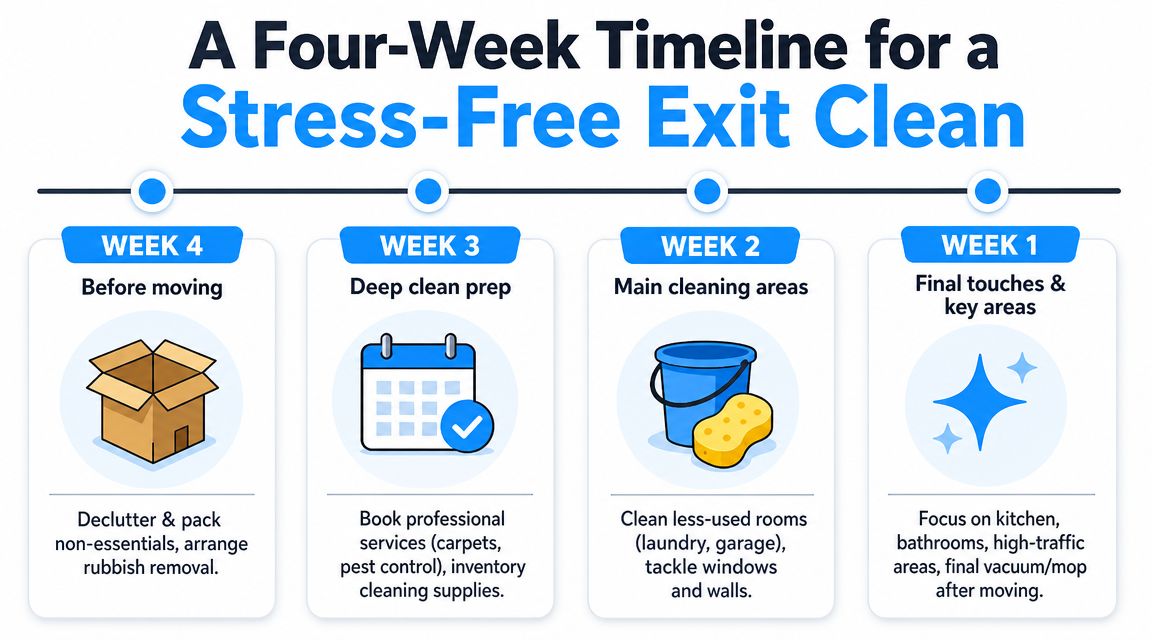
Four weeks out
At this point, the job is preparation.
Start by reducing what has to stay in the property until moving day. Pack non-essentials, clear storage areas, empty the garage if you can, and get rid of rubbish that won't be coming with you. Half the battle in a vacate clean is access.
Also decide now whether you're doing it yourself or bringing in help for all or part of the work. Carpet steam cleaning, pest treatment where required, and heavy oven work are the jobs that often create last-minute pressure if they're left too late.
Focus on these tasks:
- Declutter room by room: Empty cupboards, wardrobes, drawers, and shelves so you can clean inside them properly later.
- Book any specialist work: Lock in carpets or pest-related services early if your lease or agent expects them.
- Check equipment: Make sure you have microfibre cloths, degreaser, scale remover, a vacuum in good working order, a mop, buckets, a scraper suitable for glass-safe use, and gloves.
Two to three weeks out
This is the stage for jobs that won't get heavily dirty again.
Wash walls where needed, dust vents, wipe tops of cupboards, remove cobwebs, and clean less-used rooms first. If the spare bedroom is already empty, do it now. Same with the laundry cupboards, garage shelving, and window tracks in rooms you've stopped using.
For many tenants, this is also when the full scope becomes obvious. A small place with light wear can be manageable. A large family home with pets, built-up grease, and full carpets is another story entirely. Professional bond cleaning in Victoria often uses teams of 2 to 3 cleaners, and 4 to 5 bedroom homes can take 8 to 10 hours, especially with pets, according to this bond clean timing guide for Victoria. That's why DIY jobs often fall short. People underestimate the hours, not just the effort.
If you're still moving boxes at midnight before handover, the clean is already under pressure.
One week out
Now shift to the rooms that attract the most scrutiny.
The kitchen and bathrooms should be your main focus because they're the rooms where residue builds up and where agents inspect closely. Get the oven, stovetop, rangehood, splashback, shower screen, vanity, toilet, and tile edges done before the final move. You can still do a light touch-up later, but the hard work should already be finished.
Use this week for:
- Kitchen detailing: Degrease rather than just wipe. Grease moves if you use the wrong cloth and weak detergent.
- Bathroom restoration: Remove soap film and scale completely. A shiny wet surface can hide residue until it dries.
- Internal glass and tracks: These are easier when the rooms are mostly empty and daylight shows streaks.
Final 48 hours
Only do what benefits from being last.
Vacuuming, mopping, final benchtop wipes, mirror touch-ups, and a last pass on switches, handles, and entry points should happen after the house is empty. Floors cleaned before furniture removal rarely stay inspection-ready.
Do one final walkthrough in daylight. Open blinds. Get low and look across surfaces. That angle reveals dust lines, hair, smears, and missed corners far better than standing upright in dim light.
The Room-by-Room Geelong Bond Cleaning Checklist
The quickest way to fail a final inspection is to clean by feel. The reliable way is to clean by checklist. Property managers don't inspect emotionally. They inspect room by room, surface by surface.
This visual gives you the main structure at a glance.
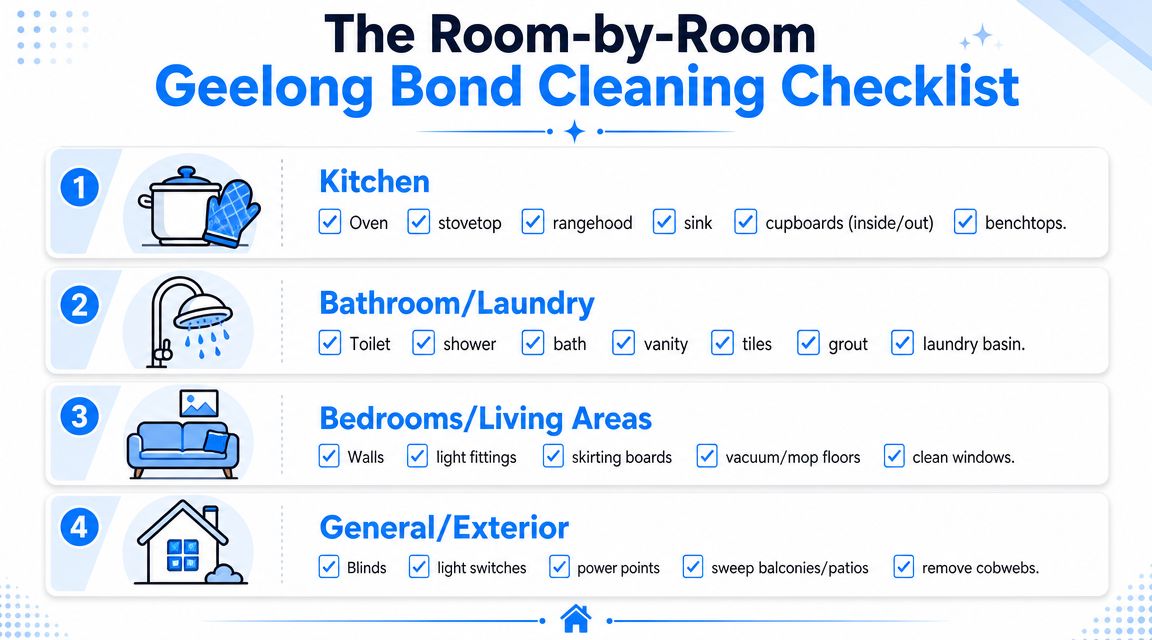
A standard Geelong vacate clean typically includes oven cleaning, stovetops, rangehoods, splashbacks, cupboards cleaned inside and out, bathroom sanitisation including shower screens and tiles, and internal windows, sills, and tracks, all of which are commonly checked at handover, as outlined on this Geelong end of lease cleaning scope guide.
Kitchen
Agents look for built-up neglect, not just surface dust.
- Oven interior: Remove baked grease from trays, racks, glass, side panels, and seals. If the seal is greasy, it usually means the rest of the oven wasn't cleaned properly.
- Stovetop and burners: Lift removable parts, clean underneath, and make sure oily residue isn't left around the edges.
- Rangehood: Wipe the canopy and clean the filter. A shiny front panel means nothing if the filter is still sticky.
- Splashback and wall area: Grease mist settles wider than most tenants think.
- Cupboards and drawers: Empty them fully and wipe inside and out. Check the top edges and handles.
- Sink and taps: Polish away residue, but also clear food waste and wipe the drain surround.
- Dishwasher: Clean the door edges, filter area, and rubber seals if the property has one.
- Benchtops: Finish with a streak-free dry cloth, especially on darker laminate or stone-look surfaces.
Manager's view: Kitchens fail on grease in hidden edges, not on crumbs in the middle of the bench.
Bathroom and laundry
Bathrooms need more than a quick spray-and-wipe. Soap scum, calcium build-up, and grout staining need dwell time and the right product.
- Shower screen: Remove film completely. If it looks clean wet but cloudy dry, it needs another pass.
- Tiles and grout: Scrub the lower rows and corners where build-up sits. If you need a method for stubborn lines, this guide on how to clean floor tile grout is useful.
- Toilet: Clean bowl, seat hinges, base, cistern, and the floor around it.
- Vanity and basin: Check underneath the lip of the basin and inside vanity storage.
- Mirrors: Dry-buff to remove haze.
- Bath: Pay attention to overflow covers and soap residue along the back edge.
- Exhaust fan cover: Dust and wipe it if accessible.
- Laundry sink and cabinet: Remove detergent residue and wipe shelves.
Here's a practical video walkthrough that helps with sequencing and missed details.
Bedrooms and living areas
These rooms are simpler, but they catch people out because the defects are subtle.
- Skirting boards: Wipe the top edge, front face, and corners.
- Doors and frames: Pay attention to handle areas, edge marks, and the top of the frame.
- Light switches and power points: Finger marks show clearly here.
- Wardrobes: Clean shelves, rails, tracks, and inside corners.
- Window glass and sills: Internal glass should be clear and dry-buffed.
- Sliding door tracks: Vacuum first, then wipe. Muddy tracks turn into slurry if you start with water.
- Blinds or accessible fittings: Dust carefully and don't force brittle slats.
- Floors: Vacuum edges and under where beds and sofas were.
Entry points, outdoor areas, and final details
These are often the spots that trigger a re-clean request even when the house “looks clean”.
- Cobwebs: Remove from eaves, corners, ceilings, and garage areas if included in your access areas.
- Balcony or patio: Sweep, remove leaves, and wipe obvious marks.
- Garage floor: Clear loose dust and rubbish.
- Front door area: Clean the inside face, handle, threshold, and frame.
- Bins and leftover items: Nothing should be left behind unless agreed.
If you're doing your own end of lease clean in Geelong, print your own checklist and physically tick it off. Memory is unreliable when you're tired.
DIY or Professional End of Lease Cleaning
The right choice depends on three things. Your time, the property condition, and your tolerance for risk.
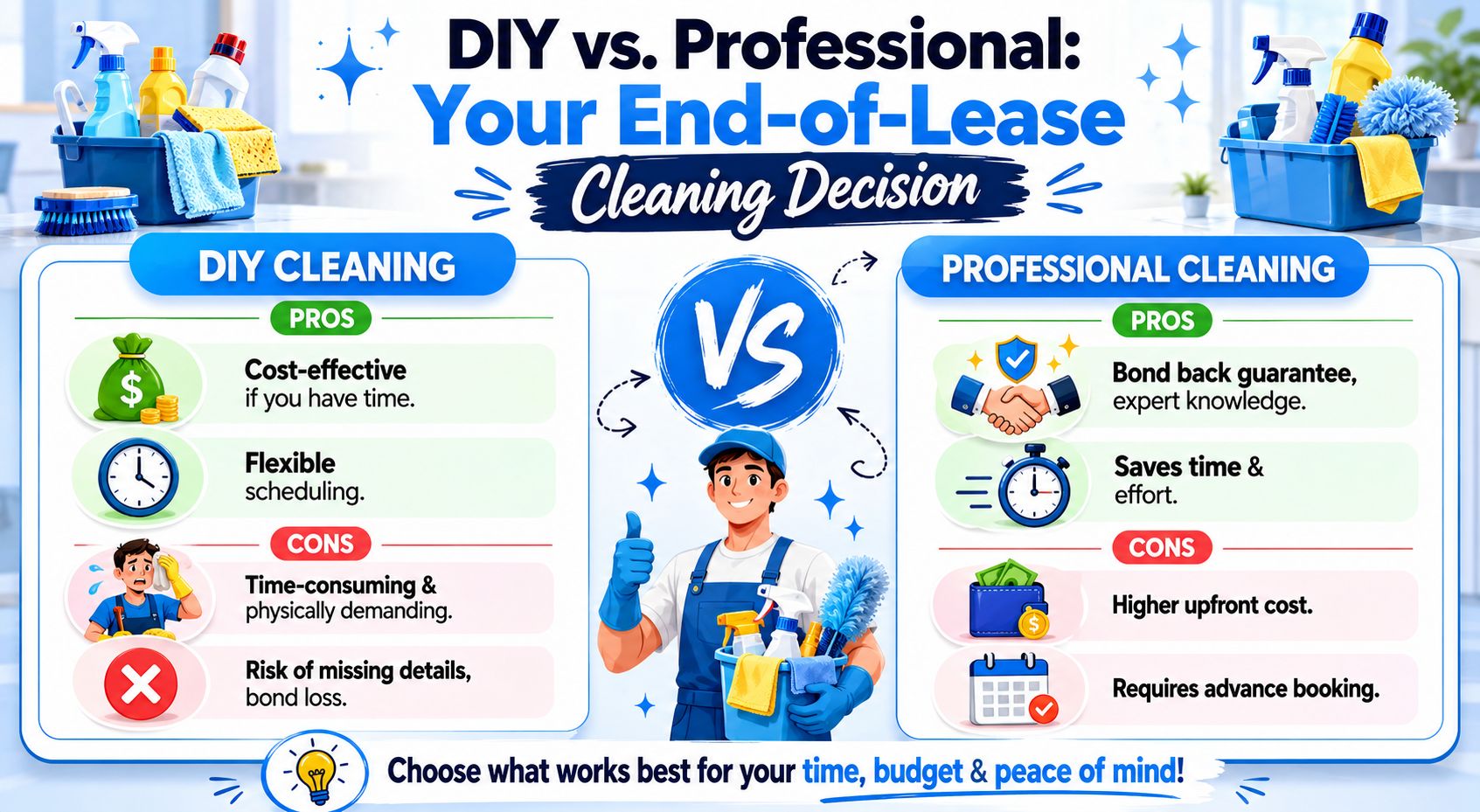
When DIY makes sense
DIY can work well if the property is small, well maintained, and you've kept on top of cleaning during the tenancy. It also helps if you can spread the work over time instead of trying to do it in one hit.
DIY is usually the better fit when:
- The home has light soil only: No heavy grease, ingrained shower scale, or neglected carpets.
- You have access to equipment: A decent vacuum, proper cloths, and suitable cleaning products matter.
- You can work to a checklist: People who clean methodically do much better than people who “just start somewhere”.
The downside is that DIY often becomes expensive in a different way. You spend your final days moving, cleaning, buying supplies, doing a tip run, and fixing missed items after the inspection email lands.
When professional cleaning is the safer move
A professional clean is usually worth considering when the property is larger, the agent is known to inspect closely, or the home has problem areas like heavy oven build-up, shower glass staining, pet hair, or full-house carpets.
What you're paying for isn't only labour. You're also paying for pace, process, and the fact that experienced cleaners know where inspections tend to fail. That includes oven seals, grout lines, cupboard tops, tracks, switches, and edge work.
One option tenants sometimes compare is a specialist provider such as End Of Lease Cleaning Melbourne's professional house cleaning service, alongside local Geelong operators and independent cleaners. The key question isn't the logo on the invoice. It's whether the scope matches your agent's expectations, the inclusions are clear, and any return-to-fix policy is written down.
A cheap quote can cost more if it excludes the very items your property manager checks first.
A quick way to decide
Use this test.
| Situation | Better fit |
|---|---|
| Small property, low wear, time available | DIY can be reasonable |
| Large home, pets, grease, scale, carpet concerns | Professional is often safer |
| You're moving interstate or under time pressure | Professional usually reduces risk |
| You enjoy detail cleaning and can document everything | DIY may still work |
If you're on the fence, price the clean against the time you'd need to do it properly. Most tenants only compare dollars. They should also compare fatigue, schedule pressure, and the chance of a re-clean.
How Much Does an End of Lease Clean Cost in Geelong
Geelong pricing is usually driven by property size, bathrooms, condition, and any extras the agent expects. The biggest mistake tenants make is assuming there's one standard bond clean price. There isn't.
Local market pricing shows that a 2-bedroom, 1-bathroom property averages about A$280, while a 3-bedroom, 2-bathroom unit averages about A$400, and pricing can vary with the property's condition and the exact task list required, according to this Geelong end of lease cleaning pricing page.
Estimated End of Lease Cleaning Prices in Geelong 2026
| Property Size | Average Price Range (AUD) |
|---|---|
| 2-bedroom, 1-bathroom | About A$280 |
| 3-bedroom, 2-bathroom unit | About A$400 |
For a broader breakdown of what affects pricing, this guide on how much bond cleaning costs helps explain why two properties with the same number of bedrooms can still quote very differently.
What changes the quote
A fair quote usually depends on the labour involved, not just the floor plan. Two three-bedroom homes can be worlds apart if one has been lived in lightly and the other has years of grease, pets, marks on walls, and neglected wet areas.
Common pricing variables include:
- Condition: Heavy soil always takes longer than a maintained home.
- Bathrooms and wet areas: More tiled surfaces usually mean more detail work.
- Kitchen build-up: Ovens and rangehoods can add significant labour when grease is baked on.
- Carpets and specialty work: Steam cleaning, pressure washing, and similar add-ons may sit outside the base package.
- Access and timing: Tight handover windows can make scheduling harder.
How to read a quote properly
Don't look at the total price first. Look at the scope.
Ask these questions:
- What rooms and fixtures are included
- Whether cupboards are inside and out
- Whether internal windows and tracks are included
- Whether carpet steam cleaning is separate
- What happens if the agent requests touch-ups
The cheapest quote is often the one with the most exclusions. The better quote is the one that matches the inspection checklist you're going to be judged against.
Securing Your Bond and Passing the Final Inspection
The clean is only half the job. The handover process matters just as much.
A lot of tenants do the work, leave the keys, and assume the result will speak for itself. Sometimes it does. Sometimes it doesn't. If there's a dispute, your evidence matters more than your memory.
Do your own inspection first
Before the property manager arrives, walk through the home slowly in daylight. Open curtains and blinds. Turn on lights where needed, but rely on natural light to show streaks, dust lines, and residue.
Take:
- Wide photos of every room
- Close photos of the oven, bathrooms, windows, floors, and any repaired or disputed areas
- Short videos showing the overall condition
- A final rubbish-free view of outdoor access areas where relevant
Keep these with your entry report and any communication about defects.
Clean homes don't win disputes on their own. Documented clean homes do.
Handle tricky issues properly
Not every problem at move-out is a cleaning problem. In this situation, many tenants hurt their own position by trying to fix the wrong thing.
The Victorian standard requires cleanliness, not the use of branded products, and tenants can use eco-friendly products. Tenants also aren't expected to solve pre-existing structural mould or pest issues, which should be escalated to the landlord rather than cleaned over, as explained in this Victorian cleaning and responsibility discussion.
That means:
- Eco-friendly products are fine: The result matters more than the label.
- Mould needs judgment: Surface mould from day-to-day bathroom moisture should be cleaned. Ongoing structural damp issues should be reported.
- Pest issues aren't always a wipe-down matter: If there's an active problem linked to the property itself, document it and raise it formally.
- Water damage and swelling surfaces should be photographed: Don't let a maintenance issue be framed as poor cleaning.
On inspection day
If you can attend or remain available, do it. Not to argue. To clarify.
Stay calm, keep your photos ready, and ask the property manager to identify specific items if they raise concerns. A focused response works better than a broad emotional defence. If there's a legitimate missed spot, it's often faster to remedy it promptly than turn it into a larger dispute.
The strongest move-out position is simple. Clean to the legal standard. Match the entry condition as closely as possible. Photograph the result. Escalate maintenance issues instead of masking them.
That's how tenants give themselves the best chance of getting the bond back without unnecessary friction.
If you'd rather hand the job to a team that handles vacate cleans across Melbourne and greater Victoria, End Of Lease Cleaning Melbourne is one option to consider. They provide end of lease cleaning, deep cleaning, and related residential services with their own equipment and eco-friendly products, which can be useful if you need a clear scope and a booked timeslot during a busy move.
