
In Melbourne, cleaning drives 67% to 70% of all bond disputes, according to these Melbourne bond dispute figures. That’s the number most tenants miss when they think a move-out clean is just another chore on an already crowded list.
A vacate clean isn’t only about making the place look tidy. It’s about reducing risk. If you hand back a property with grease left in the rangehood, soap scum on the shower screen, dust in wardrobe tracks, or damp carpets after a rushed DIY job, you give the agent something concrete to write down at final inspection.
That’s why good end of lease cleaning services melbourne aren’t just cleaners. They’re part of your bond recovery plan. The clean matters. The paperwork matters. The photos matter. And if the agent still pushes back, knowing how to respond matters just as much.
Why Professional Cleaning is a Smart Investment
A rushed DIY clean often fails for one simple reason. Final inspections are detail inspections, not surface inspections.
Most bond deductions tied to cleaning come from small misses that stack up fast. Grease on the oven door frame. Dust on top of skirting boards. Soap scum left along the bottom edge of the shower screen. Marks inside wardrobe tracks. None of these look dramatic during pack-up, but they are exactly the sort of points an agent writes down when they want grounds to question the bond.

Professional vacate cleaning changes the position you are in at inspection. It does not guarantee that every agent will be reasonable. It does give you a much cleaner hand to play if they raise issues later.
Here’s what a proper end of lease clean usually does better than a standard tenant clean:
- Targets inspection points: cleaners focus on tracks, seals, switches, filters, exhaust fans, inside cupboards, and other areas agents check closely
- Matches exit-clean standards: the work is done for handover, not for everyday living
- Saves time at the worst point of the move: tenants can finish removals, utilities, and key return without trying to scrub an oven at 10 pm
- Gives you evidence: an invoice, service list, and photos help if the agent claims the property was left dirty
That last point matters more than many tenants realise. In a dispute, the clean itself is only part of the picture. What helps is being able to say the property was professionally cleaned on a specific date, by a business that can confirm what was included. If the agent sends through a vague complaint after handover, that paperwork makes it easier to push back and ask for exact photos, exact areas, and a fair chance to rectify.
I see the same trade-off every week. DIY can save money upfront if the property is already in very good condition, the tenant has time, and they know what agents usually look for. But if the oven is heavy with grease, the bathrooms have scale buildup, or the carpets need more than a quick once-over, the risk shifts. The money saved on cleaning can disappear quickly in deductions, re-clean requests, or time off work spent arguing over avoidable issues.
Carpets are a common example. A rental can smell fine and still fail on stains, traffic marks, or damp patches from hire machines. If carpets are part of your exit clean, read what professional steam cleaning for carpet involves before deciding whether to handle it yourself.
Good professional cleaning is not about chasing perfection. It is about meeting the standard usually expected at handover, reducing easy objections, and putting yourself in a stronger position if a landlord or agent still tries to dispute the clean.
Your Complete Melbourne End of Lease Cleaning Checklist
The easiest way to fail a final inspection is to clean by memory. Memory skips things. Checklists don’t. A proper exit clean follows the same logic every time: start high, work down, clean dry soils before wet work, and finish with detail points agents notice.
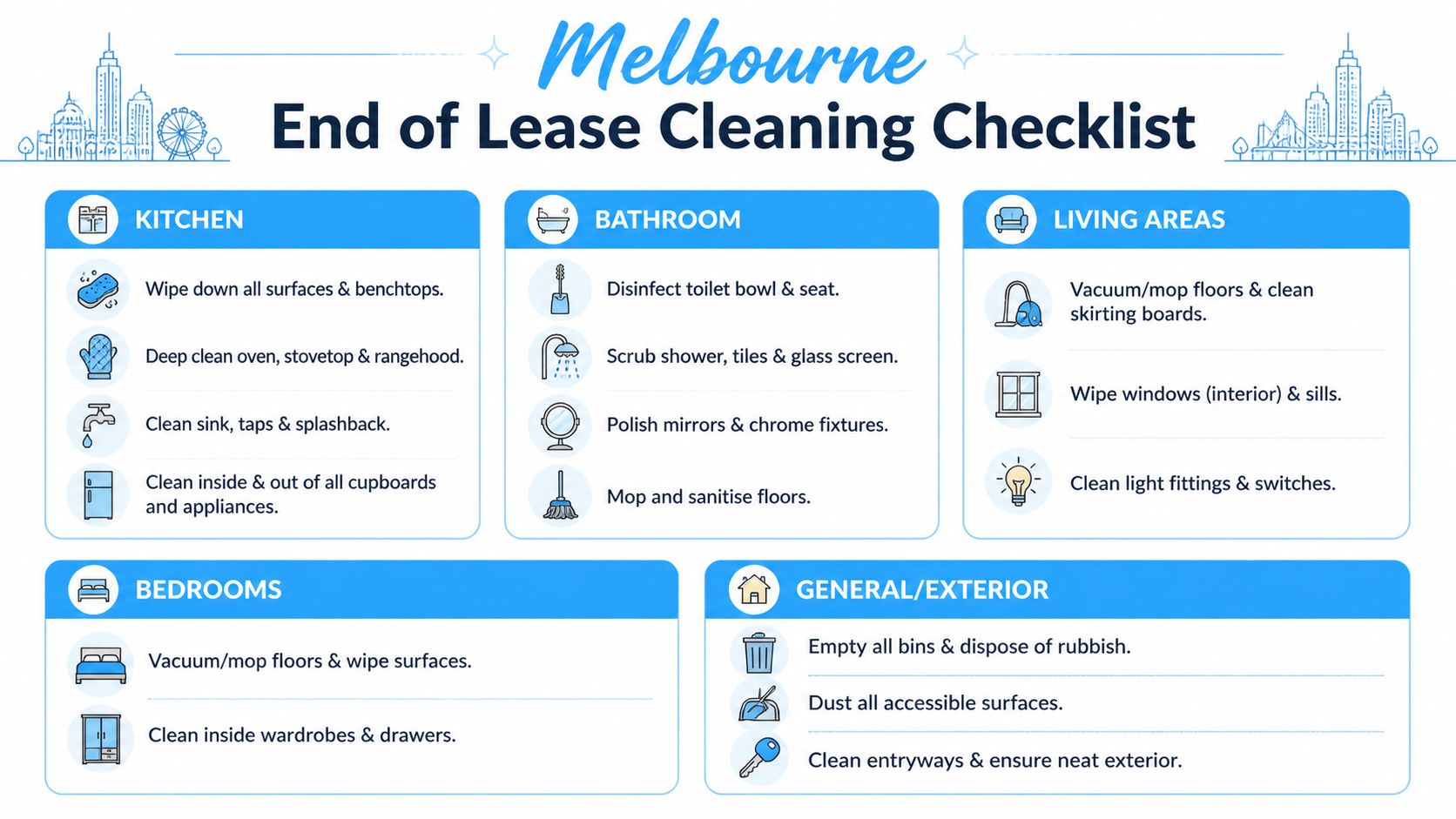
Kitchen
This is usually the most time-consuming room. Grease spreads further than people think, especially around splashbacks, overhead cupboard fronts, and the top edge of the rangehood.
Key tasks include:
- Oven cleaning: Inside glass, racks, trays, door frame, seals, and side runners.
- Cooktop and rangehood: Remove grease from burners, trivets, filters, and control knobs.
- Cupboards and drawers: Wipe inside and out, including handles and top edges.
- Sink area: Descale taps, polish the sink, and clean the drain opening.
- Benchtops and splashback: Remove grease film, not just crumbs and spots.
If the grout near the sink or splashback still looks dark after a surface wipe, it usually needs more focused work. A guide on how to clean floor tile grout helps tenants understand why those lines often fail inspections.
Bathroom and laundry
Bathrooms fail on buildup, not clutter. Soap scum, mineral residue, hair, and mould around seals are the usual problem areas.
Focus on:
- Shower screen and tiles: Remove soap film, residue, and water spotting.
- Toilet: Clean bowl, seat, hinges, pan exterior, and surrounding floor.
- Vanity: Wipe drawers, cabinet faces, basin, taps, and mirror.
- Exhaust fan and vents: Dust buildup gets noticed quickly.
- Laundry trough and tapware: Often forgotten, especially under the rim and around drains.
If the shower screen looks cloudy when it’s dry, it usually isn’t finished.
Living areas and bedrooms
These rooms seem simple until inspection day. What gets missed is usually edge work.
Check:
- Skirting boards and architraves
- Light switches and power point covers
- Wardrobe shelves, rails, and tracks
- Window sills, interior glass, and tracks
- Cobweb removal from corners and ceilings
- Flooring finish, including under where furniture sat
General and exterior touchpoints
Even when outdoor areas aren’t part of a full package, the handover still needs to feel complete.
Don’t forget:
- Entry door and frame
- Bins emptied and rubbish removed
- Balcony or small courtyard swept
- Garage floor or storage cage checked
- Air vents, ceiling fans, and visible marks on walls
Standard inclusions vs common add-ons
| Service Area | Standard Inclusion | Common Add-On |
|---|---|---|
| Kitchen | Benchtops, cupboards, sink, splashback, stovetop, oven exterior and interior | Heavy oven restoration, fridge cleaning, wall spot cleaning |
| Bathroom | Toilet, shower, bathtub, vanity, mirror, floor cleaning | Mould treatment, heavy calcium removal, full wall washing |
| Living areas | Vacuuming, mopping, dusting, skirting boards, switches | Wall washing, blind deep cleaning, external windows |
| Bedrooms | Floors, wardrobe interiors, surfaces, window sills | Carpet steam cleaning, stain treatment |
| General and exterior | Cobweb removal, bins emptied, light dusting, entry area tidy | Balcony wash, garage clean, pressure cleaning |
A good quote should tell you exactly which of these are included and which are extra. If it doesn’t, assume the disagreement will happen later, not earlier.
Decoding Your Agent’s Requirements vs Fair Wear and Tear
A large share of bond disputes starts with one simple mistake. Tenants treat an agent’s cleaning list as if every line is automatically enforceable.

That approach costs people money. In Victoria, you are expected to return the property reasonably clean and in the condition required by the tenancy, allowing for fair wear and tear. Agents still send exit lists that blur cleaning, maintenance, and damage into one bundle. If you do not separate those categories, you can end up paying for items that were never your responsibility.
Carpet cleaning is the issue I see argued over most. Under Victorian end of lease cleaning requirements for professional cleaning and carpet steam cleaning, professional carpet cleaning is generally tied to the starting condition of the tenancy or to a specific incident that goes beyond ordinary use. An agent asking for steam cleaning on every vacate is not the same thing as an agent proving it is required in your tenancy.
The key documents are usually more useful than the email thread. Check:
- Your entry condition report
- The lease agreement
- Any special conditions about carpets, pets, or professional cleaning
- Photos from the start and end of the tenancy
- Any communication about spills, stains, mould, or damage during the lease
If an item was worn at the start, aged naturally during the tenancy, or declined through normal day to day use, that does not automatically become a cleaning issue at handover.
What fair wear and tear usually looks like
Fair wear and tear is the gradual decline you would expect from ordinary living.
Examples often include:
- Light wall scuffs and minor paint marks
- Carpet pile flattening in walkways
- Slight fading from sunlight
- Small furniture impressions
- Loose wear on older fittings from regular use
What falls outside that category is usually easier to defend or concede because the cause is clearer. Large holes, heavy grease build-up, burns, strong pet odour, avoidable mould, and staining from a spill left untreated are the sorts of issues agents can reasonably raise.
This distinction matters during disputes. A cleaner can remove grime. A cleaner cannot reverse age, sun fade, or the normal decline of older materials.
Why carpet cleaning causes so many arguments
Carpet sits in the overlap between cleaning quality and property condition. That is why so many bond claims land there.
A tenant may hire a supermarket machine and feel the job is done. The agent may inspect a few hours later, find the carpet still damp, notice detergent residue, or pick up odour that returns once the fibres dry. Then the dispute shifts from "Was it cleaned?" to "Was it cleaned to the required standard?" That is a harder argument to win if you do not have receipts, photos, and a clear record of the carpet’s condition before the clean.
From a practical cleaning point of view, DIY carpet work is risky at vacate stage. The result can look fine for a short window and fail by inspection time. If the carpet was already tired, the risk is even higher because every mark stands out more on worn pile.
How to deal with agent requests without making the dispute worse
Keep the discussion narrow and evidence-based.
Ask the agent to identify the exact item in dispute and where it appears in the entry report or lease. If they say a professional service is required, ask what clause, condition, or incident they are relying on. If they claim something is damage rather than wear, ask for photos and compare them against your own records.
That usually changes the tone quickly. Strong claims become specific. Weak claims become vague.
A simple approach works best:
- Acknowledge legitimate cleaning items promptly
- Ask for evidence on anything that looks like wear and tear
- Send your exit photos in the same reply
- Keep all communication in writing
- Do not authorise extra work until the issue is clear
This is the part many guides skip. Securing the bond is not only about doing a good clean. It is also about knowing which items to fix, which items to challenge, and how to respond without turning a small disagreement into a larger claim.
How Much Does End of Lease Cleaning Cost in Melbourne?
Pricing depends less on the number of bedrooms than people think. What really changes the quote is condition, access, and how much specialist work sits on top of the base clean.
A tidy one-bedroom apartment with no carpet issues, no balcony, and a regularly maintained oven is a different job from a three-bedroom family home with pet hair, built-up grease, marked walls, and extra bathrooms. Both are “end of lease cleans”, but they don’t take the same labour, equipment, or time.
What shapes the quote
The main pricing factors are usually:
- Property size: More rooms means more surfaces, windows, fittings, and floor area.
- Condition at handover: Heavy grease, soap scum, built-up dust, and neglected appliances add labour.
- Floor type: Carpet, timber, tiles, and grout all require different methods.
- Access issues: Stairs, tight parking, key collection, or restricted lift access can slow the job.
- Add-on services: Carpet steam cleaning, wall washing, balcony cleaning, and exterior windows commonly sit outside the base rate.
Estimated end of lease cleaning costs in Melbourne 2026
| Property Type | Estimated Price Range (AUD) |
|---|---|
| Studio or 1-bedroom apartment | Varies by condition, inclusions, and access |
| 2-bedroom apartment or unit | Varies by condition, inclusions, and access |
| 3-bedroom house or townhouse | Varies by condition, inclusions, and access |
| 4-bedroom home | Varies by condition, inclusions, and access |
I’m keeping that table qualitative for a reason. Precise market-wide price brackets weren’t provided in the verified material, and honest quoting is always property-specific anyway. If a company gives you a flat figure without asking about bathrooms, carpets, wall marks, oven condition, or whether the property is furnished, they’re probably guessing.
How to read a quote properly
A solid quote should tell you:
- what’s included,
- what counts as an extra,
- whether carpet steam cleaning is separate,
- whether the oven is included as standard,
- what happens if the agent requests a return visit.
If you’re comparing providers, compare scope first and price second. One company may seem cheaper until you realise windows, blinds, mould treatment, or appliance interiors weren’t included.
Cheap end of lease cleaning often becomes expensive after the inspection.
The lowest quote usually cuts one of three things: labour time, detail work, or call-back support. Those are exactly the parts that protect your bond. If a cleaner rushes the job and you then pay for a second clean or lose money in deductions, the “saving” disappears.
How to Choose a Vetted End of Lease Cleaner
A poor cleaner usually looks fine until the invoice is paid and the agent sends back a list of missed items. By then, the keys are handed over, your inspection date is fixed, and you have very little room to fix mistakes without stress.
The safer approach is to vet the business the same way an agent will assess the property. Look for proof, not promises.
What to check before you book
Ask direct questions and pay attention to how clearly they answer. A professional operator should be able to explain their process without dodging details or speaking in generalities.
Check for:
- Public liability insurance
- A written scope of work
- Clear inclusions and exclusions
- Their own equipment and products
- A stated re-clean policy with time limits
- An invoice that itemises the work completed
If any of that is vague, treat it as a warning sign. End of lease cleaning is inspection work. Loose quoting and loose wording usually lead to disputes.
A bond-back guarantee only matters if the conditions are fair and specific. Ask what voids it. Some cleaners exclude heavily soiled ovens, mould, wall washing, furnished properties, or any issue raised outside a short callback window. Those details matter more than the headline.
Read reviews like an inspection report
Star ratings help, but the written comments reveal the full story.
Useful reviews mention whether the team arrived on time, whether the quote changed on the day, and whether they returned promptly after agent feedback. Specific comments about ovens, shower screens, skirting boards, window tracks, and carpet results are worth more than generic praise.
I also look for signs the company can handle pressure after the clean, not just on the day of it. If reviewers mention that the office answered quickly, issued updated invoices fast, or dealt with callback requests without an argument, that tells you the business is set up for bond protection, not just basic house cleaning.
Signs they understand exit cleaning properly
A cleaner who knows vacate work will ask better questions. They should ask about the condition report, the age of the property, access times, whether power and water will still be on, and any problem areas likely to trigger agent comments.
They should also know where cleaning ends and property condition begins. Mould is a common example. Surface mould can sometimes be cleaned. Recurring mould tied to moisture, poor ventilation, or damaged silicone is a different issue, and tenants often get blamed for it unfairly. If that applies to your place, it helps to understand the difference between cleaning and remediation before the inspection. This guide to mould remediation in Melbourne homes gives useful background.
Some companies, including End Of Lease Cleaning Melbourne, also handle carpet work, deep cleaning, and other structured cleaning scopes. That does not automatically make them the right choice, but it usually means they understand checklists, documentation, and inspection pressure better than a cleaner who mainly does weekly domestic jobs.
A regular house cleaner maintains a home. An end of lease cleaner prepares it for scrutiny, paperwork, and possible dispute.
Questions worth asking on the call
- Is the oven included in the base quote or charged separately?
- Are internal windows, sills, and tracks included?
- What does your re-clean policy cover?
- How soon can you return if the agent raises a legitimate issue?
- Do you provide a detailed invoice I can send to the agent if there is a dispute?
- What items do you class as damage, fair wear, or outside standard cleaning?
That last question matters more than tenants realise. A good cleaner will usually tell you, before booking, if stained grout, burnt cooktop marks, swollen cabinetry, peeling paint, or permanent carpet damage are unlikely to clean out. That honesty helps you prepare your evidence, set expectations with the agent, and avoid relying on cleaning to solve a maintenance problem.
Choose the cleaner who is clear, realistic, and prepared to stand behind the work in writing. That is usually the cleaner who gives you the best chance of getting your bond back without a drawn-out argument.
What to Do When Your Landlord Disputes the Clean
Most articles cover cleaning, but then fall short. They tell you how to clean, but not what to do when the property is clean and the agent still claims part of the bond. That gap is real, and guidance on documentation for VCAT, photographic evidence standards, and challenging unfair deductions is exactly what tenants usually need once the inspection turns difficult.

Build your evidence before the inspection
Your best defence starts before anyone complains.
Keep these items together:
- Entry condition report
- Exit cleaning invoice
- Photos and video taken immediately after the clean
- Any email instructions from the agent
- Receipts for add-ons such as carpet cleaning or mould treatment
If mould was ever part of the issue, it helps to understand whether the problem was surface cleaning, ventilation, or a bigger moisture issue. That’s where background reading on mould remediation in Melbourne homes can help you separate a cleaning concern from a property condition issue.
Respond in writing, not on the phone
When an agent raises concerns, ask for the issue list in writing. Request photos if they haven’t provided them. Then compare each item with your own evidence and the entry condition report.
A useful response is short and specific:
- acknowledge the issue raised,
- say whether you accept or dispute it,
- attach your supporting photos or invoice,
- ask for the exact basis of any deduction.
Don’t send a long emotional email. Stick to facts, room by room.
A quick overview of dispute pathways can also help before you reply:
When to push back
Push back when the claim relates to fair wear and tear, an item not reflected in the entry condition, or a cleaning standard you can show was met. If the cleaner missed something minor, a prompt return visit is usually the fastest fix. If the claim looks inflated or unfair, keep everything documented and move through the formal bond dispute process rather than arguing in circles.
The tenants who handle this well don’t rely on memory. They rely on records.
Melbourne Move Out Cleaning FAQs
How long does an end of lease clean usually take
It depends on the property size, condition, and whether the job includes extras such as carpets, wall washing, or outdoor areas. A lightly used apartment can move quickly. A larger home with built-up kitchen grease and multiple wet areas takes much longer. Good cleaners won’t lock themselves into a rushed time estimate before they understand the job.
Do I need to be there during the clean
Usually, no. Many tenants prefer to provide access, remove all belongings, and return once the job is finished. What matters more is that the property is empty, utilities are connected, and the cleaners can reach every room, cupboard, appliance, and window they’re expected to do.
Is DIY worth it if I’m trying to save money
Sometimes, but it’s riskier than people expect. In the earlier Melbourne dispute data, over 45% of renters who cleaned the property themselves still had money deducted from their bond, based on the same local bond dispute figures already cited above. DIY can work if the property is already in excellent condition, you have the right equipment, and you’re prepared to clean to inspection level. Most tenants underestimate the time and detail involved.
What if the agent finds a small issue after the clean
That’s where a clear re-clean policy matters. If the issue is legitimate and falls within the scope of work, a professional cleaner should be able to return and fix it within the agreed callback window. This is one reason written quotes matter so much. They show what was purchased.
What should I do the day before handover
Run a final check focused on the easy-to-miss items:
- Open every cupboard and drawer
- Turn on all lights and inspect skirting boards
- Check inside the oven and rangehood
- Look at shower glass when dry
- Inspect window tracks and wardrobe runners
- Take final timestamped photos
That last step is the one tenants most often skip. It’s also the one that helps most when there’s a disagreement later.
If you want a practical quote and a clearly defined vacate scope before your final inspection, End Of Lease Cleaning Melbourne offers end of lease cleaning across Melbourne with written inclusions, flexible bookings, and support for tenants preparing to hand back a property properly.
